Quick access to main page (top) Direct access to main contents Quick access to main page (bottom)

Taxi Salary System Under Threat: Why a New Bill Could Undo 5 Years of Progress

Daniel Kim Views  

A taxi driver climbed a telecom tower in front of the district office of the National Assembly’s Land, Infrastructure and Transport Committee chair and began a high-altitude protest, demanding the withdrawal of a bill that would roll back the taxi-salary system introduced to stabilize taxi drivers’ livelihoods.

On the 30th, the Public Transport Workers’ Union held a press conference in front of Rep. Maeng Hyung-kyu’s (Democratic Party) Incheon district office, urging the National Assembly to scrap the proposed amendment to Article 11-2 of the Taxi Development Act now pending in the legislature. Since the day before, Go Young-gi, head of the Daelim Transportation sub-branch of the taxi union’s Jeonbuk chapter, has been staging a high-altitude protest atop a telecom tower about 20 meters (roughly 66 feet) high near the office.

Article 11-2 of the Taxi Development Act requires taxi companies to set drivers’ working hours at “at least 40 hours per week.” Seoul already enforces the rule, and other regions had been scheduled to begin implementation in August.

The provision aims to stabilize taxi drivers’ livelihoods. Because it is difficult to measure exact working hours in the taxi industry, the sector uses a “deemed working-hours” system in which labor and management agree on hours. If those hours are set too low, wages are reduced accordingly.

For that reason, Article 11-2 has been viewed as central to implementing the so-called taxi-salary system: if drivers’ hours are set at “at least 40 hours per week,” companies are required to pay a corresponding fixed salary.

However, an amendment jointly proposed by Rep. Son Myeong-su (Democratic Party) and Rep. Kwon Young-jin (People Power Party) would allow, with a labor-management agreement, up to 40% of all licensed taxis to have weekly working hours set below 40 hours. The bill would also delay implementation outside Seoul by an additional two years.

Speaking to Pressian, Go criticized the amendment as “an absurd bill that would make some drivers receive the minimum wage based on a 40-hour week while others wouldn’t even get the minimum wage.” He said that after Kim Jae-ju, then head of the taxi union’s Jeonbuk chapter, staged a 510-day high-altitude protest in 2019 and the taxi-salary law was enacted, drivers living in hardship had waited more than five years for implementation. “Seeing not just a delay but a rollback made me conclude that dialogue wouldn’t resolve this, so I climbed up,” he said.

Choi Se-ho, head of the taxi union, said reporters asking about changes after the system began in Seoul heard many drivers say that working 40 hours a week and being guaranteed a minimum wage above 2,000,000 KRW (about $1,500) encouraged law-abiding driving and friendlier service to passengers, and that drivers get an extra hour or two of sleep. “The taxi-salary law strengthens road safety,” he emphasized.
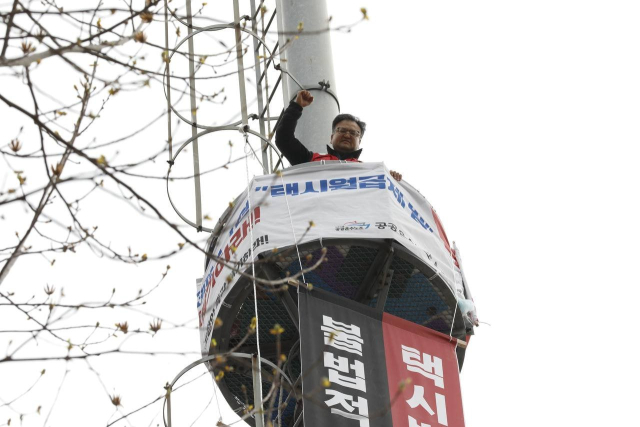
    ▲Go Young-gi, head of the Daelim Transportation sub-branch of the taxi union’s Jeonbuk chapter, during his high-altitude protest. ⓒPublic Transport Workers’ Union
  ▲Go Young-gi, head of the Daelim Transportation sub-branch of the taxi union’s Jeonbuk chapter, during his high-altitude protest. ⓒPublic Transport Workers’ Union
Daniel Kim
content@tenbizt.com

[Social] Latest Stories

  • Starbucks Korea CEO Fired Over Controversial ‘Tank Day’ Promotion
    Starbucks Korea CEO Fired Over Controversial 'Tank Day' Promotion
  • 25,000 Robots vs. Human Workers: The High-Stakes Battle at Hyundai
    25,000 Robots vs. Human Workers: The High-Stakes Battle at Hyundai
  • Hotel Hygiene Scandal: Cleaner Caught Using Guest Towels to Wipe Toilets
    Hotel Hygiene Scandal: Cleaner Caught Using Guest Towels to Wipe Toilets
  • South Korea’s Tech Giant Kakao Faces First Major Strike in 20 Years
    South Korea's Tech Giant Kakao Faces First Major Strike in 20 Years
  • South Korea’s Aging Crisis: How One Leader Is Redefining ‘Well-Dying’
    South Korea’s Aging Crisis: How One Leader Is Redefining 'Well-Dying'
  • Stop Calling Them ‘Hey You’: South Korea’s New Push for Worker Respect
    Stop Calling Them 'Hey You': South Korea's New Push for Worker Respect

Weekly Best Articles

  • Choi Dong-seok’s Family Bond: How a Simple Engraving Reveals Deep Love for His Children
  • Kwak Sun-hee’s Stunning Wedding Photos: A Celebration of Love and Courage
  • Is ‘I Am a Natural Person’ Just a Big Lie? Comedian Yoon-taek Reveals Shocking Secrets!
  • Health Scare: Why Fans Are Worried About Go Ji Yong’s Dramatic Weight Loss
  • Discover the Winter Gongju Chestnut Festival: A Taste of Korea at H-Mart in the USA!
  • 2026 Spring Wildfire Prevention: How Gyeryong City is Cutting Response Time to 30 Minutes!

You May Also Like

  • 1
    Ukraine’s EU Bid Surges as Hungary Drops Opposition Amid Russian Attacks

    Politics 

    Ukraine’s EU Bid Surges as Hungary Drops Opposition Amid Russian Attacks
  • 2
    Trump Backs Colombia's 'El Tigre' — What It Means for U.S. Relations

    Politics 

    Trump Backs Colombia’s ‘El Tigre’ — What It Means for U.S. Relations
  • 3
    Trump Backs Colombia's Far-Right Outsider—What's at Stake?

    Politics 

    Trump Backs Colombia’s Far-Right Outsider—What’s at Stake?
  • 4
    12.5% Tariff Hit: South Korea Faces New U.S. Trade Penalties

    Politics 

    12.5% Tariff Hit: South Korea Faces New U.S. Trade Penalties
  • 5
    12.5% Tariff Alert: Why the U.S. Is Targeting South Korean Imports

    Politics 

    12.5% Tariff Alert: Why the U.S. Is Targeting South Korean Imports

Popular Now

  • 1
    Marta Kostyuk Makes History at French Open Amid Ukraine Crisis

    Politics 

  • 2
    37 Years in Exile: The Tiananmen Leader Who Just Wants to Go Home

    Politics 

  • 3
    South Korea's Cheongju Airport Faces Crisis as Passenger Numbers Explode

    Politics 

  • 4
    Nuclear Submarine Race: South Korea's High-Stakes Bid for U.S. Fuel

    Politics 

  • 5
    France Finally Admits Complicity in the 1994 Rwandan Genocide

    Politics 

Weekly Best Articles

  • Choi Dong-seok’s Family Bond: How a Simple Engraving Reveals Deep Love for His Children
  • Kwak Sun-hee’s Stunning Wedding Photos: A Celebration of Love and Courage
  • Is ‘I Am a Natural Person’ Just a Big Lie? Comedian Yoon-taek Reveals Shocking Secrets!
  • Health Scare: Why Fans Are Worried About Go Ji Yong’s Dramatic Weight Loss
  • Discover the Winter Gongju Chestnut Festival: A Taste of Korea at H-Mart in the USA!
  • 2026 Spring Wildfire Prevention: How Gyeryong City is Cutting Response Time to 30 Minutes!

Must-Reads

  • 1
    Ukraine’s EU Bid Surges as Hungary Drops Opposition Amid Russian Attacks

    Politics 

    Ukraine’s EU Bid Surges as Hungary Drops Opposition Amid Russian Attacks
  • 2
    Trump Backs Colombia's 'El Tigre' — What It Means for U.S. Relations

    Politics 

    Trump Backs Colombia’s ‘El Tigre’ — What It Means for U.S. Relations
  • 3
    Trump Backs Colombia's Far-Right Outsider—What's at Stake?

    Politics 

    Trump Backs Colombia’s Far-Right Outsider—What’s at Stake?
  • 4
    12.5% Tariff Hit: South Korea Faces New U.S. Trade Penalties

    Politics 

    12.5% Tariff Hit: South Korea Faces New U.S. Trade Penalties
  • 5
    12.5% Tariff Alert: Why the U.S. Is Targeting South Korean Imports

    Politics 

    12.5% Tariff Alert: Why the U.S. Is Targeting South Korean Imports

Popular Now

  • 1
    Marta Kostyuk Makes History at French Open Amid Ukraine Crisis

    Politics 

  • 2
    37 Years in Exile: The Tiananmen Leader Who Just Wants to Go Home

    Politics 

  • 3
    South Korea's Cheongju Airport Faces Crisis as Passenger Numbers Explode

    Politics 

  • 4
    Nuclear Submarine Race: South Korea's High-Stakes Bid for U.S. Fuel

    Politics 

  • 5
    France Finally Admits Complicity in the 1994 Rwandan Genocide

    Politics 

Share it on...