
Inha University Medical Campus: The 1.6 Trillion Won Illusion and Its Impact on Kimpo’s Future
Daniel Kim Views
Translation result
Inha University Hospital’s 160 billion KRW (approximately 120 million USD) mirage, stalled core projects and private daycare blind spots… Three councilors dissect four years of the 8th elected administration
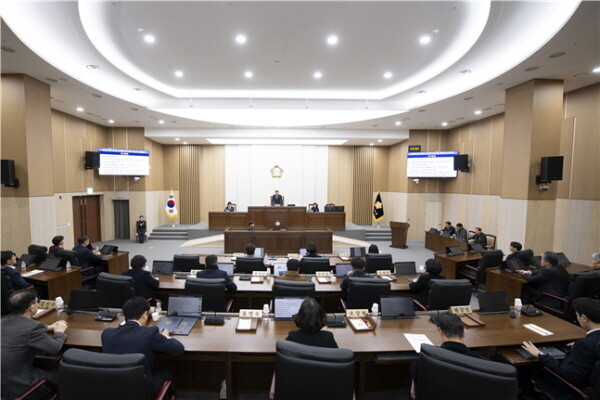
On March 25 — a session that effectively served as the final plenary of the 8th elected administration — three councilors took the five-minute podium and delivered pointed critiques one after another.
Their topics differed — the stalled Inha University Gimpo Medical Campus, a pattern of announcements without delivery over four years, and the precarious state of private childcare that could be stabilized with roughly 1.2 billion KRW (approximately 900,000 USD) per year — but their message was unanimous: stop the showmanship and produce results.
△ Councilor Han Jong-woo: “A 160 billion KRW (approximately 120 million USD) pledge turned into a 320 billion KRW (approximately 240 million USD) bomb”
Councilor Han Jong-woo directly dissected what he called the “administrative cruelty” surrounding the Inha University Gimpo Medical Campus. He said the administrative probe revealed a grim reality: the previous administration and the Gimpo Urban Development Corporation advanced a hollow promise of 160 billion KRW (approximately 120 million USD) in support without legal authority or board approval, prioritizing publicity over substance. Construction costs then more than doubled to about 320 billion KRW (approximately 240 million USD), and the project ground to a halt.
Han warned that those irrational decisions damaged Gimpo’s credibility and held the community’s aspiration for a university hospital hostage. He said Inha University itself suffered material and reputational harm and has had its trust as a project partner eroded.
Han did not stop at criticism. He urged that any renewed hospital plan include two priorities: first, a dedicated critical emergency medical center so that severely ill residents of Gimpo — now over 500,000 in population — won’t have to seek care in other cities; second, an expanded pediatric ward and specialized pediatric services to give parents a place to turn when a child runs a high fever in the middle of the night. He pledged to monitor and support the project with constituents until the campus sheds the stigma of rushed administration and becomes a national leader in pediatric and emergency care.
△ Councilor Kim Gye-soon: “The city stalled for four years while promotion increased”
Councilor Kim Gye-soon (Gochon · Pungmu · Saeu) described the four years of the 8th administration as a period when the fundamentals of governance crumbled, and she listed five specific failures.
On transportation, she criticized the extension of Subway Line 5 for starting with a unilateral memorandum of understanding and insufficient coordination with Gyeonggi Province and Incheon, creating needless conflict and wasted time. She also said the Han River River Bus project emphasized promotion and announcements without clear, tangible benefits for residents, despite its multi-billion-won scale.
Kim also highlighted a string of stalled flagship projects: the Inha University Hospital Gimpo Medical Campus, Gimpo Arts Center, Geumbit Sports Center, development of the Geolpo 4 District, development around Gochon Station, and the Starfield commercial attraction — all delayed or frozen. She singled out the small business support center, which had 3.2 billion KRW (approximately 2.4 million USD) in national funding secured under the 7th administration but saw 3.4 billion KRW (approximately 2.55 million USD) returned during the 8th, as evidence that the administration failed to use already earmarked funds.
“Citizens no longer want plans or press releases; they want results,” Kim said. “The close of the 8th administration should not be treated as a new beginning for the same failures. It must be a time to correct the past four years and responsibly conclude ongoing matters.”
△ Councilor Kim Hyun-joo: “Prevent a collapse of childcare infrastructure with 1.2 billion KRW (approximately 900,000 USD) per year”
Councilor Kim Hyun-joo (People Power Party) called the operational crisis facing private and home daycare centers the “last blind spot” in childcare policy and urged proactive support. She noted that publicly run centers receive per-class funding that allows stable operation, while private and home providers face immediate closure if enrollment drops even slightly.
Kim pointed to Seoul’s “Seoul-type daycare” program and per-class operating subsidies in Incheon, Daejeon, and Hanam (ranging from 50,000–300,000 KRW per month (approximately 37.50–225 USD per month)) and proposed that Gimpo provide a baseline subsidy of about 100,000 KRW per class per month (approximately 75 USD per class per month) for infant classes (ages 0–2). She estimated the measure would cost approximately 1.2 billion KRW (approximately 900,000 USD) annually and argued it is not a mere handout but the minimum safeguard to prevent the city’s childcare infrastructure from collapsing — and the most cost-effective investment the city can make.
“If local childcare collapses, restoring it will require many times this amount in money and time,” she warned, urging the mayor and municipal officials to give the proposal serious consideration.









Most Commented