
Discover the Emotional Depth of Korean Spinning Wheel Songs: A Cultural Legacy of Women’s Voices
Daniel Kim Views
Translation result.
Songs that rose with the spinning wheel have endured as intimate records of Korean women’s lives. Emerging from the work of textile production, spinning‑wheel songs formed a distinct folk genre that carries everyday emotions and memories. During long, repetitive shifts, women used these songs to ease physical strain, maintain focus and share experience across their communities.
Spinning‑wheel songs form one axis of weaving music alongside “thread‑spinning songs” and “loom songs.” Each stage of textile production developed a musical counterpart, and those songs set the pace of labor. Because weaving required sustained attention, singing became a structural element of work rather than casual humming.
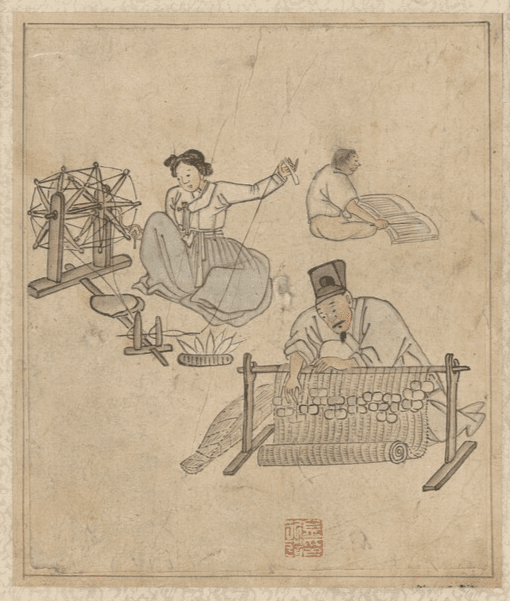
The solitary nature of spinning shaped these songs’ musical profile. Without the need for group synchronization, melodies could stretch and unfold freely. Many pieces took on a through‑composed form, with lyrics flowing continuously rather than breaking into neat sections.
Melody is often restrained in favor of words. Verses unspool like thread—linear and deliberate—so the songs prioritize storytelling, packing personal experience and emotional nuance into clear, concentrated lines.
At their core, the lyrics expose the hardships of married life under patriarchal rule: isolation, emotional suppression and separation from family. Those themes move beyond private grief to illuminate the social realities that shaped many women’s lives in historical Korea.
Singers frequently reproduce the spinning wheel’s whir with onomatopoeia, embedding the sound of labor into the music itself. The wheel’s rotation and the song’s cadence align, creating a tight link between physical rhythm and emotional expression.
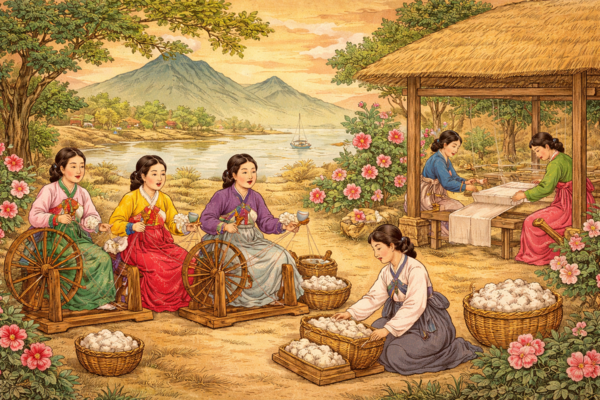
Within repetitive work, the songs also served as psychological support. They helped sustain concentration, fend off monotony and build the mental resilience required for long hours. In that way, they were a cultural adaptation—an expressive response to the demands of the environment.
Today spinning songs exist both as living traditions and as staged performance. Regional styles such as the southern “Mulle Taryeong” and the western “Anju Aewon‑gok” evolved into structured pieces led by professional singers, adopting call‑and‑response formats and refined techniques. That shift shows how everyday songs can take on new life onstage.
The evolution also demonstrates folk music’s adaptability: born in everyday labor, these songs migrated into different contexts while retaining their emotional core.
Structurally, spinning‑wheel songs accommodate extended narratives. The solitary, prolonged nature of the work allowed lyrics to grow long and complex, turning many pieces into oral narratives that differ from other folk genres.
These lyrics preserve historical memory as well. References to ancient weaving practices and figures like Mun Ik‑jeom show how communities transmitted lived memory through song, offering an alternative record to written history.
Themes of love and longing recur across the repertoire. The emotional weight of waiting for absent loved ones and enduring separation appears repeatedly, reflecting both private feeling and shared communal experience.
Regional variation adds nuance. Yeongam’s “Mulle Taryeong,” for instance, reflects local environment and culture. Despite such differences, the songs share a common emotional thread throughout Korea’s folk tradition.
Weaving songs are interconnected across the stages of production—carding, spinning and weaving form a continuous cultural sequence. That continuity underscores that weaving was a complex, multi‑stage daily practice rather than a single act.
Mechanization has largely removed spinning and weaving from everyday life, and opportunities to hear these songs in their original work settings have dwindled. As traditional labor faded, spinning‑wheel songs became invaluable records of past lives.
Their significance endures. In a historical record that often omits women’s voices, these lyrics preserve perspectives missing from written archives. As oral traditions, the songs function as an alternative archive of lived experience across generations.
Ultimately, spinning‑wheel songs occupy the intersection of labor and art. Born of repetitive motion and accumulated feeling, they outlived the spinning wheel itself. What remains is not only sound but a resonance that continues to connect past and present.
Reported by News Culture M.J._mj94070777@nc.press












Most Commented