
Discover the Living Legacy of ‘Bangataryeong’: Why This Korean Folk Song Still Resonates Today
Daniel Kim Views
Translation result
“Bangataryeong” is often recalled as a bright, buoyant folk tune. Beneath that familiar beat, however, runs a deeper current of Korean traditional music, communal feeling, and the everyday textures of life accumulated over generations. More than a work song or a leisure melody, it carries the breath of people who once lived, labored, and sang together. Today the song still moves listeners as living music, not as a static relic.
No single origin can be pinpointed for “Bangataryeong.” It was passed down orally long before anyone kept written records, and each era left its mark on the song’s language and feeling. As generations exchanged the tune, regional character and everyday life naturally settled into its form.
The title derives less from milling grain than from the repeating refrain woven through the melody. The lyrics evoke twilight scenes, rising moons, and boats drifting along waterways, quietly reflecting the emotional world and sensibilities of earlier Korean communities.
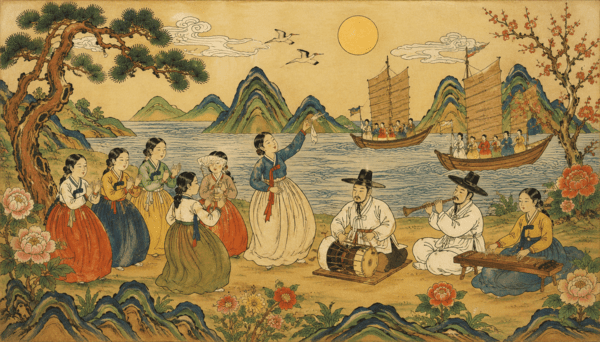
The lyrics are never entirely fixed. Singers reshape verses to suit the moment, so the same song can carry a different mood with each performance. That openness is part of what keeps “Bangataryeong” alive: it belongs not to a single composer but to the shared voice of a community.
At the heart of the piece is the semachi rhythm. Its gentle sway creates a breathing flow that pulls performers and listeners into a common movement. Even within repeated structures, tension and release alternate, giving the music its enduring vitality.
The repeated phrase “Noja johguna” anchors the song. It steadies the rhythm, invites participation, and gradually enlarges the performance’s emotional space. Through repetition, the music builds not just pulse but a sense of shared connection among those who sing.
The song moves into “Jajeun Bangataryeong,” where the tempo quickens and the mood rises. As the melody accelerates and grows more animated, the performance unfolds almost like a continuous musical narrative.
How the song is performed depends on the setting. Whether offered casually in everyday spaces or staged for an audience, its essential structure remains: people breathing together through rhythm and melody. In that way, “Bangataryeong” preserves its musical core even as its forms evolve.
The song reflects a time when music and daily life were inseparable. It begins naturally, flows freely, and comes alive through the responses of those taking part. Rather than standing apart from life, the music grows from within it.
Another defining feature is how multiple voices blend. Individual expression persists, but each voice becomes part of a larger collective flow. That balance mirrors the communal nature of traditional Korean musical culture.
Today, “Bangataryeong” remains one of the most recognizable pieces on gugak stages. Artists continue to rearrange and reinterpret it, yet the song’s essential energy endures.
Performers and audiences still breathe together within its repeating rhythm and refrain. That shared breath explains why “Bangataryeong” survives today—not merely as a relic of the past, but as living music that continues to connect generations.
Reporting: M.J., News Culture (mj94070777@nc.press)










Most Commented