
BYD Dolphin Launch: Is the 20 Million Won Electric Car a Game-Changer for Korea’s EV Market?
Daniel Kim Views
BYD Launches ‘Dolphin’ on March 11th
Chinese-Made EVs Flood the Market
Domestic Electric Cars Face Price Competitiveness Test
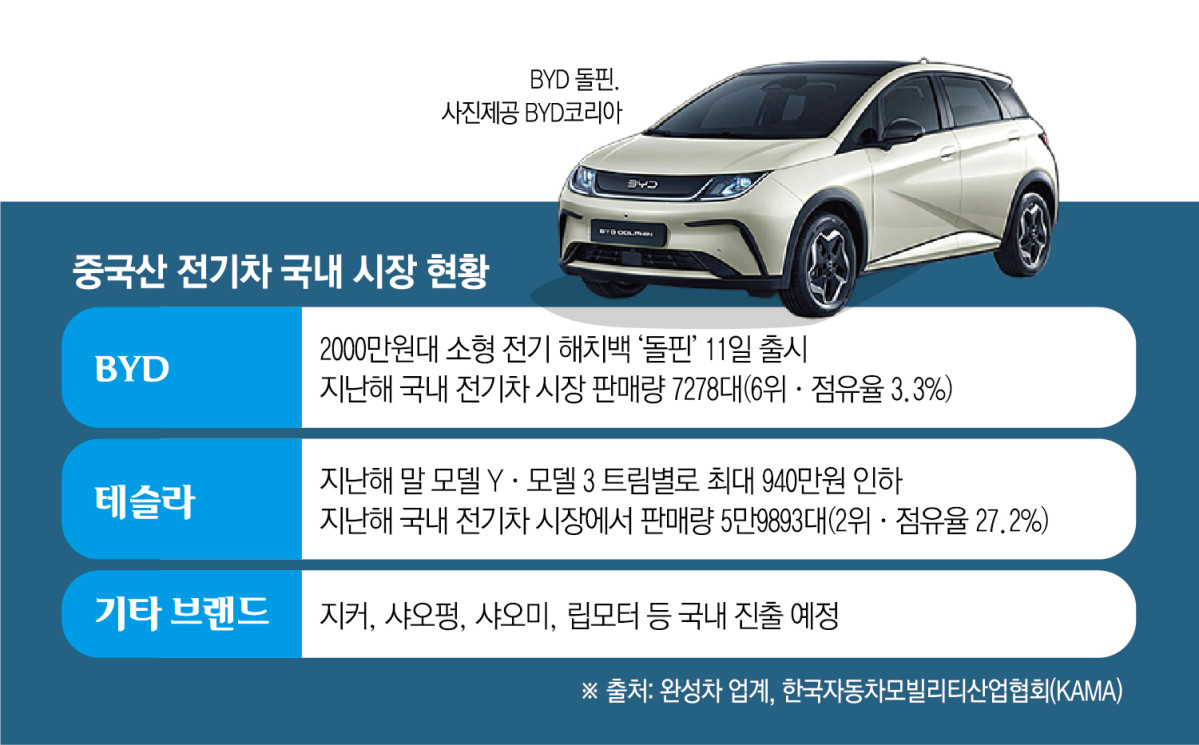
BYD, China’s leading electric vehicle manufacturer, is set to release its compact EV priced in the 20 million KRW (about 15,000 USD) range, sparking fears of a price war in the Korean auto market. The influx of both Chinese brands and “Made in China” global products is rapidly shrinking the market share of domestic EV brands.
Industry sources report that BYD Korea will begin domestic sales of its compact electric hatchback ‘Dolphin’ on March 11th. The Dolphin, a popular urban EV with over 1 million units sold globally, will be priced between 24.5 million KRW (about 18,375 USD) for the base model and 29.2 million KRW (about 21,900 USD) for the active trim before incentives. This aggressive pricing strategy positions it as a rare entry-level import in the 20 million KRW (about 15,000 USD) range in the Korean electric vehicle market.
The Korean EV market is already experiencing intensified price competition. Following BYD’s entry last year with its low-cost strategy, Tesla shocked consumers by slashing prices on Model 3 and Model Y trims by up to 9.4 million KRW (about 7,050 USD). In response, domestic brands like Hyundai have launched low-interest financing promotions for their EVs, while Kia has reduced prices on the EV5 Long Range and EV6 models by 2.8 million KRW (about 2,100 USD) and 3 million KRW (about 2,250 USD) respectively. Industry analysts predict that the increasing presence of Chinese EV brands could further drive down prices across the board.
A more pressing concern is the growing market share of Chinese-made EVs in the Korean auto market. This includes not only Chinese brands but also vehicles produced in Chinese factories by global automakers. The Korea Automobile & Mobility Association (KAMA) reports that one in three newly registered EVs last year was manufactured in China. These vehicles benefit from substantial Chinese government support, including direct subsidies and low electricity rates, allowing them to offer competitive pricing while improving quality to target the Korean market.
Tesla, which sells a significant portion of its Shanghai-produced vehicles in Korea, poses a particular threat to domestic brands. Last year, Tesla’s Korean EV sales reached 59,893 units, narrowly trailing Kia’s 60,609 units. Hyundai, with 55,461 units sold, fell behind Tesla. Tesla’s market share hit 27.2%, just 0.3 percentage points behind Kia’s 27.5%.
As the influx of “Made in China” EVs intensifies, concerns grow that domestic brands may lose ground in their home market. Unlike some competitor nations, the Korean government currently offers purchase incentives for foreign-made EVs as part of its climate change initiatives. Industry experts argue for the swift implementation of a Korean version of the Inflation Reduction Act (IRA), which would provide tax incentives for locally manufactured products. A spokesperson for KAMA stated, “We need to discuss introducing support measures, such as domestic production tax incentives, to ensure price competitiveness for Korean-made EVs and protect our manufacturing ecosystem.”










Most Commented