
Translation result.
|
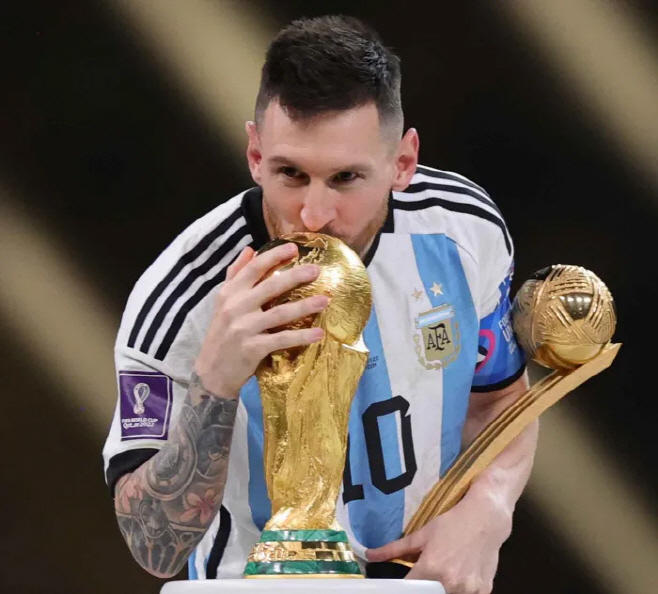
Lionel Messi (Inter Miami), widely regarded as the greatest player in soccer history, will be making his sixth World Cup appearance. Argentina, the 2022 Qatar champion, has retained much of its core and will push to become the first team in recent memory to win back-to-back World Cups.
On May 29 (KST), the Argentine Football Association (AFA) unveiled its 26-man final roster for the 2026 FIFA World Cup in North America. As expected, Messi made the cut, securing his sixth World Cup berth.
That puts Messi alongside Cristiano Ronaldo (Al-Nassr) in a unique club: six straight World Cups. Mexico goalkeeper Guillermo Ochoa is also on track to reach six consecutive tournaments.
Messi has appeared in five World Cups — from Germany 2006 through Qatar 2022 — totaling 26 matches, 13 goals and eight assists on soccer’s biggest stage. He already holds the record for most World Cup appearances and now has his sights on Miroslav Klose’s all-time World Cup scoring mark of 16 goals, sitting three shy of the record.
Messi’s fitness was a question mark until the final list was released. On May 25, during Inter Miami’s MLS match against the Philadelphia Union, he felt discomfort in his left hamstring and was substituted. Inter Miami described it as an overload linked to muscle fatigue, and coach Lionel Scaloni ultimately included Messi on the roster, saying there were no major issues.
Argentina has largely kept the Qatar-winning nucleus intact. Seventeen members of that squad returned, including Messi, goalkeeper Emiliano Martínez (Aston Villa), Nicolás Otamendi (Benfica), Cristian Romero (Tottenham), Enzo Fernández (Chelsea), Alexis Mac Allister (Liverpool), Lautaro Martínez (Inter Milan) and Julián Álvarez (Atletico Madrid).
Giovani Lo Celso (Real Betis), who missed the Qatar tournament due to injury, is back. The squad also features younger additions such as José Manuel López (Palmeiras), Thiago Almada (Atletico Madrid) and Nico Paz, a key figure in Como’s surprising season.
Argentina will play friendlies against Honduras and Iceland ahead of the World Cup, then open Group J against Algeria on June 17. They will round out group play against Austria and Jordan.
On paper, Argentina remains one of the favorites. Observers say the team’s structure didn’t unravel after Qatar, and the refresh in midfield and attack has been managed smoothly. The Mac Allister–Enzo Fernández pairing offers work rate, forward thrust and pressing ability, while Lautaro and Álvarez have matured into top-level forwards in Europe’s elite leagues.
The back line looks solid, too. Centered on Cristian Romero and Lisandro Martínez, Argentina’s defense is optimized for aggressive, high-line play, and Emiliano Martínez’s presence between the posts is still a huge plus in knockout formats. In recent major tournaments the squad has shown a resilience often described as “champion DNA.”
At 38, whether Messi can reproduce his previous tournament form is uncertain. He still brings elite playmaking and finishing, but managing his workload will be crucial. The long travel distances and heat typical of a North American World Cup add to the challenge. How Scaloni handles Messi’s minutes could have a major impact on Argentina’s title chances.
Even so, Messi’s symbolic weight and influence are immense. His triumph in Qatar largely settled the GOAT debate with Cristiano Ronaldo in the eyes of many. If Argentina completes a successful World Cup title defense, Messi will further cement his place as arguably soccer’s greatest player.











Most Commented