
Translation result.
Iran insisted that calling the payments ships must make to transit the Strait of Hormuz a \”passage tax\” or \”toll\” is incorrect.
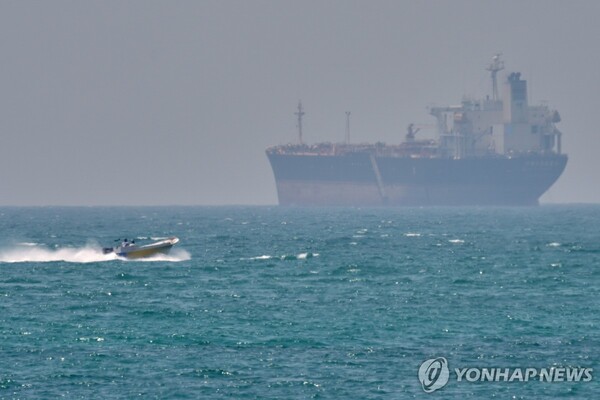
At a regular briefing on the 25th (local time), Iranian Foreign Ministry spokesman Esmail Baghaei said careful wording is required. He was responding to questions about whether the Strait of Hormuz would be opened under certain conditions and whether authorities would charge a set fee for transiting vessels, Yonhap News reported.
Baghaei said the term \”abaraz,\” which implies a tax or fee imposed unilaterally by a government agency, is inaccurate. Officials should instead use \”hazine,\” meaning \”cost,\” he said.
\”We do not collect abaraz (passage taxes or tolls),\” he said. \”We must provide services to ensure ships can transit the Strait of Hormuz safely, and it is appropriate to recover the hazine (costs) associated with those services.\”
He said such \”services\” include pilotage and navigation assistance for transiting vessels, along with measures to protect the marine environment of the strait, the Persian Gulf and the Gulf of Oman.
In short, he said, even if Iran signs a memorandum of understanding (MOU) with the United States to end hostilities, passage through the Strait of Hormuz would not be free. Earlier, U.S. outlet Axios reported on the 23rd that the MOU would include a provision opening the strait without charges during a 60-day cease-fire.
Baghaei also argued that it would be responsible and consistent with international law for Iran and Oman, the strait’s littoral states, to establish rules and procedures to guarantee safe passage. He said such measures would serve both countries’ national interests and security, as well as the broader international public interest.
He added that Iran and Oman are working responsibly toward that goal and hope to reach a final outcome as soon as possible.















Most Commented