
Did the National Intelligence Service Mislead the CIA? Unpacking the Emergency Martial Law Controversy
Daniel Kim Views
Translation result.
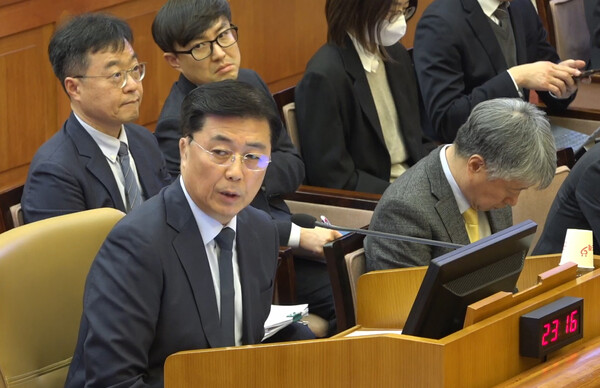
[The Public = Reporter Oh Doo-hwan] A special prosecutor’s team has intensified its investigation into allegations that, immediately after martial law was declared, the National Intelligence Service (NIS) briefed the U.S. Central Intelligence Agency (CIA) on the reasons behind the move. The special prosecutor says the NIS command chain was informed of and approved the process.
Former NIS first deputy director Hong Jang-won has flatly denied the allegations, calling them false testimony. The inquiry now centers on what orders and reports actually circulated inside the NIS the day after martial law was declared.
On the 20th, the second comprehensive special prosecutor team led by Kwon Chang-young released a briefing stating that, under orders from former NIS Director Cho Tae-yong, the overseas division under the first deputy director summoned the CIA station chief in Seoul to the NIS and explained the intent of documents related to the martial law. The special prosecutor believes Hong was informed of the process and signed off on it.
Prosecutors reportedly seized a document characterized as an external briefing during an April search of NIS offices. That document appears to have been intended to explain the rationale for the martial law to foreign audiences. Since then, the special prosecutor’s office has interviewed roughly 40 NIS officials to trace who wrote and passed along the document.
The team has reconstructed the sequence as follows: on the morning of Dec. 4, 2024 — the day after martial law — the NIS received a request from the Office of National Security to explain the background of the martial law to allied countries. A Korean-language document accompanied the request. The NIS’s overseas division translated the document into English and then summoned the CIA station chief to brief him in person.
The special prosecutor has registered charges against six former NIS political appointees, including former director Cho and Hong, accusing them of performing key duties in connection with an insurrection. The team plans to summon Hong for questioning on the 22nd. Investigators will focus on how the external briefing document was circulated, who ordered the translation and briefing, and whether Hong actually received a report.
Hong has strongly protested the allegations. “If that’s true, someone is giving false testimony,” he said. “I never received any instructions from Director Cho or anyone at the National Security Office to send any message to the U.S. or the CIA.”
He added, “I never told anyone to deliver a message to the CIA, and no one below me reported that they planned to deliver a message or had been ordered to do so. If someone intended to engage in an insurrection, the president would have called and given direct orders — and they would have followed them. So what would be the point of sending a message to the CIA?”
Hong says he will clarify his position during the special prosecutor’s questioning. “If I had told anyone to deliver a message to the CIA, you could simply find the person who received that order,” he said.
The investigation now hinges on how well internal NIS statements align with objective evidence. The special prosecutor points to seized documents and NIS officials’ testimony as indicating possible involvement by the command chain. Hong insists there were no orders, reports, or approvals. With the two accounts in direct conflict, testimony about actual approval and reporting lines, the document’s author, who ordered the translation, and the officials who contacted the CIA has taken on critical importance.
The internal atmosphere at the NIS at the time has also become a key issue. Dec. 4, 2024, is reported to be the day Cho decided to replace Hong. Hong says that on the night martial law was declared, after a meeting of political appointees at the NIS, he approached Cho, mentioned movements by counterintelligence units, and asked for guidance — only, he claims, for Cho to storm out in anger.
Cho has reportedly told prosecutors that he convened a morning meeting of political appointees on Dec. 4 to discuss the lifting of martial law and future tasks. He said that afternoon Hong suggested calling Lee Jae-myung, then leader of the Democratic Party, and that Cho viewed the suggestion as a breach of political neutrality. Cho then recommended Hong’s replacement to President Yoon the next day. Hong was later notified of his dismissal.
The special prosecutor’s probe has now entered a phase focused on assessing the credibility of internal NIS statements. If the allegation that the CIA was briefed is confirmed, a new question will arise: did officials seek to justify martial law not only to domestic authorities but also to foreign intelligence services? Conversely, if key testimony proves inaccurate as Hong claims, it could shake the very foundation of the special prosecutor’s investigation.











Most Commented