
Translation result.
“Failure to honor trade deal,” EU car tariffs rise from 15% to 25% starting next week
Underlying motive: frustration with European allies’ lack of cooperation in the U.S.-Iran conflict
 U.S. actions related to the conflict with Iran are delivering a significant shock to the global economy.
The U.S. warned shipping companies worldwide that do business with Iran that they could face sanctions. It also announced steep tariff increases targeting the European Union (EU), which Washington says has not supported U.S. efforts in the conflict.
The U.S. Treasury Department’s Office of Foreign Assets Control (OFAC) said in a notice on the 1st (local time) that it was issuing an advisory “to warn that anyone who pays the Iranian regime for safe passage or seeks guarantees that they will not be attacked risks being sanctioned.” Iran has proposed alternate coastal routes and is seeking to collect transit fees from vessels, while the U.S. has moved to impose maritime measures intended to cut off the regime’s sources of war funding.
OFAC identified a wide range of payment types that could trigger sanctions, including cash transactions, digital assets, offsetting trades, informal swaps, and in-kind payments. The agency said it would also strictly prohibit payments routed through Iranian embassies abroad or disguised as charitable donations to organizations such as the Red Crescent.
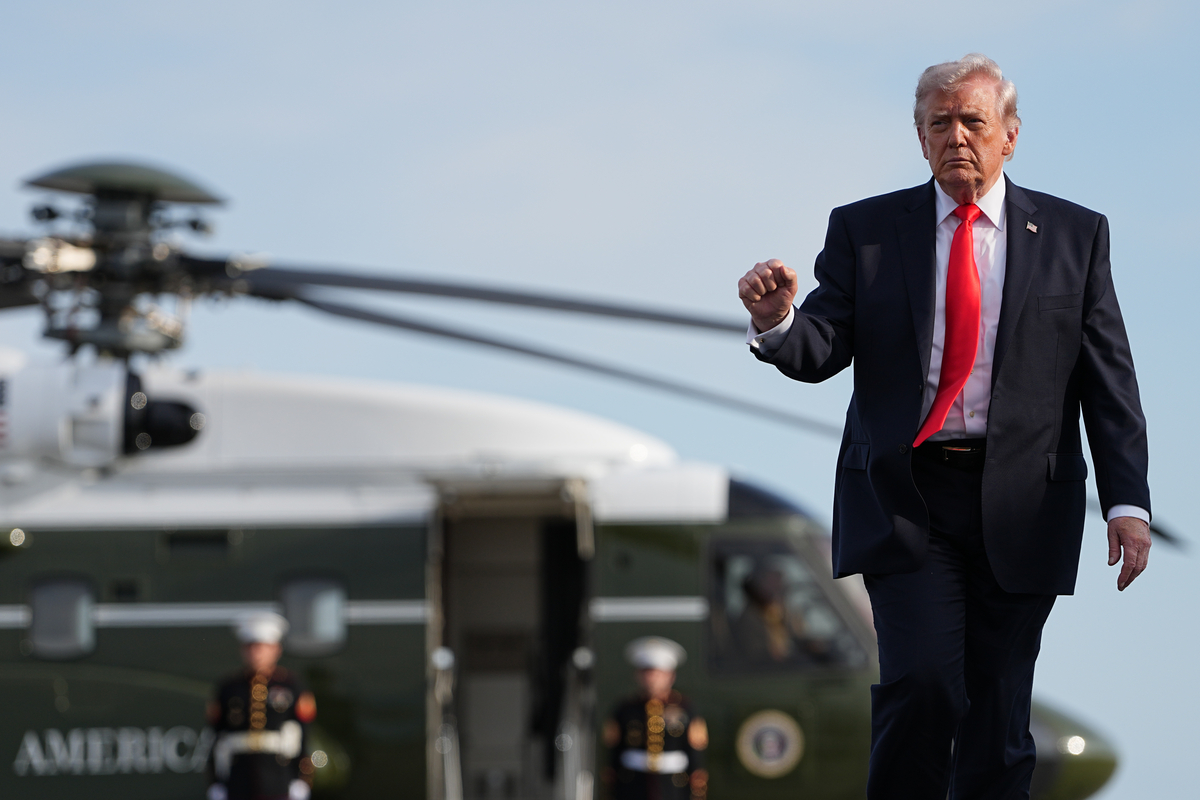
The administration also sharply raised tariffs on EU-made cars. President Donald Trump abruptly announced he would raise tariffs on EU passenger cars to 25%, framing the move as a response to the EU’s “failure to comply” with a trade agreement.
On the 1st (local time), Trump posted on Truth Social: “Starting next week I will raise tariffs on passenger cars and trucks coming into the United States from the EU to 25%.” He added that he was announcing the increase “based on the fact that the EU is not honoring the trade agreement we fully negotiated,” and reiterated that “the tariff rate will go to 25%.”
Last year, beginning April 3, Trump imposed a 25% product-specific tariff on foreign-made cars; EU-made cars were then subject to a base tariff of 2.5% plus the 25%, for a total of 27.5%. A day earlier, on the 2nd, he also imposed a 20% reciprocal tariff on the EU.
 EU Commission President Ursula von der Leyen entered negotiations with Trump, and the EU pledged $750 billion (approximately 1,000 trillion KRW) in U.S. energy and defense purchases and $600 billion (approximately 800 trillion KRW) in investment into the United States. That deal had allowed both reciprocal and product-specific tariffs to be cut by 10 percentage points to 15%. But Trump’s sudden announcement to raise tariffs has returned the rate to the pre-agreement level of 25%.
Trump said the EU has been slow to implement the investments it promised as conditions for the tariff reductions, citing that “noncompliance” as his reason. “Countries like Japan, South Korea, Canada and Mexico are all building factories in the U.S., but the EU is not honoring the agreement,” he said.
Analysts say frustration over major European allies’ reluctance to support U.S. actions in the Iran conflict also helped drive the decision. Trump has publicly expressed strong disappointment that key NATO members refused requests to send warships to the Strait of Hormuz and declined to allow U.S. military aircraft to use bases in Europe. The U.S. also announced plans to reduce by roughly 5,000 the approximately 36,000 troops stationed in Germany, a move that has heightened concerns the rift between the administration and the EU over the U.S.-Iran confrontation will deepen.













Most Commented