
Translation result.
Jeon Hyun-hee: “Jeong Won-o’s pledges are only nominally practical”
Park Ju-min: “We need a concrete plan to secure funding”
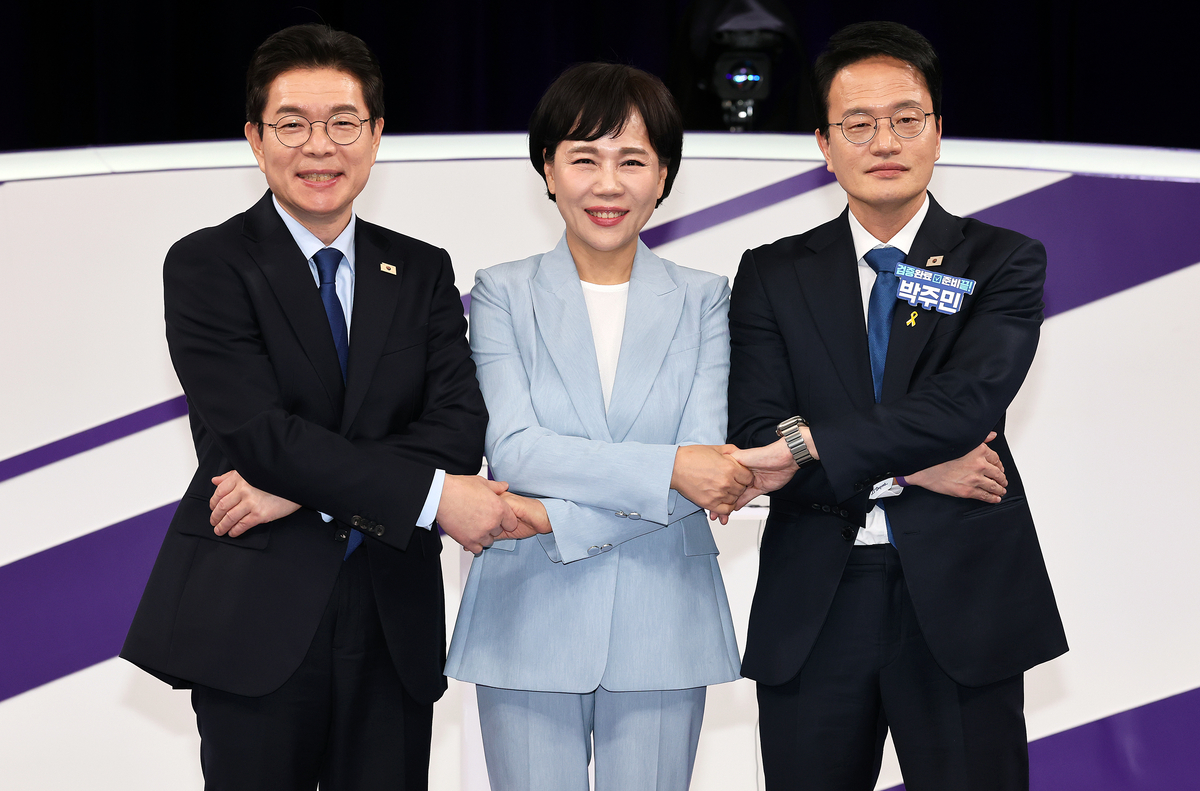
Jeong Won-o, Park Ju-min and Jeon Hyun-hee, candidates in the Seoul mayoral primary, clashed over policies spanning real estate, transportation and other key areas. Observers noted the debate centered heavily on Jeong, who is seen as aligned with President Lee Jae-myung. Jeon labeled Jeong’s pledges “hollow,” while Park pressed him on the realism of his funding plans.
Park and Jeon took part in the special “100-Minute Debate” at MBC’s new Sangam-dong building in Mapo on the 31st, and both used their opening remarks to underline that they are “vetted candidates.” Park warned, “If we fail to vet properly during the primary, that failure will cost us the general election. We need more rigorous vetting and more disciplined debates.” Jeon said, “The Yoon Suk Yeol administration has scrutinized me and found not a speck of dust,” adding, “You win when you can stand proudly — voters won’t choose a candidate who appears uncertain.” Their remarks came as questions about Jeong have surfaced, allowing them to emphasize their credentialed records.
All three candidates said they agreed with the intent of President Lee Jae-myung’s recent proposal to restrict seniors’ free subway rides during peak commuting hours, but they differed on implementation. Park framed the idea as a response to energy pressures and congestion: “Given the global energy situation, we should encourage public transit while also looking for ways to reduce crowding. One option is a temporary subsidy or fare reduction to boost ridership, combined with measures to diversify and flexibilize commuting times to ease peaks.” Jeon proposed a targeted approach: “We should issue separate transit cards for seniors who still commute so they can continue to use free services, while preserving access for working elders.”
Jeong argued a voluntary campaign would be preferable to government-mandated restrictions. “It’s very difficult to distinguish seniors who commute from those who do not, and it’s impossible to forcibly restrict older citizens’ travel,” he said. “Rather than having the government or Seoul limit free subway rides, we should run a campaign asking seniors to voluntarily adjust their commute times.”
Jeon strongly criticized Jeong’s housing pledge as lacking feasibility. “The so-called ‘practical housing’ is highly unlikely to be delivered within a single term,” she said, calling it “practical in name only.” She noted that reconstruction and redevelopment projects in Seoul commonly take more than a decade, making the proposed supply unrealistic. Jeong countered, “If there’s a need, we should build it,” and asked rhetorically, “If we demand realism in every pledge, wouldn’t every candidate’s plan be vulnerable?” Jeon also dismissed Jeong’s “5-minute bus, 10-minute subway” promise as appealing in theory but hollow in practice.
Park also questioned Jeong’s ambition to make Seoul a “global G2 city.” “Jeong’s plan relies primarily on Seoul’s permitting powers to attract private investment, but that alone won’t generate sufficient resources,” Park argued. “Seoul should set up an economic development corporation to actively attract private and foreign capital.” Jeong defended his proposal, saying the city can create new business districts to secure growth engines in ways that do not require large upfront funding, describing it as a “low-cost” approach.
Critics raised Jeong’s earlier social media post that said the court “carried out the will of the people” when it handed a former president a life sentence. Park noted, “He initially wrote that the court reflected citizens’ will and later edited the post. Given the circumstances, it’s hard to say the ruling represented the people’s will, so Jeon and I issued a strong response.” Jeong defended his wording, arguing that even a previously criticized bench ultimately convicted a defendant of rebellion, which he took as reflecting public sentiment.









Most Commented