
This Year’s Resignations Likely to Set a Record
With Special-Prosecutor Deployments, Frontline Offices Say “No Prosecutors Left to Do the Work”
Prosecutors are already exiting offices that are slated for abolition in six months. Assignments to several special-prosecutor teams have depleted staff at frontline offices, and a continuing wave of resignations—largely attributed to falling morale over the planned abolition—has deepened the shortage.
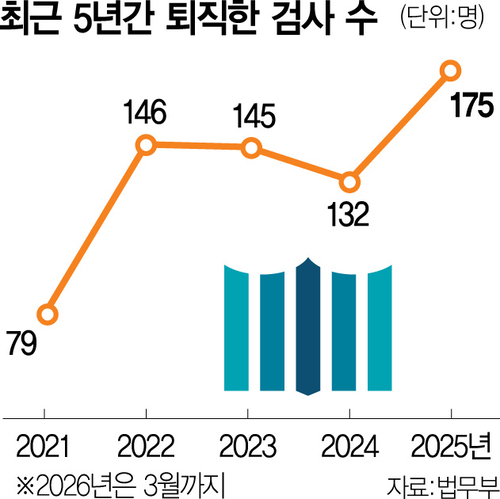
On March 28, the Ministry of Justice reported that 58 prosecutors resigned between January and March. Including prosecutors who have announced their intent to resign but whose resignation letters have not yet been processed, departures are expected to exceed 60. Last year 175 prosecutors resigned—the highest in a decade—and this year appears poised to surpass that figure.
Some 67 prosecutors have been seconded to five special-prosecutor teams, meaning frontline offices have already lost roughly 100 prosecutors in total.
When those on leave are added, frontline offices effectively have no prosecutors left to handle cases. According to the office of Rep. Joo Jin-woo (People Power Party), 132 prosecutors took leave last year—109 for childcare and 19 for illness—the highest number of leaves since 2016.
As prosecutors depart because of special-prosecutor assignments, resignations and leaves, many district prosecutors’ offices are virtually paralyzed. The Cheonan branch of the Daejeon District Prosecutors’ Office has an authorized staff of 35 but only 17 prosecutors are currently on duty. The Anyang branch of the Suwon District Prosecutors’ Office similarly has 17 active prosecutors out of an authorized 34.
A more pressing problem is the surge in backlogged cases. With too few prosecutors, case processing has stalled. Sources say criminal divisions in Seoul-area offices now carry more than 300 unresolved cases per prosecutor. Typically, a caseload of around 100 unresolved cases per prosecutor renders normal operations impossible.
On March 25, An Mi-hyun, a prosecutor at the Cheonan branch, posted on Facebook under the headline “Bankrupt Branch.” She wrote, “Seven junior prosecutors at Cheonan—assigned there as their first posting—have vanished under various pretexts, including special-prosecutor teams and the joint investigation unit.” She added, “Two of eight prosecutors in the investigative unit recently announced their resignations. Yesterday I heard that a prosecutor at a provincial office collapsed and was taken to the ICU; today one of our junior prosecutors—known for treating overtime as routine—went to the emergency room.”
Legal insiders say the chief cause of the exodus is a steep fall in morale and motivation during the debate over abolishing the current prosecution office. They point to shrinking roles for prosecutors, shifting authorities under reform, and heavy workloads that together have made the prosecution far less attractive to junior staff. With a planned transition to a public-prosecution agency scheduled for October—likely to weaken prosecutors’ institutional standing—insiders warn another large wave of departures could occur before the new agency takes effect.
A current senior chief prosecutor said, “Younger prosecutors tend to assess their future prospects dispassionately rather than display loyalty to the organization.” He added, “Internal morale declined sharply around the passage of the Public Prosecution Service law, and a sense of mission alone no longer sustains people.”















Most Commented