
Prosecutorial Reform in South Korea: The Debate Over Supplementary Investigation Powers Explained
Daniel Kim Views
Translation result.
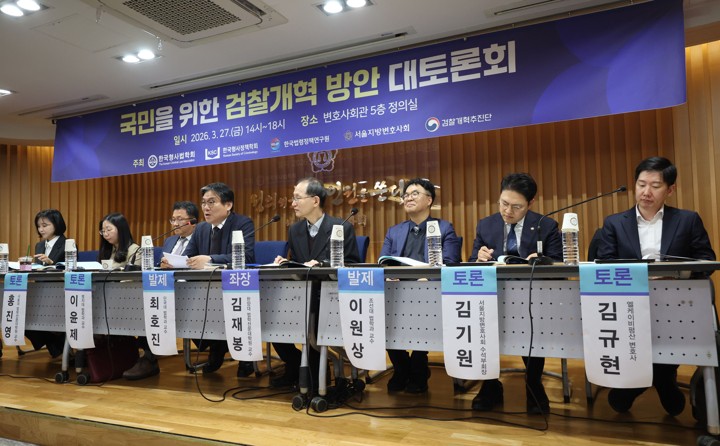
Prosecutorial Reform Task Force, Forum on Reform MeasuresProsecutorial Reform Task Force, Forum on Reform Measures
(Seoul=Yonhap News) By Ryu Young-seok — At a large forum on prosecutorial reform for the public, held at the Seoul Bar Association building in Seocho-gu, Seoul, on March 27, Professor Choi Ho-jin of Dankook University’s Department of Law delivered remarks. Mar. 27, 2026
ondol@yna.co.kr
(End)
「Copyright(c) Yonhap News Agency, unauthorized reproduction, redistribution, AI training and use prohibited」Prosecutorial Reform Task Force, Forum on Reform Measures
(Seoul=Yonhap News) By Ryu Young-seok — At a large forum on prosecutorial reform for the public, held at the Seoul Bar Association building in Seocho-gu, Seoul, on March 27, Professor Choi Ho-jin of Dankook University’s Department of Law delivered remarks. Mar. 27, 2026
ondol@yna.co.kr
(End)
「Copyright(c) Yonhap News Agency, unauthorized reproduction, redistribution, AI training and use prohibited」
At a forum hosted by the Prosecutorial Reform Task Force, experts argued that introducing an offense for \”distorting the law\” increases the need to grant prosecutors at the new public prosecution office exceptional supplementary investigative powers.
In his presentation at the forum on March 27, Professor Lee Won-sang of Chosun University’s Department of Law warned that when additional investigation is required, a prosecutor who indicts or decides not to prosecute before adequate supplementary probing is completed could face allegations of violating the anti–legal-distortion statute.
He emphasized that conducting supplementary investigations should be viewed not as an exercise of discretionary authority but as a duty to prevent concealment of substantive truth.
Lee said any supplementary investigative authority conferred on prosecutors at the public prosecution office should be narrowly confined—limited to certain serious offenses such as large-scale organized crime, corruption, and major economic crimes—and subject to specific, heightened conditions.
He also proposed establishing a permanent, statutory framework for joint investigations so that investigative agencies and the public prosecution office can cooperate more effectively, and suggested creating an independent Investigative Dispute Mediation Committee to resolve interagency conflicts.
Professor Choi Ho-jin of Dankook University proposed striking a balance between a principle-based model for requesting supplementary investigations and a strictly regulated system for exceptional cases in which prosecutors undertake direct supplementary investigations.
Professor Hong Jin-young of Seoul National University School of Law cautioned that it would be dangerous to hastily abolish or curtail direct supplementary investigations on the assumption that agencies will comply smoothly with requests for such probes.
By contrast, Superintendent Song Ji-heon of the Seoul Metropolitan Police Agency’s investigation division argued that equating incomplete supplementary investigations with legal distortion is a logical leap. He warned that granting prosecutors direct supplementary-investigation powers could itself create a pathway to legal distortion.
He added that, despite the passive implication of the term \”supplementary investigation,\” the power does not authorize prosecutors to open wholly new probes; rather, within the scope of the case and related matters it effectively gives them broad authority to carry out both voluntary and coercive investigative measures.
He stressed that separating investigation and prosecution is a constitutional requirement grounded in the principle of separation of powers, and that recognizing prosecutors’ supplementary-investigative authority could undermine that core purpose.
#ProsecutorialReformTaskForce
Yonhap News TV — Inquiries and tips: KakaoTalk/Line jebo23
Jang Bo-kyung (jangbo@yna.co.kr)








Most Commented