
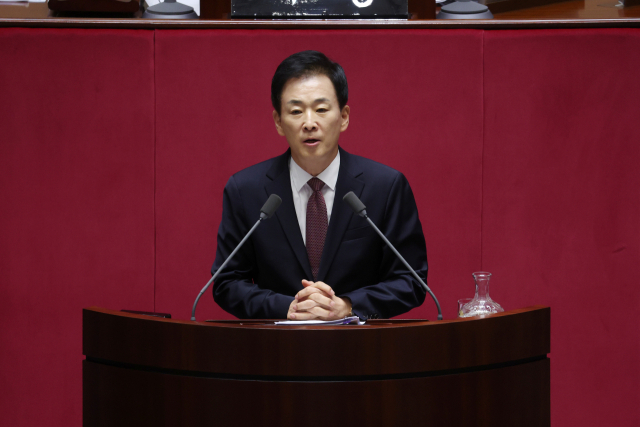
On February 10, Yoo Young-ha, a member of the National Assembly from the ruling People Power Party and a candidate for the Daegu mayoral race, argued for the need to decentralize the semiconductor industry in the southern region, including Daegu and North Gyeongsang Province. During a government inquiry session, he cited limitations in power and water supply for the Yongin semiconductor cluster and vulnerabilities to disasters and accidents as key reasons. In response, Prime Minister Kim Min-seok announced plans to establish a presidential committee focused on developing a semiconductor cluster in the southern region.
Yoo raised concerns with Prime Minister Kim and Minister of Climate, Energy and Environment Kim Sung-hwan about how the current semiconductor industry structure, concentrated in the Seoul metropolitan area, exacerbates regional imbalances and creates issues with power and water supply.
Yoo stated that if Samsung Electronics and SK Hynix were to construct ten semiconductor fabs in Yongin, they would require approximately 15 GW of power. He noted that Samsung has secured only 3 GW out of the 9 GW needed, relying on the construction of LNG power plants and unconfirmed sources for the remainder. Yoo added that building transmission lines is realistically challenging due to local opposition.
Addressing the water supply issue, Yoo cited research from the Seoul Water Research Institute, which indicates that the government’s plan to expand housing supply would increase the demand for domestic water by an additional 560,000 tons, highlighting potential supply disruptions.
He also pointed to examples of Taiwan’s TSMC and Japan’s semiconductor fabs, which are widely distributed across their respective countries, from Hokkaido to Kyushu in Japan’s case. Yoo emphasized that semiconductor factories should not be concentrated in specific areas due to the risk of significant damage from earthquakes, typhoons, natural disasters, wars, and power outages.
Yoo proposed Daegu and North Gyeongsang Province as the optimal location for a semiconductor cluster. He argued that North Gyeongsang Province hosts half of the country’s nuclear power plants, ensuring a stable power supply, and that utilizing the Nakdong River system would make securing water easier. He also highlighted the strengths of the logistics system linked to the new Daegu-Gyeongbuk airport, the industrial base of the materials and parts industry in Gumi, and the workforce development conditions in Daegu and North Gyeongsang Province.
Yoo suggested to Prime Minister Kim that decentralizing the semiconductor cluster aligns with the government’s energy policy and would strengthen local investments while contributing to balanced regional development. In response, Kim confirmed that a presidential committee would be established to address this matter.









Most Commented