
Translation result.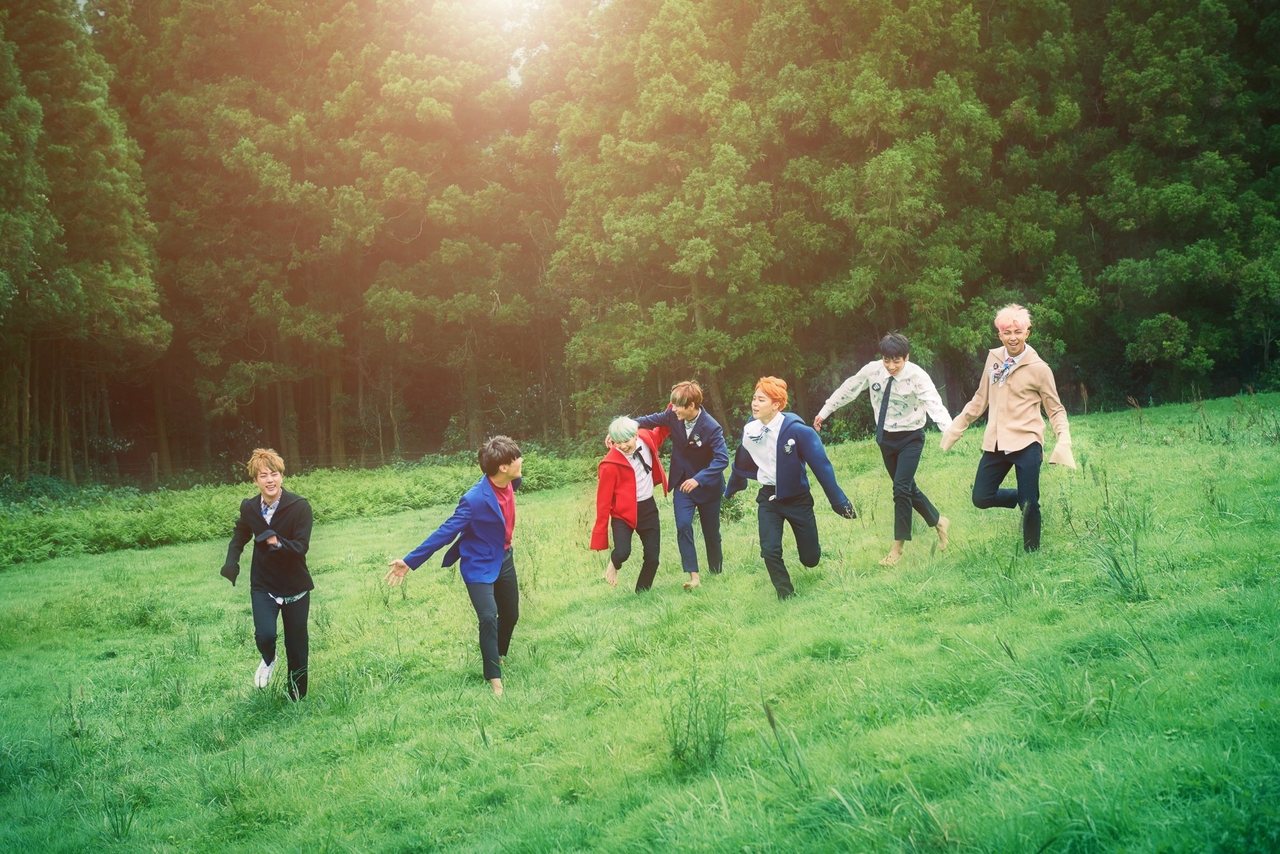 [Herald Economy reporter Ko Seung-hee] A bloodied boy stands in a scene that jars against sunlight slanting through a window and the sound of birds. He wipes his bloodied hands as if trying to erase a terrifying memory; tears streak his face. Youth here is not beauty but anxiety. The boy frantically searches for his hyung. As V, his rescuer, and six other boys converge, the story begins. Those radiant days—so beautiful they induce fear—were painfully unstable. The broken young cling to one another. Even when rescue finally fails, their solidarity never does. Hwa Yang Yeon Hwa On Stage: Prologue marks the origin of BTS’s narrative universe.
In K-pop history, a “universe” is more than a concept. It is a platform that keeps fandoms engaged, an independent intellectual property that prolongs an artist’s life, and a sustainable asset global entertainment companies covet. At the heart of that shift was the BTS universe: the BU (BTS Universe).
In 2015, BTS’s Hwa Yang Yeon Hwa (花樣年華) became, in effect, a textbook for K-pop worldbuilding and the prototype for HYBE’s storytelling IP strategy. The BU fused the band’s musical themes with fictional narratives and expanded into webtoons, novels and other IPs, establishing a standard for transmedia storytelling. That initial move now broadens through BTS’s fifth studio album, Arirang, laying the foundation for a new BTS 2.0 era.
Early in their career, BTS appeared as archetypal teenage rebels in their “school” trilogy, resisting social pressure. In 2015 they pivoted to a new narrative. The music video for “I Need U,” the lead single from Hwa Yang Yeon Hwa pt.1, began the members’ character reboot.
‘Burning flowers, soaked sneakers, a train platform, repeated falls and deaths.’
The video left K-pop fandoms with something unfamiliar: an unsettling, elliptical story. It offered little exposition and unfolded in fragments. Scenes seemed to connect and then cut away; characters’ emotions resisted tidy explanation. Fans set about decoding the visuals and, in doing so, helped assemble the story.
 The video presented seven fictional characters, each named after a member of the band. Through them, BTS dramatized the anxiety, pain and solidarity that lie beneath the universal theme of youth.
The time-loop centered on Kim Seok-jin (Jin) became the device that sparked a participatory interpretive culture among fans. Where once fandoms passively accepted agency-crafted worlds, the BU turned them into co-creators of a shared narrative. Fans began to inhabit the artist’s universe together, evolving from mere music consumers into creators of a parallel IP.
BTS’s Hwa Yang Yeon Hwa story later expanded into a Naver Webtoon, Hwa Yang Yeon Hwa Pt.0, and the novel Hwa Yang Yeon Hwa: The Note in 2019. Casting the members as protagonists and supplying concrete plotlines and character detail deepened fan immersion. A robust original text gave the fandom enduring creative energy, enabling them to consume and reproduce the narrative even during the group’s downtime.
A decade on, BTS’s universe moved from Love Yourself to the acceptance of wounds, and through Map of the Soul into an exploration of the inner self. The 2026 narrative transcends individual adolescence and reaches into layers of collective memory with the release of their fifth studio album, Arirang.
What began as a shaky “dirt spoon” origin has, over ten years of steady growth, produced a group that now commands the center of the global music market. They have evolved into artists who can fuse national identity with global universality.
The album draws its central energy from a historical episode: in 1896, Korean students at Howard University in Washington, D.C., made the first recorded performance of “Arirang.”
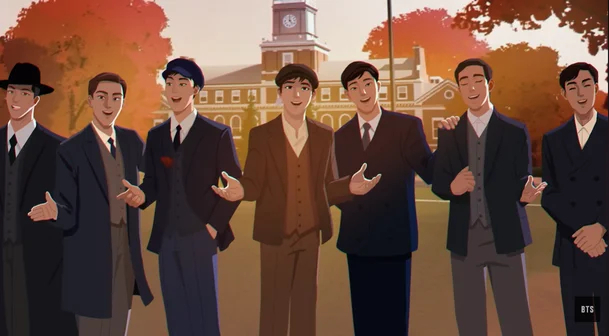 Seven young Koreans—Ahn Jung-sik, Lee Hee-cheol, Son Young-deok and others—had traveled to the United States to escape Japanese surveillance and left their voices on wax cylinders in an unfamiliar land. That episode, later called the Howard Seven, now resonates across 130 years and fatefully overlaps with the seven members of BTS today.
HYBE distilled this research into a roughly one-minute animated teaser. The clip shows the 1896 students gathered before a phonograph, transitioning into BTS at their 2013 debut—a visual shorthand for Korean cultural resilience. The survival story of diasporic Koreans and the present-day rise of BTS as global pop stars converge in a single image.
The survival memories of those who lived as outsiders echo BTS’s history: born in Korea, they helped lift a peripheral culture—K-pop—into the world’s center. The Arirang narrative is both a search for roots and an expansion of the universe. On the album, BTS calls themselves “Aliens,” reclaiming experiences once othered by Western frameworks and reframing difference as distinction.
Where Hwa Yang Yeon Hwa examined individual anxieties of youth, Arirang broadens that emotion into collective memory and diasporic layers. The BTS universe now reads as a contemporary myth, addressing movement, survival, otherness and recovery.
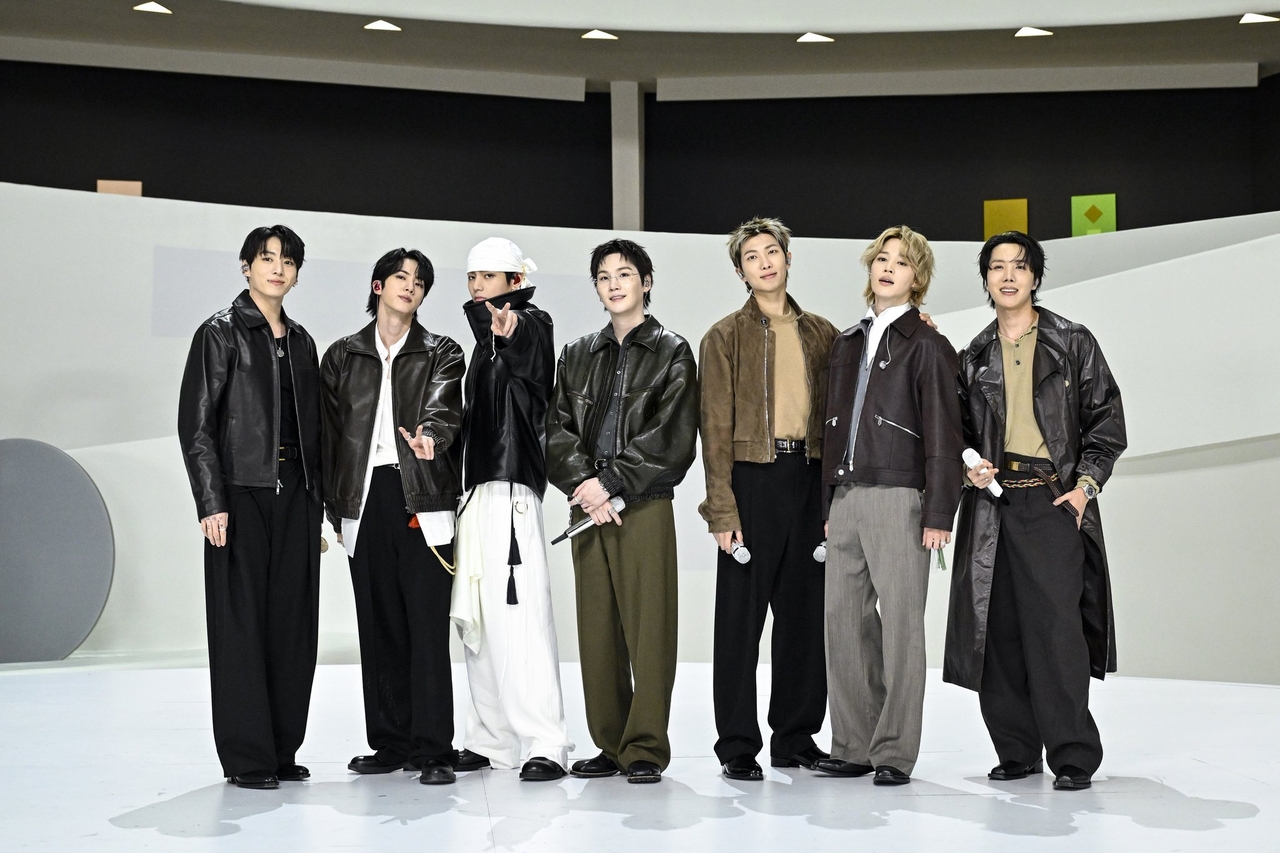
Arirang shot to No. 1 on Apple Music charts in 115 countries immediately after its release. The lead single “Swim (SWIM)” reached No. 1 on the Billboard Hot 100.
Ahead of the album, BTS ran a universal campaign asking, “What is your love song?”—a simple, inclusive prompt that drew fans back into the universe in much the same way as before.
The traditional K-pop consumption cycle has often lacked longevity. An industry executive observed that consumption typically spikes around a comeback, and during quiet periods fans tend to drift away—especially among more casual followings. To boost loyalty and lengthen dwell time, companies are increasingly diversifying their IP.
Expanding a world into story IPs, as BTS has, lengthens fandoms’ stay. Fans who laugh and cry with an artist’s universe remain engaged, showing a loyalty beyond a handful of hit singles.
K-pop is no longer only a music industry. It is moving toward a narrative-driven sector—an industry of stories built around characters and worlds, akin to Marvel, Star Wars and Harry Potter.
An industry insider said, “Once you build a solid universe, content can expand endlessly into webtoons, animation and games. Each element drives its own merchandise consumption, creating a virtuous cycle for the IP.”













Most Commented