
Translation result
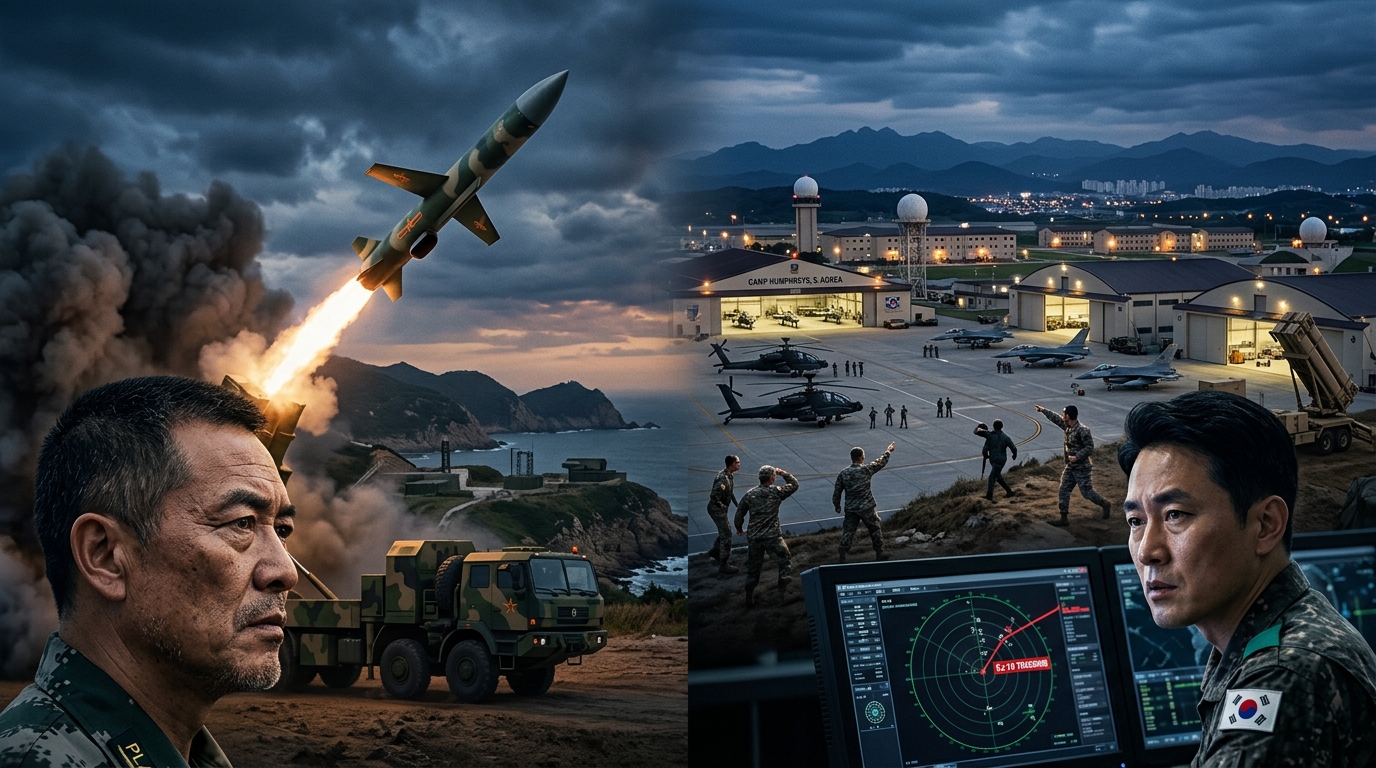
China’s Rocket Force has fielded a longer-range CJ-10 cruise missile, altering the strategic balance in Northeast Asia.
Officials and open-source analysts put the missile’s maximum range at roughly 2,000 km (about 1,243 miles), with some upgraded variants assessed at up to 2,500 km (about 1,553 miles). That extend ed reach means launches from China’s interior or littoral could place key U.S. facilities in South Korea—such as Camp Humphreys in Pyeongtaek and Osan Air Base—within precision-strike range.
At the same time, North Korea recently fired its Hwasal-2 strategic cruise missile—also estimated at roughly a 2,000 km range—into the East Sea as a show of force. Seoul now faces a layered threat: North Korean provocations coupled with China’s expanding long-range precision-strike capability.
Scenario: Korea Could Be Drawn In Automatically if a Taiwan Conflict Erupts
The CJ-10’s extended range is more than a tactical upgrade. U.S. and regional analysts warn that, in the event of a Taiwan Strait conflict, Beijing could target U.S. rear-area bases in South Korea to disrupt reinforcement and logistics flows. If Beijing were to strike those facilities preemptively, the Korean Peninsula could be pulled into the fighting irrespective of Seoul’s political decision-making.
Open-source assessments also classify the CJ-10 family as dual-capable: primarily a conventional cruise missile but with a potential nuclear role. That elevates its deterrent implications from the tactical sphere to a strategic level.
Low-altitude threats beyond THAAD’s reach
The most urgent problem is a structural gap in South Korea’s air-defense architecture. The Korean Air and Missile Defense (KAMD) system is optimized to intercept ballistic missiles descending from altitudes above roughly 40 km, and THAAD is likewise configured to counter ballistic threats. CJ-10 cruise missiles, however, fly at low altitude and use terrain-following guidance to remain under typical air-defense radar horizons.
Subsonic cruise missiles are slower than ballistic missiles, but their ability to thread valleys and hug mountain ranges creates a highly unpredictable flight path and makes impact points difficult to forecast. That reduces detection and engagement windows for interceptors, leaving defenders with little time to react.
Reinforce layered air defenses and strengthen deterrence
In April 2026, the United Arab Emirates drew worldwide attention when a layered air-defense network reportedly intercepted more than 90% of a combined strike comprising five cruise missiles and 50 ballistic missiles launched from Iran. Built around the Cheongung-II (M-SAM), that network demonstrated an engagement envelope of roughly 40 km and interceptions at altitudes near 15 km—evidence that a multilayered approach can be effective against low-altitude threats.
In March 2026, Japan fielded domestically produced long-range missiles with its ground forces for the first time and deployed escort ships capable of operating Tomahawk-class cruise missiles with ranges near 1,600 km. Analysts argue South Korea should accelerate upgrades to its Hyunmoo series long-range strike capabilities while bolstering low-altitude surveillance and intercept systems to close gaps in the air-defense picture.
China’s CJ-10 deployment coupled with North Korea’s advancement of strategic cruise missiles has placed South Korea in a more complex threat environment. South Korea’s military needs to move beyond a doctrine focused primarily on ballistic missiles, build a genuinely layered air-defense network that covers low-altitude cruise threats, and field credible deterrent options without delay.
Most read
- “We built the KF-21, but China doubled its factories” — the mass-production gap that Korea must close
- “They’ll shoot even with a UN helmet on” — Israel’s ‘Yellow Line’ puts the 300-member Dongmyeong Unit in the crossfire
- “With the U.S. tied down in the Middle East, Japan has become Asia’s policeman” — South Korea’s deepening strategic dilemma















Most Commented