
Translation result
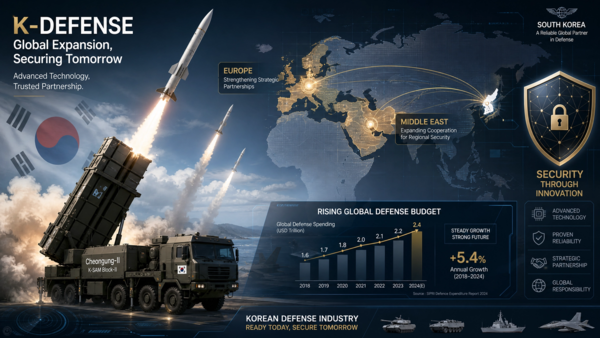
On the 28th, Seung-han Han, an analyst at SK Securities, recommended an “Overweight” position on the defense sector for the second half of 2026 in a research note. He argued that a global shift toward self-reliant national defense will drive structural growth in South Korea’s defense industry.
Han says that since the start of a potential second Trump administration, the U.S. has been moving to expand defense spending while geopolitical risks tied to Russia, China and Iran have deepened, accelerating a trend toward de-globalization. He noted that, historically, globalization was a short-lived exception tied to an era of hegemonic stability; the current environment prioritizes security and resilient supply chains.
Washington is reportedly pursuing a roughly 43% increase in its 2027 defense budget over this year’s level, targeting about $1.5 trillion (approximately 2,000 trillion KRW).
Following the Iran conflict that began in the first half of this year, demand across the Middle East for air- and missile-defense systems to counter ballistic missiles and drones surged. With global interceptor-missile production unable to keep pace, South Korean firms have stood out for faster delivery and competitive pricing, making them an attractive option for regional buyers.
Han assessed that major U.S. and European primes are facing extended lead times because of production constraints, while South Korean companies are meeting Middle Eastern demand for air-defense and interceptor systems through lower prices and quicker production turnarounds.
That dynamic increases the likelihood of additional export contracts for Korean systems such as Cheongung II and LSAM. The report urges treating progress in Iran cease-fire talks not as a sign of industry contraction but as an opening for significant budget execution and procurement.
He added that unless geopolitical risks are fully resolved, any cease-fire in the region will likely trigger active budget outlays for rearmament. Short-term investor pessimism after a cease-fire could therefore present buying opportunities at lower prices.
Indeed, since 2018 global defense spending has outpaced GDP growth, signaling a structural shift that is unlikely to reverse in the near term.
As European demand for conventional weapons converges with Middle Eastern demand for advanced air-defense systems, K-defense is strengthening its earnings base. Rapid budget execution in the Middle East and clearer export prospects for Cheongung II and LSAM should provide added share-price momentum for domestic defense contractors, Han emphasized.










Most Commented