
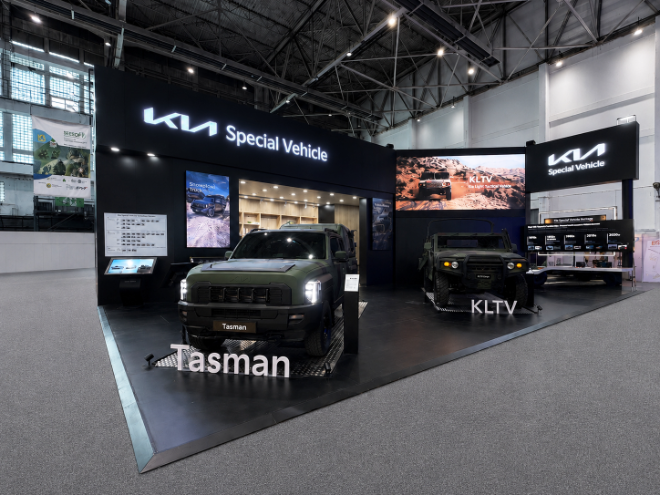
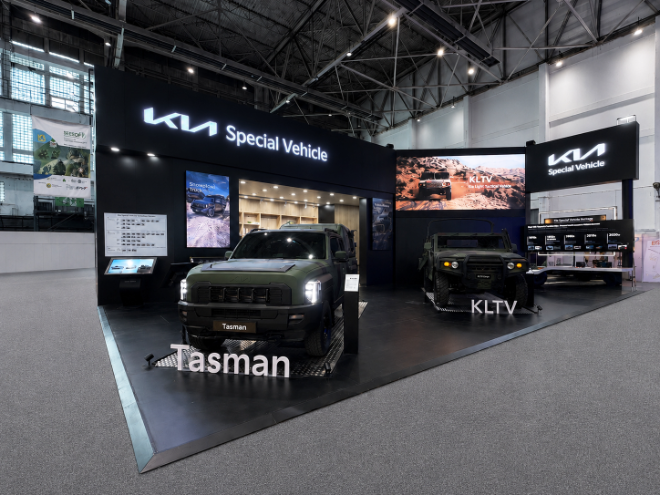
Kia booth at the BSDA defense exhibition in Romania. / Photo: Kia
Kia doubles down on defense, eyes Eastern Europe with the Tasman after Middle East push
Enlarge image
[Korea Financial News reporter Kim Jae-hoon] As Hyundai Motor Group moves to expand its defense business, Kia is pushing exports with its traditional pickup, the Tasman, as the centerpiece. Analysts say the Tasman’s pickup-based versatility fits modern battlefield needs, which increasingly call for not only combat vehicles like self-propelled guns but also transport, light tactical, and logistics platforms.
Kia plans to leverage years of small tactical vehicle experience along with proven conversion capabilities and fast delivery times to expand from the Middle East and Latin America into Eastern Europe. With established European OEMs such as Mercedes-Benz showing interest in defense programs, Kia believes it can gain a first-mover advantage in some segments.
Kia unveils Tasman command vehicle in Eastern Europe for the first time
Kia attended BSDA (Black Sea Defense, Aerospace & Security) 2026 in Bucharest, Romania, this month for the first time and unveiled the Tasman military command vehicle—its European debut.
Now in its 10th year, BSDA is one of the leading defense shows for Eastern Europe and the Black Sea region. This year, about 650 companies from 36 countries displayed advanced defense and aerospace technologies and equipment.
Kia’s Tasman command vehicle, shown in Europe for the first time, builds on the pickup’s off-road capability and its safety and comfort features. The company outfitted the vehicle with mission-specific gear such as military radios and lighting-control systems—measures designed to reduce enemy detection and enhance operational capability.
The platform entered service last year as the standard command vehicle for the Republic of Korea Armed Forces. Military evaluators have described it as a next-generation military vehicle that combines modern systems, durability, and driver-focused design.
Kia also displayed products already in service, including the two-seat cargo KLTV (Kia Light Tactical Vehicle), the next-generation KMTV (Kia Medium Tactical Vehicle), and the large Palletized Load System (PLS) for rapid loading, transport, and offload of heavy cargo.
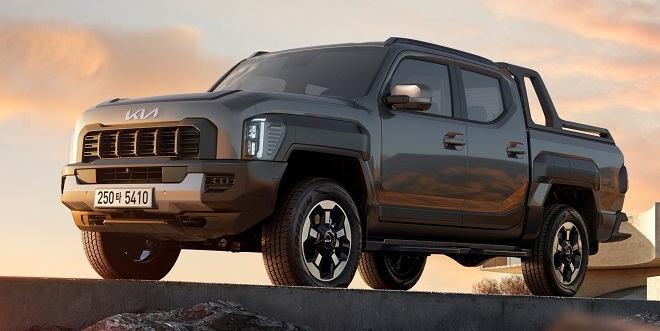
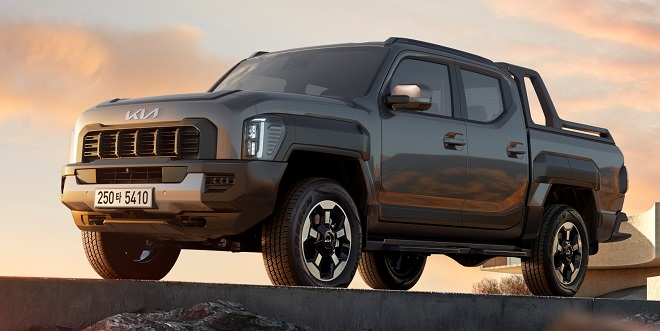
Kia’s first pickup truck, the Tasman. / Photo: Kia
Kia doubles down on defense, eyes Eastern Europe with the Tasman after Middle East push
Enlarge image
Kia aims to secure Eastern European contracts by emphasizing Tasman’s utility
Kia already exports tactical vehicles to roughly 30 countries across Latin America and elsewhere, led by its small tactical platforms. Its BSDA appearance signals a coordinated push to expand export markets this year. Eastern Europe, in particular, has accelerated military modernization centered on NATO since the Russia-Ukraine war.
Kia established a foothold in Eastern Europe in 2023 by exporting KLTVs to Poland. The deal reflected competitive pricing versus U.S., U.K., and German light tactical vehicles, combined with Kia’s technical competency and the mass-production and on-time delivery capabilities inherent to an OEM.
Modern warfare increasingly demands layered capabilities beyond offensive systems such as self-propelled guns and missiles. Militaries need transport trucks, light tactical vehicles, logistics platforms, drones, and special-mission architectures.
As a pickup-derived platform, the Tasman offers the multipurpose utility that modern operations call for. U.S. manufacturers such as GM already supply modified pickup-based vehicles to armed forces.
The Tasman-based command vehicle features a bull bar for protection, a snorkel for deep wading, and a tactical rack in the bed to secure equipment—enhancements that improve occupant safety and mobility in austere environments. The platform can be converted for command, cargo, tanker, or refrigerated logistics roles depending on mission requirements.
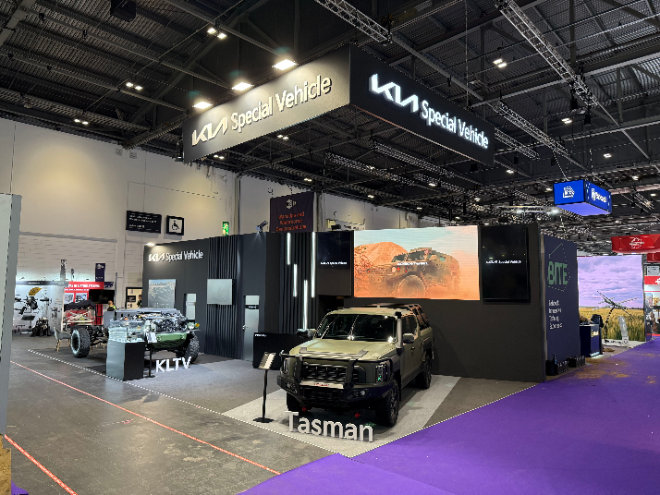
View of Kia’s exhibit at ‘DSEI UK 2025.’ / Photo: Kia
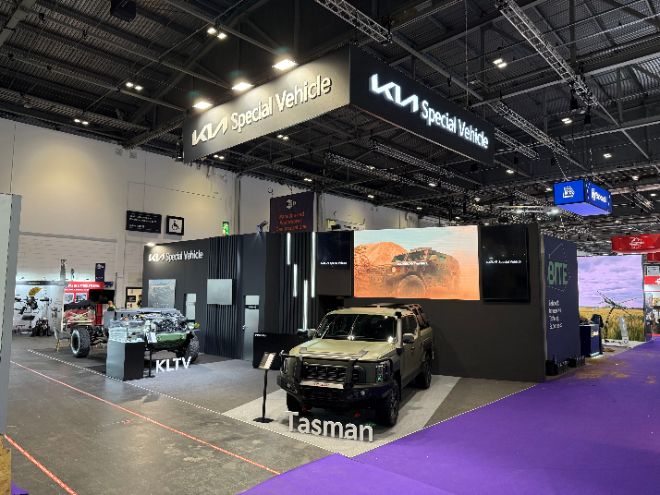
Kia doubles down on defense, eyes Eastern Europe with the Tasman after Middle East push
Enlarge image
Automakers pivot to defense — Kia brings five decades of military know-how
Defense has become an increasingly prominent sector for global automakers. Geopolitical pressures have accelerated military build-ups, and OEMs with past military production experience are drawing attention for their mass-production capacity. At the same time, armed forces are exploring software-driven mobility and other future systems.
Mercedes‑Benz CEO Ola Källenius recently told international media that the company could enter defense if it proves commercially viable. Mercedes already participates indirectly through Mercedes‑Benz Special Trucks under Daimler Truck, spun off in 2021.
Toyota, GM, and Jaguar Land Rover are among other global OEMs pursuing military vehicle production and defense contracts. Renault is developing military drones with French defense firm Turgis & Gaillard.
In Korea, Hyundai Motor Group and the Defense Ministry are collaborating on tactical vehicles, robots, drones, and urban air mobility (UAM) projects.
Hyundai Motor Group is also reviewing how best to align defense activities across affiliates such as Hyundai Rotem and Hyundai Wia to consolidate group capabilities.
Within Hyundai Motor Group, Kia is the longest-standing affiliate in defense work. Kia was designated a defense contractor in 1973, earlier than Hyundai Wia (1976) and Hyundai Rotem (1977).
In 1985, Kia established Korea’s first research center dedicated to special-purpose vehicles. Among automakers, Kia remains unique in combining tactical-vehicle operational expertise with a full-scale production system.
A Kia spokesperson said, “We already have more than 50 years of experience producing and operating military vehicles,” adding, “We will continue to advance a vision for military mobility that ensures safe movement for armed forces.”
Kim Jae-hoon, Korea Financial News reporter rlqm93@fntimes.com










Most Commented