
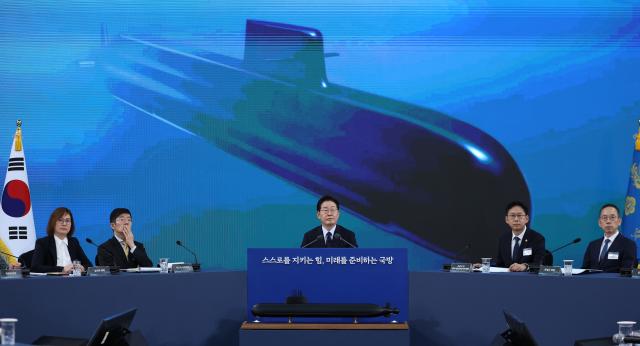
The unveiling of South Korea’s nuclear-powered submarine program—estimated in the tens of trillions of KRW (tens of billions of USD)—has ignited a fierce leadership contest between frontrunners Hanwha Ocean and HD Hyundai Heavy Industries. Hanwha Ocean grabbed the early advantage after winning the basic-design contract, while HD Hyundai is pushing back with a bid centered on small modular reactor (SMR) technology, the submarine’s propulsion core.
Shipbuilding and defense sources said Hanwha Ocean signed the basic-design contract with the Agency for Defense Development (ADD) in 2022. The government has branded the effort the Jangbogo‑N program, targeting the first hull’s launch in the mid-2030s and full operational capability by the late 2030s.
The plan calls for roughly three submarines around 8,000 metric tons each. It would be South Korea’s largest submarine program and comparable in scale to the U.S. Navy’s Virginia class, putting it among the world’s leading projects.
Considering U.S. nuclear-submarine development and construction costs, analysts estimate the Korean program will cost at least 20 trillion KRW (15 billion USD). If the effort extends beyond hull construction to include maintenance and repair (MRO), reactor and propulsion-system development, and follow-on production, the economic ripple effects could be substantial.
Only six countries—the United States, Russia, China, the United Kingdom, France and India—currently operate nuclear-powered submarines. By entering this field, which is central to global maritime power competition and a potential pillar of future K‑defense exports, South Korea has signaled its ambitions.
The government announcement has naturally focused industry attention on Hanwha Ocean and HD Hyundai Heavy Industries. Observers say Hanwha Ocean holds an early lead after signing the ADD basic-design contract. Basic design determines core elements—hull form, propulsion architecture and operational concepts—and will shape the program’s direction.
HD Hyundai is aiming for a turnaround in the detailed-design and construction phases, highlighting its in‑house SMR manufacturing capabilities as a key competitive edge.
Still, analysts expect the two companies will eventually need to cooperate. A nuclear‑powered submarine program integrates ultra‑complex technologies—from hull fabrication to reactor systems, combat systems and safety design—making it unlikely that a single firm could execute the entire program alone.
“This project consolidates national strategic technologies,” an industry source said. “Given the project’s scale and technical complexity, the government will likely step in to coordinate roles and marshal domestic shipbuilding and defense capabilities.”















Most Commented