
Translation result
Training one experienced F-35A pilot costs at least 6,170,000,000 KRW (≈$4.63M)… Air Force says it’s working to improve retention
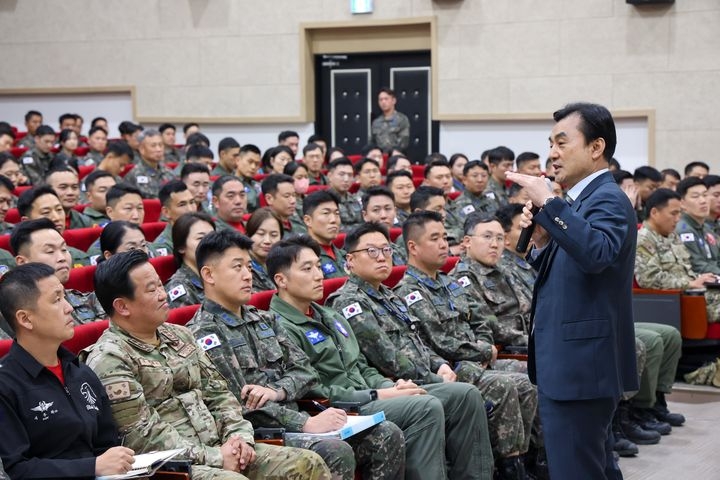 Over the past decade, the Republic of Korea Air Force has lost nearly 900 seasoned pilots to commercial carriers, signaling a serious personnel drain. Pay disparities and tough working conditions were cited most often as the reasons for leaving.
According to data the Air Force submitted on May 4 to Kang Dae-sik, a member of the National Assembly’s Defense Committee from the People Power Party, 896 experienced pilots voluntarily separated between 2017 and March of this year. The Air Force classifies “experienced pilots” as those with eight to 17 years of service who can conduct operations independently and train junior pilots — core operational personnel.
By platform, fighter pilots accounted for the bulk of departures with 730 leaving, followed by 148 transport pilots and 18 rotary‑wing pilots. Most of those who departed joined Korean Air — 622 pilots (69.4%) — with 147 (16.4%) moving to Asiana Airlines and 103 (11.5%) to low‑cost carriers.
Annual losses of experienced pilots typically exceeded 100, but they plunged to just seven in 2021 after the height of the COVID‑19 pandemic before rebounding. Through March of this year, 47 pilots have left the Air Force for commercial airlines.
Training an experienced pilot requires substantial investment. On average the Air Force spends more than 1,000,000,000 KRW (≈$750,000) per pilot on initial training. By platform, flight instruction and training costs are highest for the F‑35A at 6,170,000,000 KRW (≈$4.63M), followed by the F‑15K at 2,670,000,000 KRW (≈$2.00M), the (K)F‑16 at 1,840,000,000 KRW (≈$1.38M), the FA‑50 light attack at 1,630,000,000 KRW (≈$1.22M), and the C‑130J transport at 1,210,000,000 KRW (≈$0.91M). When aircraft operations, maintenance and other force‑readiness costs are included, the total per‑pilot training bill can climb into the range of several hundred hundred‑million KRW — roughly $7.5 million to $67.5 million.
The Air Force has relied on mandatory service obligations to curb losses, but the measure has had limited effect. Fixed‑wing pilots commissioned from the Air Force Academy are subject to a 15‑year service obligation; non‑academy pilots face a 10‑year obligation (13 years for those commissioned after 2015). The average service time for separated experienced pilots was 15.2 years for academy graduates and 10.6 years for non‑academy pilots, indicating many left as soon as their obligation ended.
Officials warn that continued departures could increase workload for remaining pilots and trigger a damaging cycle of attrition. In a service survey last year, pilots identified pay gaps with commercial airline pilots, stress from high‑risk missions and prolonged alert duties, and family strain from frequent reassignments as primary reasons for leaving. An Air Force official said, “We retooled retention measures last year — including raising incentives for extended service — and we continue working to improve pilots’ working conditions and compensation.”









Most Commented