
Is Bitcoin the New Power Projection Tool? Insights from US Military and Fed Chair Nominee
Daniel Kim Views
Translation result.
On the same day, the U.S. military’s top commander and a Federal Reserve nominee both signaled support for Bitcoin. That was no accident.
Power projection is a military term describing a nation’s ability to project economic, political and military influence beyond its borders. For the past century, the dollar has been America’s most effective tool of power projection. Last week in Washington, after taking the oath at a Senate hearing, a four‑star admiral put it bluntly.
Bitcoin is a tool of power projection.
That same day, at a separate hearing, the Fed chair nominee — who holds Bitcoin as a personal asset — appeared before senators and pledged to serve.
The military and the central bank don’t coordinate testimony. Yet both sent the same directional signal within hours.
Commander, is Bitcoin a national‑security asset?
Adm. Samuel Paparo, commander of U.S. Indo‑Pacific Command, testified last week before the Senate Armed Services Committee. He oversees the Indo‑Pacific theater and occupies a central role in U.S. military strategy. He put Bitcoin on the public record.
Bitcoin is valuable computer‑science technology as a tool of power projection. It has important applications in cybersecurity.
He went further, disclosing that INDOPACOM is running Bitcoin nodes to test military network security. This is not theoretical — it’s operational.
This is the first time an active U.S. combat commander has publicly described Bitcoin as a national‑security asset in congressional testimony.
Context matters. Think tanks linked to China’s central bank are reportedly circulating internal reports treating Bitcoin as a reserve asset. Both Washington and Beijing appear to be assessing Bitcoin’s strategic value. Paparo’s comments read less like a personal aside and more like a sign that Bitcoin already occupies a role inside U.S. national‑security calculations.
Portfolio of the Fed chair nominee
That same day, the Senate Banking Committee held a confirmation hearing for Kevin Warsh, President Trump’s nominee for Federal Reserve chair.
Warsh told senators he would defend the Fed’s independence while also signaling a regime change at the central bank: a smaller balance sheet, fewer policy meetings and a new inflation framework. Taken together, he sketched a fundamental redesign of conventional monetary policy.
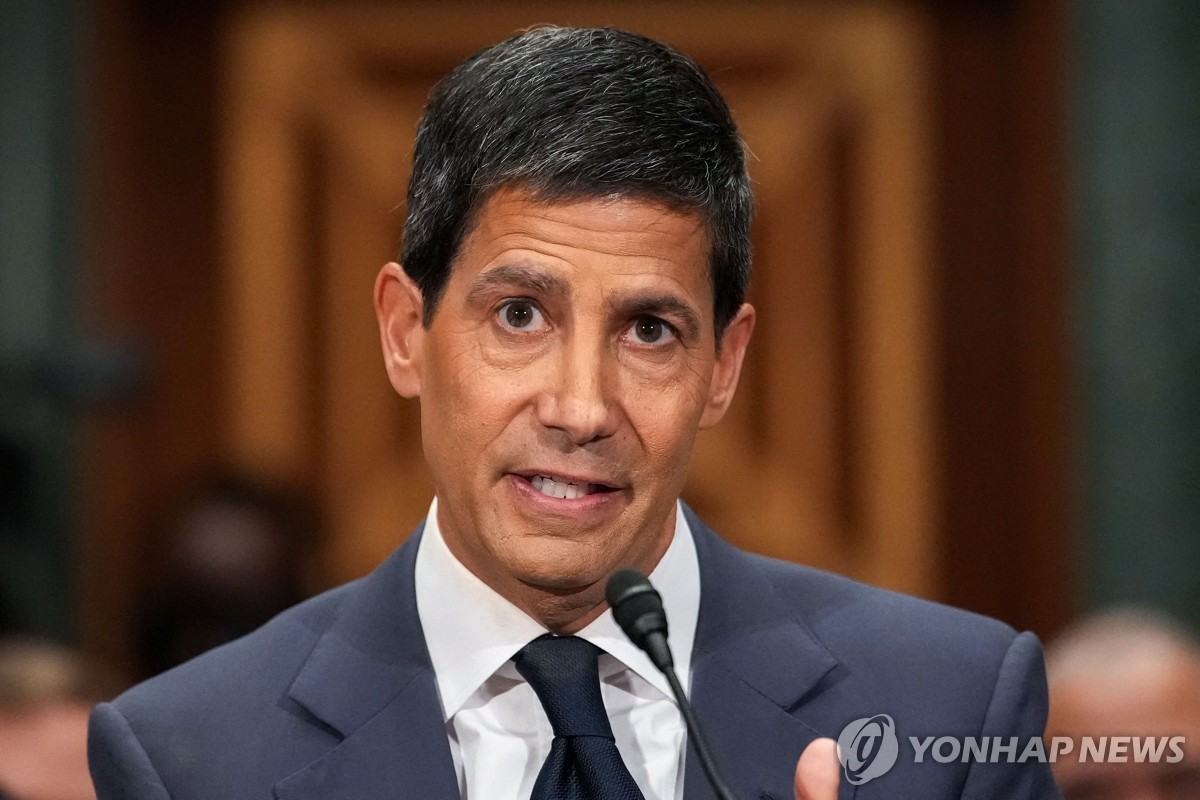
Warsh also brings an unprecedented personal background: he is the first Fed chair nominee known to hold a meaningful personal investment in Bitcoin. He has publicly compared Bitcoin to gold as a durable store of value.
The Fed has steadily eroded the dollar’s purchasing power over the past century. If a Fed chair who grasps Bitcoin’s monetary implications assumes the post, the cryptocurrency could become more deeply integrated into the U.S. financial system. That would change the playing field.
The downside of decentralization: two incidents in one week
The same week a senior commander identified Bitcoin as a national‑security asset, projects built on Ethereum that tout decentralization exposed a different reality.
The Arbitrum freeze
Arbitrum’s Security Council carried out an emergency on‑chain freeze tied to the KelpDAO bridge hack, locking 30,766 ETH — roughly 71 billion KRW (approximately $53.3 million) — at the request of law enforcement. A small group of insiders used a multisignature arrangement to control user funds.
The exploit connected to the incident amounted to about $292 million, and it helped trigger a $13.2 billion decline in DeFi’s total value locked (TVL).
Technically, dozens of insiders signing a multisig to move protocol‑level funds mirrors the operational model used by banks. Bitcoin has no admin keys, no foundation with intervention authority, and no committee that can freeze a specific UTXO (a unit of Bitcoin balance). That is Bitcoin’s defining difference.
Justin Sun and the lawsuit against the Trump‑linked crypto venture
Tron founder Justin Sun sued World Liberty Financial (WLFI) — a crypto venture tied to the Trump family — in U.S. federal court in California. Sun alleges WLFI froze his WLFI tokens, once valued at more than $1 billion, after he declined to make additional investments worth hundreds of millions of dollars. He claims WLFI quietly amended its rules to grant itself blacklist authority over token transfers. WLFI says the suit has no merit.
Whatever the legal outcome, the structural lesson mirrors Arbitrum’s: in crypto systems that include admin keys, foundations or multisigs, those authorities eventually get exercised — against strangers, former partners and even presidential associates.
Bitcoin adoption spreads worldwide
The same week saw several moves that underscore global Bitcoin adoption.
Russia’s State Duma passed a bill classifying Bitcoin as legal property by a 327–13 vote. State‑owned Sberbank said it will offer Bitcoin trading to its 110 million retail customers.
Uzbekistan created the Besqala Mining Valley by presidential decree, granting tax exemptions to licensed Bitcoin miners through 2035 in exchange for a monthly 1% fee.
In Japan, a 2026 survey by Nomura and Laser Digital found 79% of institutional investors plan to allocate to Bitcoin within three years.
In the U.K., three Bitcoin exchange‑traded notes (ETNs) became eligible for the Innovative Finance ISA, reopening a tax‑advantaged route for retail investors to gain Bitcoin exposure.
Global financial‑infrastructure firm Broadridge launched a Bitcoin platform for a Canadian asset manager on top of infrastructure that processes about $8 trillion per month.
Can AI make money obsolete?
The industry also debated a provocative claim this week: Elon Musk argued that AI and robotics could boost productivity so dramatically that governments could pay a universal high income without triggering inflation — and might even depress prices.
Economist Peter C. Earle countered that the argument, while intuitive, is structurally flawed.
Musk’s logic is simple: view inflation as dollars ÷ goods. If the denominator (goods) grows faster than the numerator (dollars), prices fall. But prices are not set by aggregate totals alone; relative prices form across sectors and decisions at the intersection of supply, demand and expectations. Those relative‑price signals coordinate what gets produced, when and how. Distorting them undermines the production structure.
A deeper problem is distribution. Newly issued money never reaches the whole economy uniformly or simultaneously. Money flows through particular channels — government transfers, banks and asset markets — and those closest to the faucet benefit first and most. Those farthest away effectively bear the cost. That is the Cantillon Effect, a concept Richard Cantillon formalized in the 1730s. No level of AI‑driven productivity eliminates it.
Bitcoin caps supply at 21 million coins. No one can mint new Bitcoin and distribute it through political networks. In a Bitcoin‑based economy, AI‑driven productivity gains would translate directly into purchasing power. Prices would decline, and those who postpone consumption would be rewarded.
If AI does deliver a dramatic leap in productive capacity, the only reliable way to ensure ordinary people share that prosperity is to anchor the economy to a currency no one can print.
Military strategy, central‑bank policy, DeFi failures and monetary theory — these threads are converging in the same direction.















Most Commented