Quick access to main page (top) Direct access to main contents Quick access to main page (bottom)

Taiwan’s Defense Budget: How U.S. Senate Visit Could Shape Military Strength Against China

Daniel Kim Views  

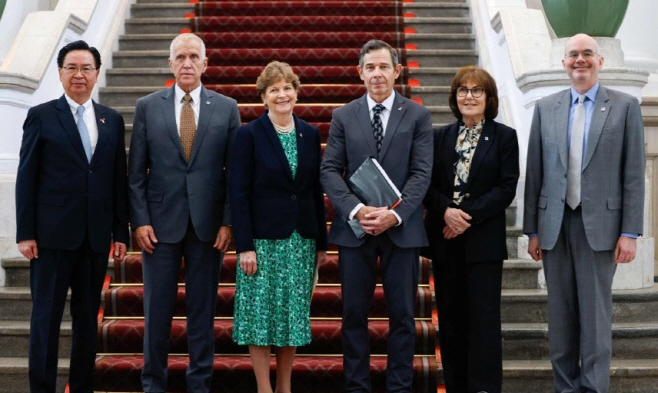
A U.S. Senate delegation met with Taiwan President Lai Ching‑te(賴淸德) on the 30th and urged Congress to quickly approve a special defense budget, warning that further delays could weaken Taiwan’s ability to deter growing Chinese military pressure.
U.S.
A U.S. Senate delegation arriving in Taipei. At far left is Wu Chao‑hsieh, secretary‑general of Taiwan’s National Security Council, who went to the airport to greet them. / Taiwan Lianhebao (聯合報).

According to Beijing sources familiar with cross‑Strait affairs, President Lai received a bipartisan U.S. Senate delegation led by Sen. Jeanne Shaheen (D) and Sen. John Curtis (R) at the presidential office on the 30th.

After the meeting, Sen. Curtis told reporters, “Passing Taiwan’s special defense budget matters greatly to me and my colleagues in Washington. While we are investing in this region, you are investing as well. We want to make clear that we stand together.”

The delegation also expressed concern about rising Chinese military pressure and reaffirmed U.S. support for Taiwan. Sen. Shaheen said, “We are worried about increasing pressure from China, including military activity around Taiwan that raises the risk of miscalculation.”

She added, “U.S. support for Taiwan remains strong and steady. Bipartisan backing for maintaining Taiwan’s defenses endures, and I hope the two sides deepen their cooperation.”

President Lai responded, “The special defense budget has undergone rigorous review. Public support at home exceeds 60 percent, but political factors have delayed the legislature’s consideration. Our government’s resolve and commitment to strengthen self‑defense and deepen cooperation with the United States to safeguard national security remain unchanged.”

He continued, “As authoritarian threats grow, the core tenet of national security is to enhance self‑defense, deepen security cooperation with allies such as the United States, and work to preserve peace and stability in the Taiwan Strait.”

The ruling Democratic Progressive Party drafted a Special National Defense Budget Act late last year worth NT$1.25 trillion (60 trillion KRW, about $45 billion).

The plan aims to build an air‑defense network dubbed “Taiwan’s Shield,” accelerate artificial‑intelligence systems, and strengthen non‑China supply chains. But the bill has stalled in the Legislative Yuan amid opposition from the Kuomintang, the main opposition party and current majority in the legislature, which argues the special defense budget would raise tensions in the Taiwan Strait.

The Senate delegation’s visit was the first since August of last year and carried added significance because it came ahead of U.S. President Donald Trump’s scheduled visit to China on May 14–15. If Taiwan feared U.S. support might waver around that trip, the visit was likely meant to address those concerns.

In December, the Trump administration approved a weapons sale to Taiwan worth $11.1 billion (about 14.8 trillion KRW). The administration is pursuing an additional weapons package of about $13 billion (about 17.3 trillion KRW), but it has been cautious about timing congressional notifications, reportedly delaying them out of consideration for the president’s China trip.

Daniel Kim
content@tenbizt.com

[Military] Latest Stories

  • 30 of 33 Iran Missile Bases Still Active: Intelligence Defies Trump Claims
    30 of 33 Iran Missile Bases Still Active: Intelligence Defies Trump Claims
  • US Javelin Missiles Deployed in Taiwan’s High-Stakes Live-Fire Drill
    US Javelin Missiles Deployed in Taiwan's High-Stakes Live-Fire Drill
  • North Korea’s 10-Year Nuclear Threat: Is a Limited Strike Imminent?
    North Korea's 10-Year Nuclear Threat: Is a Limited Strike Imminent?
  • AI vs. Video Compression: How RMX is Redefining Tactical Edge Tech
    AI vs. Video Compression: How RMX is Redefining Tactical Edge Tech
  • US-South Korea Security Meeting Sparks Tension Over Military Control
    US-South Korea Security Meeting Sparks Tension Over Military Control
  • Iran Claims Missile Strikes on U.S. Military Bases: Did They Hit?
    Iran Claims Missile Strikes on U.S. Military Bases: Did They Hit?

Weekly Best Articles

  • Choi Dong-seok’s Family Bond: How a Simple Engraving Reveals Deep Love for His Children
  • Kwak Sun-hee’s Stunning Wedding Photos: A Celebration of Love and Courage
  • Is ‘I Am a Natural Person’ Just a Big Lie? Comedian Yoon-taek Reveals Shocking Secrets!
  • Health Scare: Why Fans Are Worried About Go Ji Yong’s Dramatic Weight Loss
  • Discover the Winter Gongju Chestnut Festival: A Taste of Korea at H-Mart in the USA!
  • 2026 Spring Wildfire Prevention: How Gyeryong City is Cutting Response Time to 30 Minutes!

You May Also Like

  • 1
    Trump Slashes AI Review Window to 30 Days Amid National Security Debate

    Politics 

    Trump Slashes AI Review Window to 30 Days Amid National Security Debate
  • 2
    Ukraine’s EU Bid Surges as Hungary Drops Opposition Amid Russian Attacks

    Politics 

    Ukraine’s EU Bid Surges as Hungary Drops Opposition Amid Russian Attacks
  • 3
    Trump Backs Colombia's 'El Tigre' — What It Means for U.S. Relations

    Politics 

    Trump Backs Colombia’s ‘El Tigre’ — What It Means for U.S. Relations
  • 4
    Trump Backs Colombia's Far-Right Outsider—What's at Stake?

    Politics 

    Trump Backs Colombia’s Far-Right Outsider—What’s at Stake?
  • 5
    12.5% Tariff Hit: South Korea Faces New U.S. Trade Penalties

    Politics 

    12.5% Tariff Hit: South Korea Faces New U.S. Trade Penalties

Popular Now

  • 1
    12.5% Tariff Alert: Why the U.S. Is Targeting South Korean Imports

    Politics&nbsp

  • 2
    Marta Kostyuk Makes History at French Open Amid Ukraine Crisis

    Politics&nbsp

  • 3
    37 Years in Exile: The Tiananmen Leader Who Just Wants to Go Home

    Politics&nbsp

  • 4
    South Korea's Cheongju Airport Faces Crisis as Passenger Numbers Explode

    Politics&nbsp

  • 5
    Nuclear Submarine Race: South Korea's High-Stakes Bid for U.S. Fuel

    Politics&nbsp

Weekly Best Articles

  • Choi Dong-seok’s Family Bond: How a Simple Engraving Reveals Deep Love for His Children
  • Kwak Sun-hee’s Stunning Wedding Photos: A Celebration of Love and Courage
  • Is ‘I Am a Natural Person’ Just a Big Lie? Comedian Yoon-taek Reveals Shocking Secrets!
  • Health Scare: Why Fans Are Worried About Go Ji Yong’s Dramatic Weight Loss
  • Discover the Winter Gongju Chestnut Festival: A Taste of Korea at H-Mart in the USA!
  • 2026 Spring Wildfire Prevention: How Gyeryong City is Cutting Response Time to 30 Minutes!

Must-Reads

  • 1
    Trump Slashes AI Review Window to 30 Days Amid National Security Debate

    Politics 

    Trump Slashes AI Review Window to 30 Days Amid National Security Debate
  • 2
    Ukraine’s EU Bid Surges as Hungary Drops Opposition Amid Russian Attacks

    Politics 

    Ukraine’s EU Bid Surges as Hungary Drops Opposition Amid Russian Attacks
  • 3
    Trump Backs Colombia's 'El Tigre' — What It Means for U.S. Relations

    Politics 

    Trump Backs Colombia’s ‘El Tigre’ — What It Means for U.S. Relations
  • 4
    Trump Backs Colombia's Far-Right Outsider—What's at Stake?

    Politics 

    Trump Backs Colombia’s Far-Right Outsider—What’s at Stake?
  • 5
    12.5% Tariff Hit: South Korea Faces New U.S. Trade Penalties

    Politics 

    12.5% Tariff Hit: South Korea Faces New U.S. Trade Penalties

Popular Now

  • 1
    12.5% Tariff Alert: Why the U.S. Is Targeting South Korean Imports

    Politics 

  • 2
    Marta Kostyuk Makes History at French Open Amid Ukraine Crisis

    Politics 

  • 3
    37 Years in Exile: The Tiananmen Leader Who Just Wants to Go Home

    Politics 

  • 4
    South Korea's Cheongju Airport Faces Crisis as Passenger Numbers Explode

    Politics 

  • 5
    Nuclear Submarine Race: South Korea's High-Stakes Bid for U.S. Fuel

    Politics