
Peace Over Conflict: President Lee’s Vision for a United Korea on the 11th West Sea Defense Day
Daniel Kim Views
Translation result.
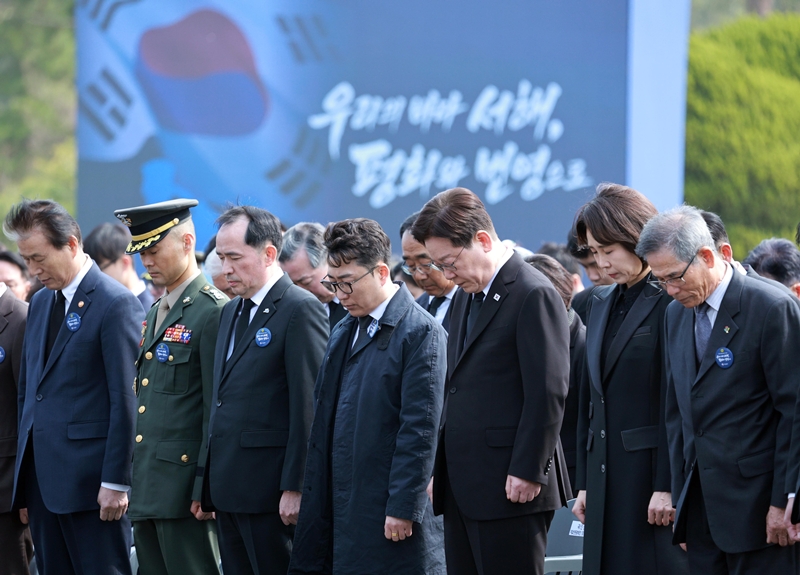
SisaWeek reporter Kwon Sin-gu On March 27, at the 11th West Sea Defense Day ceremony, President Lee Jae-myung honored the 55 service members who gave their lives defending the nation in his commemorative address. He called for proper honors for those \”special sacrifices\” and pledged that the government would fulfill its responsibilities to the community. He also vowed to pursue a lasting record of peace and prosperity so those sacrifices are not in vain.
Terms emphasized by the previous administration — notably \”North Korea\” and \”provocation\” — were absent. Instead, the speech repeatedly returned to the word \”peace.\” Observers say that, replacing the conservative emphasis on strong deterrence, President Lee underscored the need to build a peace that wins without fighting — a state in which combat is unnecessary.
At the ceremony at Daejeon National Cemetery, Lee said, \”Winning by fighting is important. Winning without fighting is more important.\” He added, \”More important than both is a peace that makes fighting unnecessary.\” He pledged, \”We will do everything possible to end an era of confrontation and tension in the West Sea and to write a new history of shared growth and prosperity.\”
That emphasis ran throughout his address. Using the Korea Press Foundation’s BigKinds data service for a morphological analysis of the speech, analysts found Lee used the word \”peace\” eight times. Aside from terms that naturally recur at this ceremony — \”West Sea\” (11 mentions), \”Republic of Korea\” (10 mentions), and \”people\” (10 mentions) — \”peace\” was the most frequently used value-laden term, underscoring his renewed focus on peace on the Korean Peninsula.
◇ Promise of special compensation for special sacrifices
The tone marked a clear break with previous administrations’ addresses. When President Yoon Suk Yeol attended the 8th West Sea Defense Day in 2023, he issued a hardline message: \”North Korea’s reckless provocations must pay a price.\” He used the words \”North Korea\” and \”provocation\” six times each. Aside from \”West Sea\” (10 mentions) and \”people\” (8 mentions), those were the most repeated terms. The 2024 address at the 9th ceremony similarly featured words such as \”North Korea\” (7), \”security\” (7), \”provocation\” (6), and \”threat\” (5).
That difference in tone reflects each administration’s security outlook. The prior government emphasized a tough response to North Korean provocations and framed policy around defending freedom. President Lee has emphasized community values rooted in peace. His description of the West Sea as \”the frontline of the homeland\” while also calling it \”the people’s sea\” highlights that approach.
He praised those who served the country as heroes regardless of political stripe, using the word \”heroes\” seven times. \”We must never forget that the freedom, peace and prosperity we enjoy today rest on special sacrifices made for the community,\” he said. He promised appropriate honors and stressed a principle of \”special compensation for special sacrifices,\” citing measures such as livelihood support payments for veterans’ spouses and expanding the number of veterans-contracted medical institutions to 2,000.
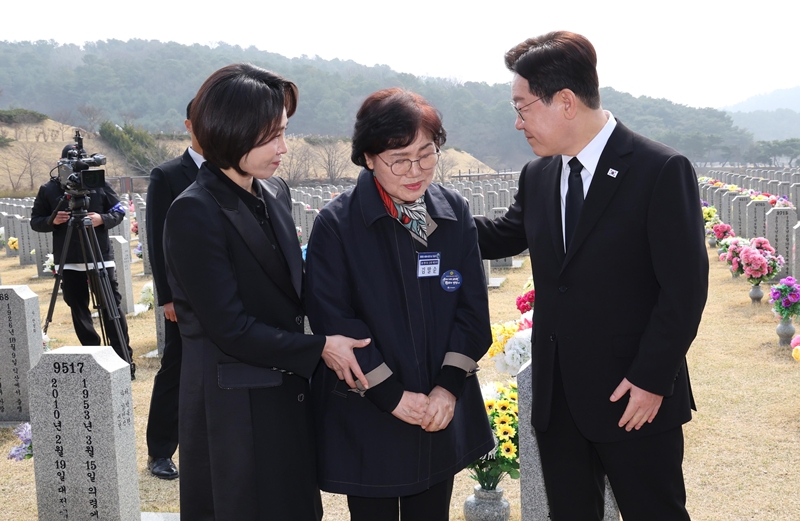
Before the ceremony, the president and the first lady visited memorial sites for the Second Battle of Yeonpyeong, the Yeonpyeong Island shelling, and the Cheonan victims, laying wreaths and paying respects. Lee met the mother of the late Sergeant Seo Jeong-woo, who died in the Yeonpyeong shelling, and offered comfort: \”The most important thing is that this never happens again.\” He also met the father of the late Corporal Park Jeong-hoon, killed in the Cheonan sinking, who asked, \”What our families want is to preserve our loved ones’ honor. Please protect that.\” Lee replied, \”We will ensure that.\”









Most Commented