
DX KOREA 2026: What You Need to Know About the Future of Predictive Maintenance in Defense
Daniel Kim Views
Translation result.
|
Battle outcomes no longer hinge on sheer inventory. Operational availability — how long and how reliably systems can be kept in service — has become the defining element of combat power.
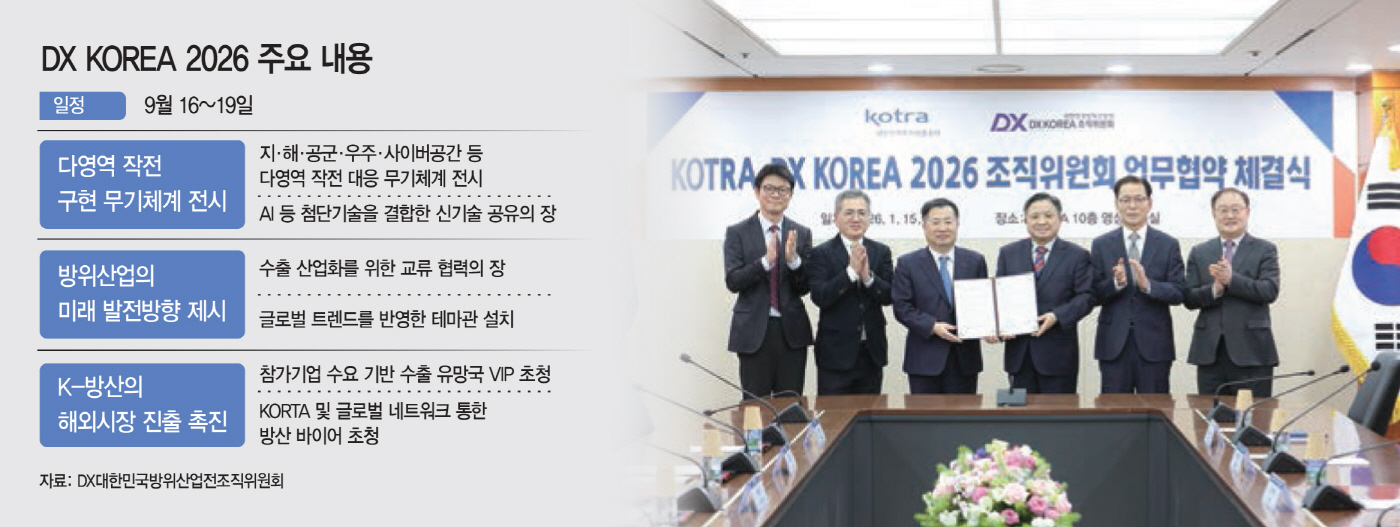
Against that backdrop, DX KOREA 2026, Korea’s defense industry exhibition, is putting maintenance, repair and overhaul (MRO) — the \”invisible\” force-multiplier — front and center. On March 26, organizers announced a special AI-based Defense MRO pavilion to showcase an integrated future military logistics support system.
The core shift is from reactive repairs after failure to proactive prediction. Traditionally, military logistics has been reactive—fixing systems after they break. Going forward, armed forces will use AI and data to spot likely failures before they occur and to manage equipment lifecycles, ushering in predictive, condition-based sustainment. That isn’t merely an efficiency gain; it alters the fundamentals of force sustainment.
At the center is Predictive Health Monitoring (PHM), which combines AI, big data and digital twins. By analyzing telemetry and sensor data, PHM can flag anomalies early and recommend maintenance timing and procedures automatically. When tied to lifecycle management (LM), these tools can sharply boost system availability. The approach shifts the logic from \”repair when it breaks\” to \”prevent failure before it happens.\”
DX KOREA 2026 will consolidate the full logistics spectrum. The exhibit links defense policy and sustainment architectures; platform and subsystem repair techniques; AI-driven maintenance innovation; remote servicing enabled by digital twins and AR/VR; robotics and automation; on-demand 3D-printed parts production; and global MRO cooperation networks across the entire lifecycle.
The goal is a cross-domain maintenance ecosystem that covers land, sea and air.
Participation has broadened beyond prime contractors to include midsize and small firms, startups and research institutes, many showing fielded applications and emerging technologies. That shift signals logistics is becoming an industrial-ecosystem competition rather than a contest between individual suppliers.
Notably, the pavilion stresses full-lifecycle MRO: a single framework linking force operations, sustainment, performance upgrades and life extension. Analysts say that architecture is key to delivering the persistent, uninterrupted capability future battlefields will demand.
On site, the event aims to generate real business, not just displays. Military officials and global buyers will hold one-on-one meetings while concurrent seminars on MRO policy and technology promote tech exchange and export negotiations.
Military leaders and defense buyers from roughly 50 countries are expected to attend, offering participating companies a springboard for global expansion.
The event runs from Sept. 16 at KINTEX in Ilsan, Gyeonggi Province, South Korea. KINTEX’s capacity for heavy-equipment displays and outdoor demonstrations, its proximity to the Seoul metro area and its links to Incheon International Airport are assets for attracting overseas buyers.
The exhibition’s message is clear: battlefield success will hinge less on the weapons themselves and more on the sustainment capabilities that keep them operational.
AI-based MRO is fast becoming a strategic necessity. DX KOREA 2026 will test whether South Korea’s defense sector can move beyond exporting hardware to selling integrated operations and sustainment systems.











Most Commented