
Translation result.
[Sports Seoul | Reporter Kim Hyun-deok] K-content’s next major export is the Korean language. As dramas, variety shows and K-pop travel the globe, the language is traveling with them. Where viewers once relied on subtitles to follow Korean dramas, many now study the language so they can turn those subtitles off.
Learning Korean has moved beyond a niche hobby among devoted fan communities. It has become an extension of content consumption and a growing pillar of the Hallyu industry. Terms such as oppa, unnie, maknae, sunbae, nunchi and jeong resist simple translation.
Those words often encode relationships and feelings before literal meaning. That is a major reason international viewers choose to learn Korean: they want to grasp the content more precisely. That desire — to better understand nuance — drives language study.
The change begins with the content itself. Overseas fans replay memorable lines from dramas, imitate an actor’s delivery, read variety show captions closely and watch idols’ live broadcasts. They look for subtleties that translations miss. In this way, Korean slips out from the screen into everyday practice.
K-dramas, above all, have become an especially effective classroom for learners. A single drama exposes viewers to everyday speech, honorifics, casual forms, workplace language, family terms and expressions of romance. Short phrases like “Have you eaten?” (bap meogeosseoyo?), “Thanks for your hard work” (gosaenghaesseo) and “Are you okay?” (gwaenchanh-a?) carry cultural tone. Literally translated they may seem ordinary, but in context they can change the emotional temperature of a relationship. International viewers want to learn those distinctions.
“Overseas fans no longer just consume a plot,” a broadcaster said. “They study an actor’s speech, the rhythm of lines and emotions that don’t transfer well to subtitles. Learning Korean is a natural expansion for fandoms that want to engage more deeply with K-content.”
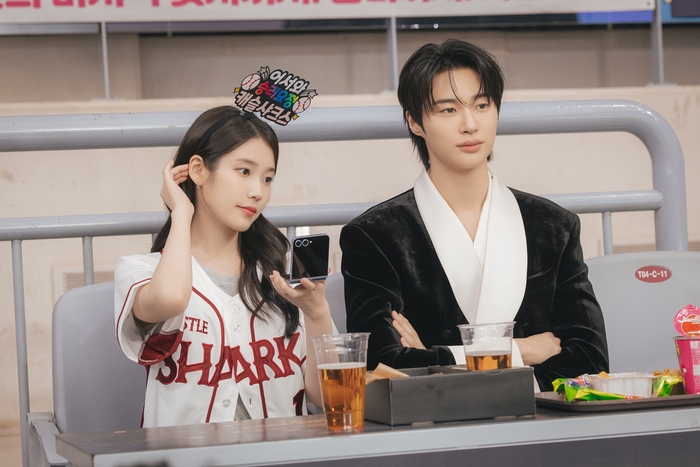
The data reflect that shift. The Ministry of Culture, Sports and Tourism and the Korea Foundation for International Cultural Exchange reported in the “2026 Overseas Hallyu Survey” that people who experienced Hallyu in 2025 spent an average of 14.7 hours per month consuming Korean cultural content — up 0.7 hours from the previous year.
By category, time spent learning the Korean language led the list at 23.8 hours. Excluding language study, viewers spent 18.3 hours on dramas, 17.7 hours on variety shows and 16.8 hours on games. Spending on Korean language study was also high — 29.3 USD (approximately 39,067 KRW) — ranking just behind fashion and beauty.
Those figures matter because they show Hallyu consumption no longer ends with passive viewing. Fans move from watching dramas to actively learning the phrases and expressions they hear. Korean has become both a tool for understanding Hallyu and a form of content in its own right.
This pattern will be familiar to Korean viewers. Many once learned English by repeatedly watching American TV shows. Series such as Friends, Modern Family and The Big Bang Theory served as informal language textbooks. Viewers turned on subtitles, repeated dialogue, memorized common expressions and mimicked characters’ speech and intonation. Television felt less rigid than a textbook and provided phrases closer to everyday conversation.
The way international fans learn Korean through K-dramas resembles that model, but in reverse. Where Koreans once picked up English from U.S. shows, international audiences now learn Korean language and Korean-style social norms from dramas, variety programs and idol content. Hallyu is reshaping not only what content moves across borders but the direction of language learning itself.
K-content no longer exports only images. It exports speech patterns, forms of address, emotional expression and the grammar of relationships. Overseas viewers use Korean to deepen their understanding of works and to feel closer to Korean culture. We’re living in an era when people learn Korean by watching dramas — and the next expansion of Hallyu begins with language. khd9987@sportsseoul.com












Most Commented