
Translation result

Google announced an update intended to make it easier for users to find trusted sources and higher-quality material within AI Search.
On May 27 (local time), the company added a \”Preferred Sources\” option that lets users pin favored websites in AI Overview and AI Mode.
If users open Search settings and register media outlets or blogs they visit or trust under Source preferences, AI-generated answers will prioritize links from those sites.
Google said early tests showed users were more than twice as likely to follow links marked as preferred sources than ordinary links, and that more than 345,000 unique sources have been registered so far.
The company also introduced a carousel-style collection of links to present multiple perspectives on a topic.
For searches like \”Super El Niño,\” the AI will provide a concise contextual summary alongside a carousel of recent, reliable reports and in-depth analyses. Google says it plans to add carousels that surface views from online forums, communities and social media in the future.
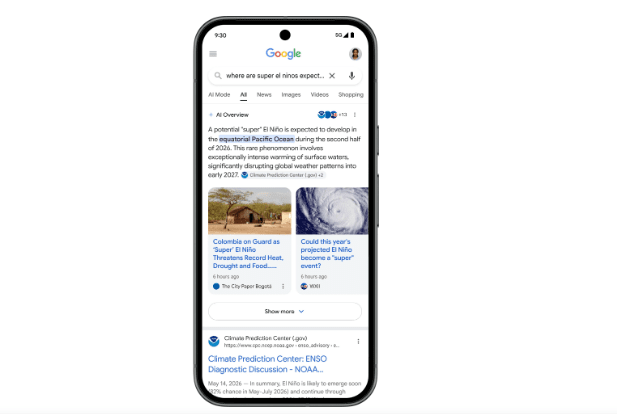
Google also rolled out a new \”Highly Cited\” badge to flag influential reporting. The label is applied automatically to links for web articles that other outlets or pieces cite frequently. The company says the badge should help readers identify which articles represent original sourcing or the most impactful coverage among similar stories.
Duncan Osborne, Google’s search product manager, said, \”This update helps users explore trusted sources, creators’ content and first‑hand perspectives in search results with greater confidence. We’ll continue to innovate to better connect high‑quality content across the web.\”
Separately, Google addressed an issue users reported last week involving the search term disregard. The Verge reports that, since the 29th, typing that word returns standard search results rather than an AI overview.
Previously, when users entered terms such as ignore, quit, stop, look or forget, the AI sometimes treated them as commands and responded in a chatbot-like way with messages such as \”Understood. Let me know if you need anything else.\” In effect, the search service had lost some of its conventional dictionary-like behavior for certain words.
Reporter Dae-jun Lim ydj@aitimes.com














Most Commented