
Translation result
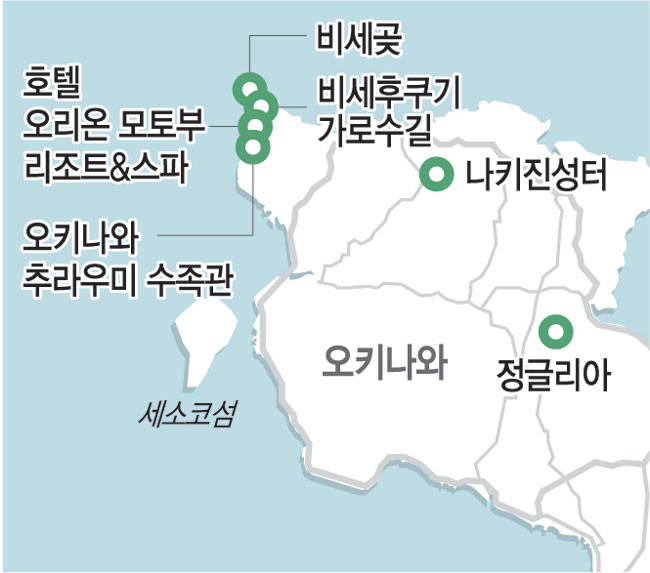
Bise Village, Motobu Peninsula, northern Okinawa
Fukugi trees planted to block wind and waves
A cozy, picture-perfect forest tucked between alleys and houses
An emerald-green tunnel of dense foliage with hidden cafés and souvenir shops
At the end: an emerald coral-reef sea
Resort-style theme park Junglia
A dinosaur paradise in a subtropical evergreen forest
Missions and jeep escape experiences
Kids go absolutely wild with excitement
Bird‑nest dining, an infinity spa, a hot-air balloon — full of analog charm
 Kunigami (Kunigami, Okinawa) = Text & photos by Park Kyung-il, senior correspondent
# Sea scenes I saw in Okinawa
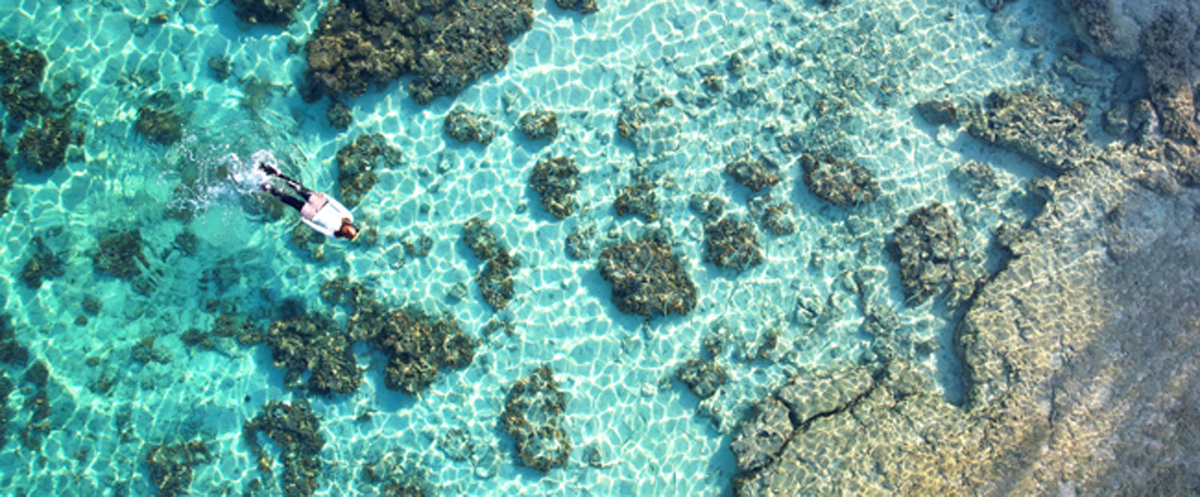
I only caught a true view of Okinawa’s emerald sea once — the morning after I arrived. The sunlight pierced down through cobalt water so clearly that the boats on the surface looked like they were floating in midair. It was the kind of tropical sea that stops you in your tracks.
That afternoon rain began, and it didn’t let up for more than three days. They called it an early rainy season. Rain ran through most of the itinerary, and on the day I left a torrential downpour hit.
That brief morning by the sea felt ecstatic and left me wanting more. The memory of the dazzling sun and the ocean scene lingered long after.
Rainy weather at a sun-and-sea getaway feels like an unexpected setback — something travelers can rarely control, especially on overseas trips booked weeks in advance.
Rain also pushes you off the usual tourist path. Certain things reveal themselves only on clear days; others appear only in the rain. Okinawa under a downpour is a different place than Okinawa under bright sun. Same island, different trip.
While I missed more time with the blinding ocean, the rain revealed scenes I wouldn’t have seen otherwise.
Darkened, rain-soaked stone walls; the steady drip from rooftop eaves; the scent of wet stone paths; the hush of emptied alleys; the languid market streets of a rainy afternoon — these are moments sunny travelers often overlook.
Between the bright-morning sea, the rainy alleys I wandered, the painful history hidden behind resort façades, and a subtropical evergreen forest now home to a theme park, I saw many faces of Okinawa. And I have rain to thank — or blame — for that.
 # Walking a green tunnel under a tropical sun
The Motobu Peninsula sits in northern Okinawa, where few tourists venture. The kanji 本部 reads “Motobu”; I briefly wondered if it once held a wartime headquarters. In fact, the name dates back to the Ryukyu Kingdom, long before Japan’s annexation.
At the peninsula’s tip is Bise Village, famous for its fukugi tree-lined streets. On that morning after I arrived, I found the brilliant tropical sun and emerald sea here.
Bise’s fukugi trees are subtropical evergreens with dense branches and glossy, palm-sized leaves. They’re related to mangosteen species you won’t find growing on the Korean mainland.
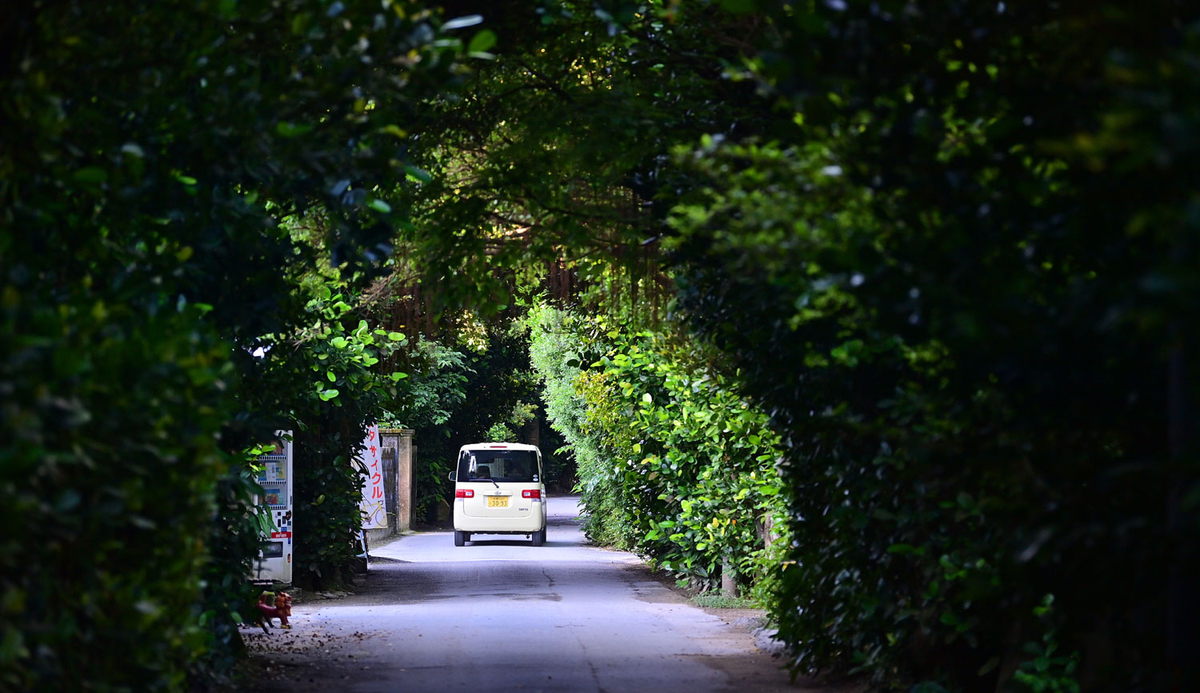
In Okinawa, locals plant fukugi along the coast to shield villages from wind and waves. In Bise, the trees were sown in a grid between alleys and houses to block tides, sandstorms, and wave damage. Today the grove numbers about 20,000 trees.
Villagers began planting them roughly 300 years ago. The coastal rows grew into a living seawall, while trees facing each other in the lanes formed deep, almost endless forest tunnels.
Those tunnels make perfect walking routes. Tucked into the green you’ll find pension-style lodgings, simple souvenir shops, and atmospheric cafés. The tree-lined streets feel so romantic that just walking them seems to leave a refreshing green trace on you.
The village alleys open onto a headland jutting into the northern sea — Bisezaki. On the coral-reef shore, a monument honors a folk song. It’s not an ancient ballad; the song was recorded in 1974. The lyrics, written by a poet from the area, capture the village’s charm and the tender feelings of its people.
 # The unreal sea at Bisezaki
More striking to me than the song’s words was an inscription on the monument’s base explaining why villagers erected it.
Bise looks beautiful today, but it used to be barren, abandoned land. There were no mountains, no rivers, little wood or fresh water, and in summer typhoons; in winter, cold north winds and sandstorms made life harsh.
Those handsome tree avenues began as small prayers planted sapling by sapling — each tree set into the sandy soil to protect the village from typhoons and erosion. The thick fukugi groves are a living record of centuries of tears and sweat — survival itself.
Bise’s story isn’t unique. Okinawa’s past is layered with pain and sorrow; few places there escaped grief.
Okinawa is beautiful, but that beauty carried a steep price. Traveling with awareness of that cost is different from traveling without it. I’ll share more of the island’s stories beyond the resorts and tourist sites next time.
Standing on Bisezaki alone makes you gasp — the sea’s color felt one-of-a-kind. Early one morning a middle-school girl surfaced from snorkeling in the shallow water off the cape. She said she’d come out simply because the water looked dazzling that day. Living with such a sea lets you enjoy it like that — almost unreal.
Bise has other small draws: coral-built stone walls, twin “married” trees whose trunks grow together, and a 350-year-old katafana tree locals call the “tropical diamond.” Still, Bise remains relatively unknown because it lies in Okinawa’s less-visited north.
 # Junglia: an immersive narrative theme park
A new-concept theme park called Junglia opened in northern Okinawa last July. It’s a sharp departure from the parks we usually see.
If Tokyo Disneyland or Universal Studios Japan are built for day-trippers in urban settings, Junglia aims to be a resort — a resort-style park. I’ll explain the difference later, but first, where they put it matters.
Junglia sits adjacent to Yanbaru National Park, a UNESCO natural heritage site since 2021. Yanbaru made the list not only because of its well-preserved ecosystem and endemic species like the flightless Yanbaru rail, but also because of the role people played in conserving it. That surprised me.
When you imagine “natural heritage,” you picture untouched wilderness. But Yanbaru’s listing credits centuries of human stewardship. From the Ryukyu Kingdom onward, local communities managed the forest, supplying charcoal and timber to central and southern Okinawa while avoiding reckless exploitation. Long-term human practices helped maintain the ecosystem — and UNESCO recognized that.
Junglia seems to carry forward that Ryukyuan attitude toward forests. The park’s design emphasizes “90% nature, 10% facilities.” They’ve also set aside a 200,000 m² green belt to protect wildlife.
The park even reclaimed part of an old golf course and is restoring sections back to forest. I emphasize Yanbaru’s background because when you visit Junglia, don’t just see the attractions — look at the forest. That intent is visible in the park’s Horizon Balloon. Daisuke Sato, vice president of Japan Entertainment, keeps reminding visitors to enjoy both the thrills and the unique nature that surrounds them.
# Analog, immersive dinosaur experiences
Junglia’s attractions also differ from U.S.-style urban parks. While many city parks push advanced digital tech like VR and simulators, Junglia favors raw, analog sensations.
Beyond the balloon, the treetop zip line “Sky Phoenix” and the rope-and-plank adventure “Treetop Trekking” offer hands-on thrills. The goal isn’t to manufacture fake urban sensations; it’s to let guests feel wind, sun, temperature, and texture out in clean nature.
To make fakes feel real often requires exaggeration and overstimulation. The real thing tends toward understatement — which is why Junglia can feel relatively low-stimulation compared with other parks.
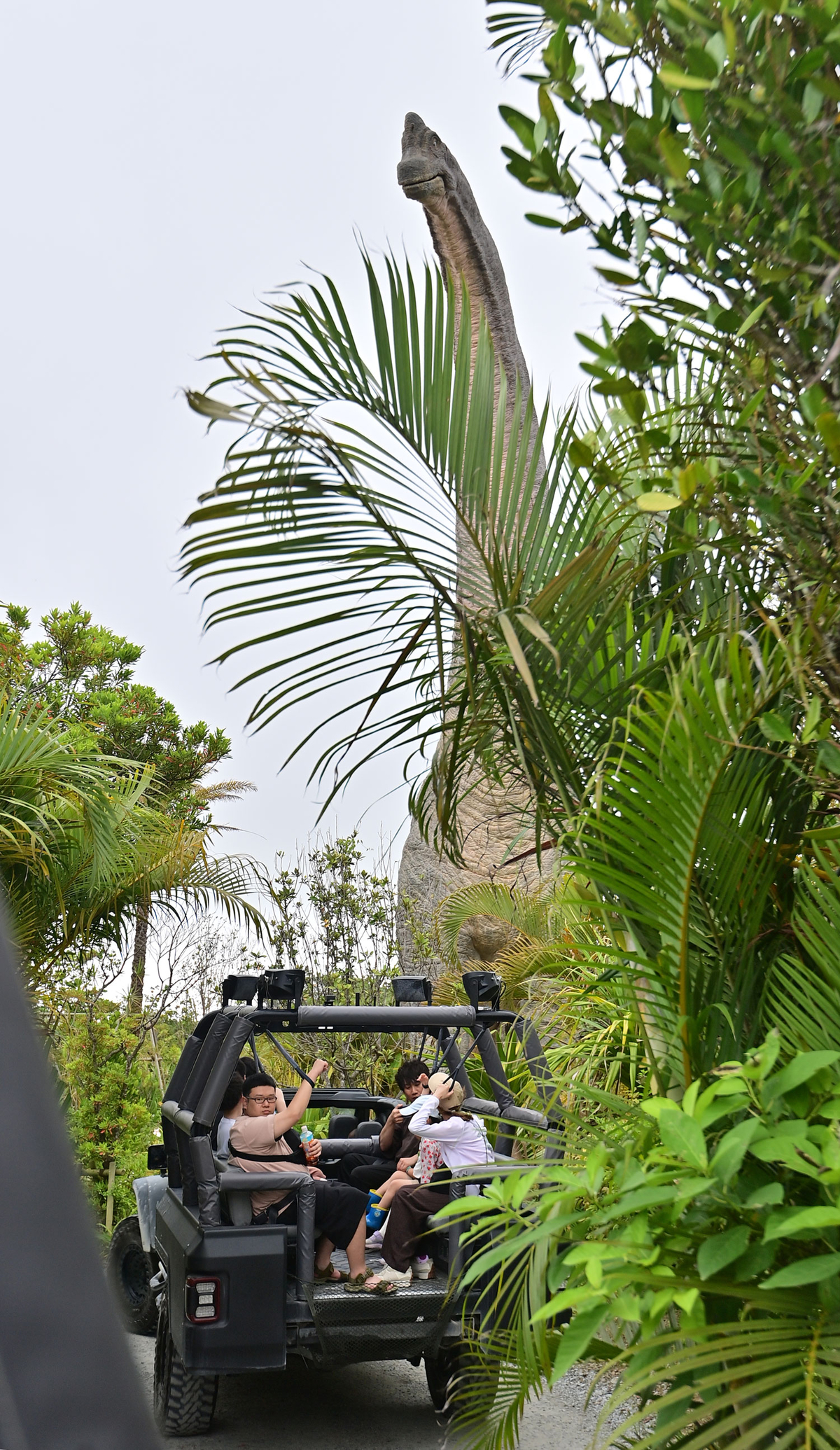
Junglia pursues two things at once: excitement and luxury/relaxation. It largely leaves thrills to its dinosaurs. The lifelike recreations overwhelm visitors by scale alone. As you enter, a colossal sauropod lifts its head above the tall trees; even from a distance, your heart races.
The park offers two dinosaur attractions. “Finding Dinosaur” gives visitors a mission to search the forest for baby dinosaurs — a story-driven, gentler experience. “Dinosaur Safari” ramps up intensity: you ride in a jeep-like vehicle through the tropical forest to confront aggressive predators. Both drop guests into an overwhelmingly realistic ecological setting, creating different experiences depending on how each person engages — classic immersive content.
# The looks on children’s and parents’ faces
The dinosaurs are very well made, but they rarely feel truly alive — not because of craftsmanship, but because we’re so used to “fake dinosaurs” from films and CGI.
Adults focus on how convincingly the park recreates ancient life. But for kids in that “dinosaur-loving” phase, hunting baby dinosaurs or being chased by carnivores is wildly thrilling — a heart-stopping moment.
The dinosaur attractions aim squarely at that excitement for children and at parents who want to give their kids those moments.
If dinosaurs deliver the thrills, Junglia’s luxury-and-relaxation side centers on the spa. “Spa Junglia” operates like a traditional bathing facility. In many resort spas in Japan, guests wear swimsuits, but Spa Junglia follows the traditional bathing style: separate men’s and women’s baths where you wash and soak unclothed.
Spa Junglia has several indoor and outdoor baths. Even the “infinity spa” is a proper bath rather than a swimsuit pool. An open-air onsen bath that faces the subtropical evergreen forest is a singular experience.
The spa isn’t enormous, but it’s comfortably sized. In peak season it could feel crowded; at the moment I visited it was pleasantly uncrowded. Given Okinawa’s mild winters, this scale feels appropriate.
# A “Made in Japan” theme park experiment
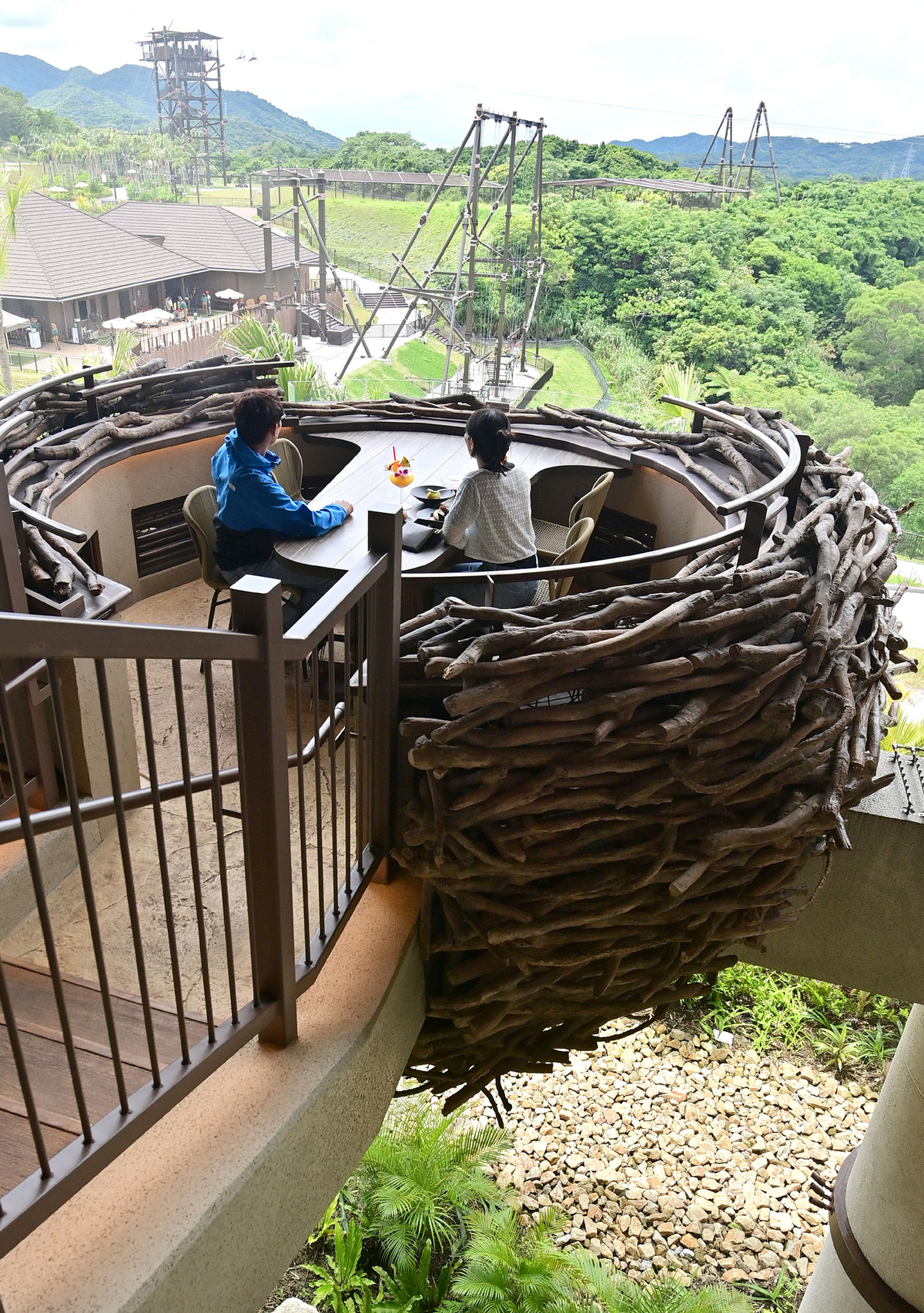
Two signature images represent Junglia: the park’s dinosaurs and the bird‑nest seats hanging in the outdoor restaurant area.
The bird‑nest seats sit in Panorama Dining, the restaurant in Junglia’s main tower. They look irresistible in photos, but because the outdoor seating can be hot, they’re not as popular as you’d expect.
Panorama Dining offers fine-dining options, while the Tropical Oasis restaurant beneath Spa Junglia serves more casual à la carte dishes. Even so, Panorama Dining’s lunch set — about 70,000 KRW (approximately $52.50) — won’t break the bank.
What makes Junglia worth watching is that it’s a “Made in Japan” challenge to multinational, mostly American, theme-park giants. The key question: how competitive can Junglia be against U.S.-style parks like Disneyland or Universal Studios? Kos Mozni, Japan Entertainment’s marketing director, said, “If Junglia succeeds in Okinawa, we could see Junglia at resorts in other countries.”
One downside: Junglia charges foreigners more than Japanese visitors — a dual pricing system. A park ticket costs 6,930 yen (approximately $46.43) for Japanese guests but 8,800 yen (approximately $58.96) for foreigners. The ticket that includes spa access is 9,240 yen (approximately $61.91) for Japanese visitors and 11,550 yen (approximately $77.39) for foreigners. The gap is noticeable. Junglia says the foreign price reflects the standard rate and that the domestic price is a discounted rate for Japanese guests.
Junglia explains it subtracts costs for translation and guide services when calculating domestic prices, since those services aren’t necessary for Japanese visitors. Vice President Sato said, “We’re still experimenting with everything from park operations to pricing,” and noted country-specific promotions may offset the price difference. Calling it an experiment sounded candid — after all, the whole park still feels experimental.
 ■ Junglia lodging and getting there
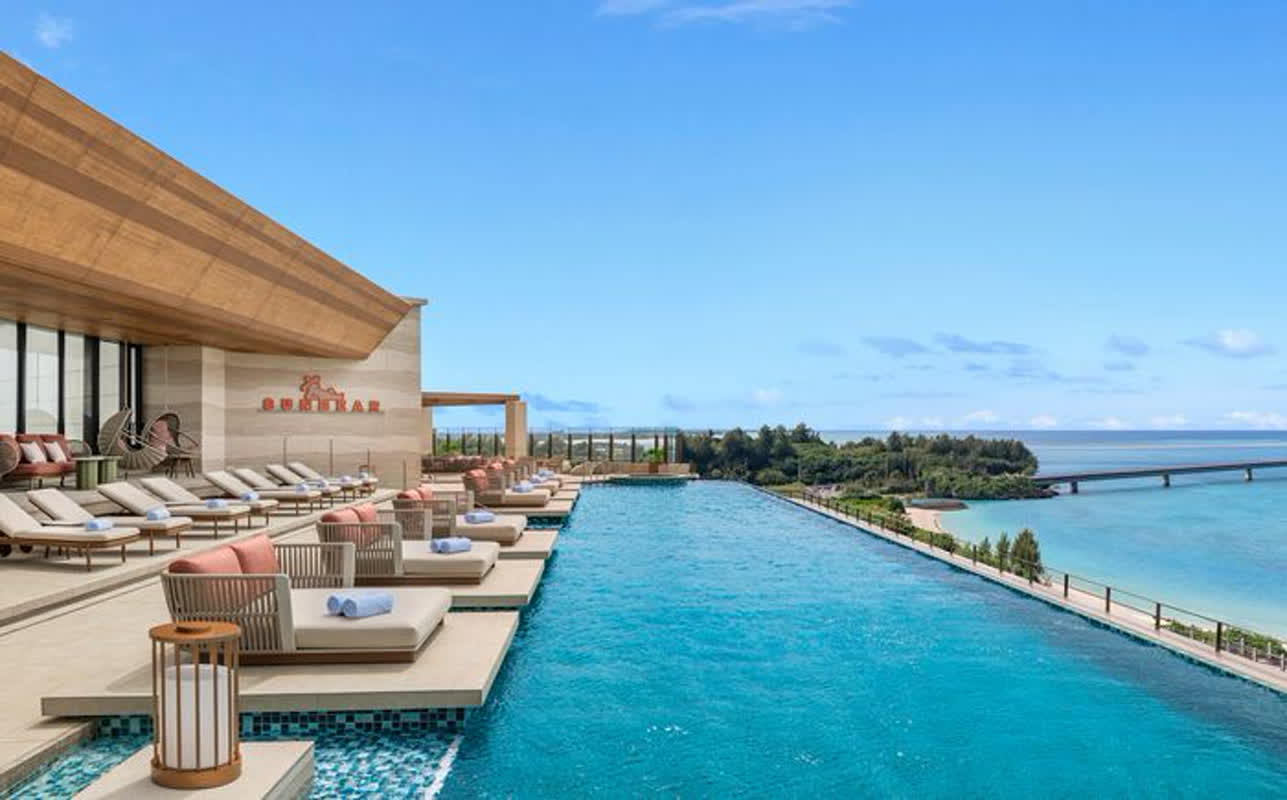
If you plan to visit Junglia during an Okinawa trip, I recommend the Orion Motobu Resort & Spa — a luxury hotel run by Orion Beer. Junglia partners with several hotels to attract visitors; Orion Motobu Resort & Spa is the closest, about a 30-minute drive from the park. The hotel runs a shuttle called the Junglia Express. You can drive, but parking at Junglia costs 2,000 yen per day (approximately $13.40).
「To be continued next week」









Most Commented