
K-Food Takes South America by Storm: How Kimchi and Korean Cuisine are Winning Hearts
Daniel Kim Views
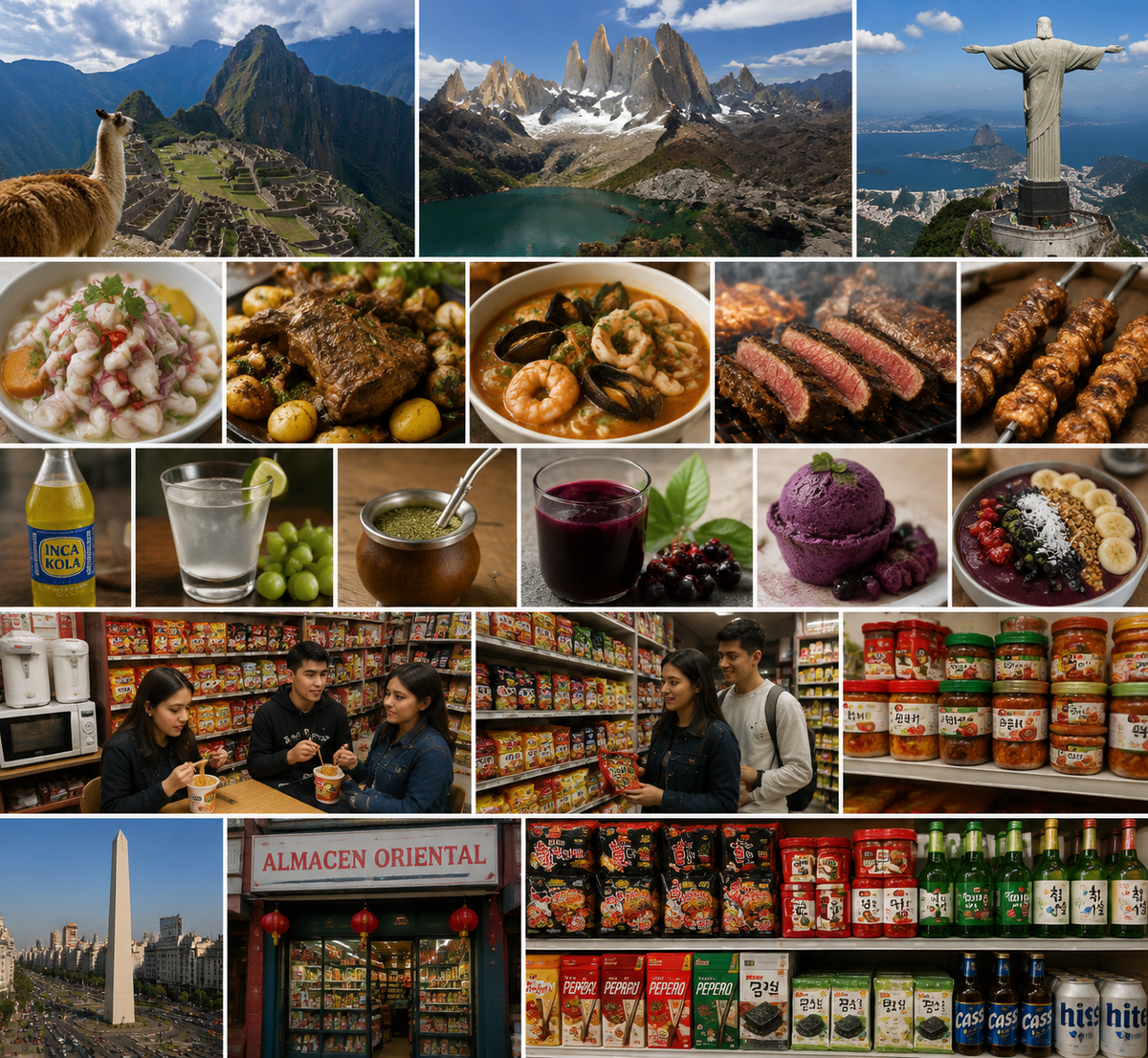 I had several items on my bucket list. One was an anthropological tour of ancient civilizations—Egypt, Crete (Mycenaean), Greece and Rome—to trace the beauty of human life. Another was a quest to chase the world’s great landscapes across China, the Americas and Europe. To check one of those off, I set out for South America to see the legacy of the Incas and the wilds of Patagonia.
After finishing my Egypt trip last year, I finally took the plunge and headed to South America this year. Traveling to the opposite side of the globe isn’t easy. Could I handle a 36-hour-plus journey? Could I beat altitude sickness in places like Cusco? Would I have the stamina for Patagonia’s famous treks—Fitz Roy, Torres del Paine? I had plenty of doubts. But Peru’s ancient sites, Patagonia’s dramatic landscapes, and the buzzing modern cities of Argentina and Brazil quickly put them to rest.
Framed by the Andes and a long Pacific coastline, South America is a food lover’s paradise with many distinctive traditional dishes. I sampled Peru’s raw seafood classic ceviche; Bolivia’s traditional lamb ribs, cordero; Chile’s Parila Marina, a seafood stew cooked using heat from the water; Argentina’s asado, meats cooked by radiant heat rather than an open flame; and Brazil’s churrasco, meats grilled on skewers.
Every time I ate these dishes, I thought about kimchi. Given that kimchi was born out of a need to keep rice and meals flavorful and never boring, it felt natural to imagine it alongside these foods. For anyone who’s tasted kimchi, adding it to those meals would have amplified the experience.
These countries have evolved their own sauces and condiments to enhance flavor, but I can’t help thinking that if kimchi had been part of their culinary histories it might have outshone many of them from a gastronomic perspective. Some might say I’m biased because I’m Korean—but that’s not the whole point. Kimchi is remarkable. To persuade others, we need to tell its cultural story and support it with rigorous scientific research and smart promotion. It will take time, but with the right explanation, historical context and scientific evidence, people will taste kimchi and demand will follow.
Chile and Argentina are famous for wine and consume it in abundance, but they also have notable traditional drinks. Peru’s Inca Kola, Chile’s pisco, Argentina’s mate tea—once the go-to drink of ranchers—and Brazil’s guarana tea (served on LATAM flights) each carry history and unique flavors. As for frozen treats, South America offers distinctive options like calafate ice cream (made from the thorny calafate berry) and Brazilian açaí bowls—both deliciously singular.
With the exception of Bolivia—a high-altitude nation with a large indigenous population—I found overall awareness of Korea across South America was higher than I expected. Young people especially love taking photos with Korean tourists. K-dramas and K-pop clearly boosted Korea’s visibility among the youth.
It’s harder to measure K-food fever while traveling. Mostly I noticed Korean restaurants popping up and a gradual rise in local customers. But in Buenos Aires I felt K-food’s presence more clearly. The number of Korean restaurants hasn’t exploded, nor did I see a wave of fusion dishes—like kimchi quesadillas or kimchi empanadas—taking over the menu scene. Big cities still show plenty of pizza, pasta and Chinese restaurants. Even in large supermarkets like Carrefour, Japanese sushi rice and Japanese instant noodles still outnumber Korean rice and ramen.
Yet visit Korean markets or Chinese-run “oriental” grocers and the K-food trend is unmistakable. In Chile’s Korean markets, shelves are stocked with instant noodles, kimchi and a variety of banchan and ingredients. In Buenos Aires, Korean stores prominently display kimchi, seaweed and an overwhelming variety of Korean instant noodles and snacks. Most customers were young locals. Interestingly, these shops had small chairs and tables by the shelves and provided microwaves and hot water—just like convenience stores in Korea—and young people sat chatting while digging into spicy instant noodles like Buldak.
Buenos Aires, a city planned about 400 years ago, centers on the Obelisk Plaza and is full of theaters and restaurants. Right in that hub stands an oriental grocery run by Chinese merchants for decades. Customers began requesting Korean products years ago, and the store gradually stocked them. Today, more than 70% of its shelf space is surprisingly filled with Korean products. Rows of instant noodles sit alongside snacks like Choco Pie and Pepero, seaweeds, soju and Korean beer. The rice on the shelves, however, comes from China’s northeast, and the kimchi—imported from China—was labeled as “Korean pao cai (泡菜).”
I’m proud of K-food’s global footprint, but I also felt a twinge of disappointment. I worry that K-food will become synonymous with packaged items like instant ramen, rather than the full breadth of Korean cuisine. Can instant noodles and Choco Pie really represent Korean food? To truly understand K-food, people need to taste Korean rice with authentic banchan. If we packaged Korean rice with a compact electric rice cooker, sold together, we might accelerate the global adoption of genuine K-food.

- [Exclusive] Prosecutors at Samsung’s semiconductor lines…boost expertise in investigating technology leaks
- “Eat pizza, then go to church” — Packed pews at a New York cathedral as Gen Z reshapes American churches [Park Si-jin’s Global Pick]
- “If I report it, I lose 2,000 KRW (approximately 1.50 USD)”…a small-business owner in distress
- Will July’s special tax and fair market value be revised…“More listings could appear in Gangnam’s three districts” [Koju-bu]
- Korea’s version of SpaceX becomes reality…Hanwha to buy more KAI shares by year-end [Biz-Plus]
- House price forecasts hit by regulation…capital region still expected to rise
- “No antibiotics or vaccines” — lungs stop, then organs fail…‘Possible human-to-human transmission’ report sparks global alarm
- [Exclusive] Science talent awards budget cut from 2.1 billion KRW (approximately 1.575 million USD) to 1.6 billion KRW (approximately 1.2 million USD)…“Judges can’t even get travel expenses”
- 2028? 2029? When will wartime operational control transfer happen…Lee: “We must prepare to operate on our own” [Lee Hyun-ho’s Military!Talk]
- ‘5th-generation indemnity’ reduces non-severe coverage and lowers premiums…launching on the 6th














Most Commented