
Why South Korea’s Public Transport is a Game-Changer for Tourists: A Must-Read Guide
Daniel Kim Views
Transit infrastructure that charms foreign visitors
Take the airport railroad, buses and subways
See the city all day for just over 10,000 KRW (approximately $7.50)
“Punctuality, convenience and low cost are its biggest strengths”
Public transit ranked second at 41% for factors driving repeat visits, after safety at 42.8%
 Aiko, a woman in her 30s who lives in Osaka and visits Korea twice a year, used to take taxis from the moment she landed at Incheon International Airport until she left the country. Although people had told her Korea’s public transit was convenient, she assumed using buses and subways as a foreigner would be difficult. On a trip last month, she tried public transit for the first time—and her whole perspective changed.
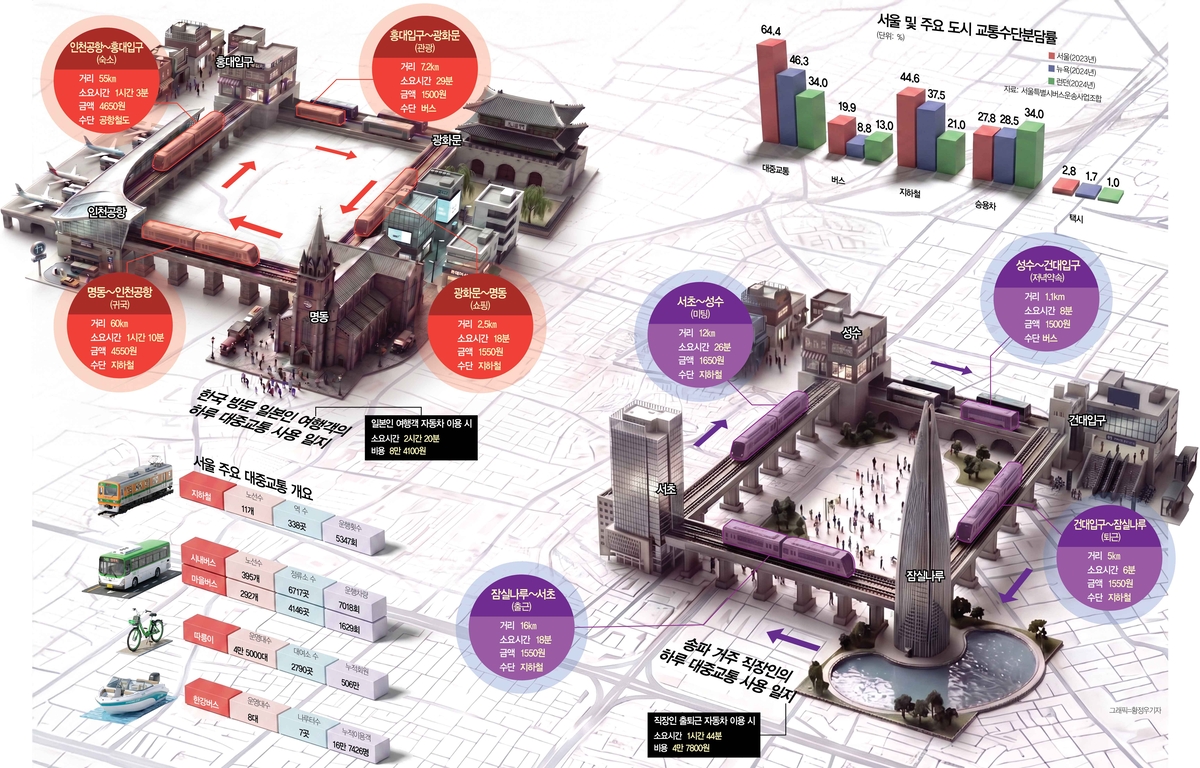
Arriving at Incheon Airport’s Terminal 1 in March, Aiko hopped on the airport railroad and rode about 55 km to Hongdaeipgu Station, reaching her hotel in roughly an hour. After dropping off her bags, she followed hotel staff directions and took bus 602 to Gwanghwamun and Gyeongbokgung, arriving in about 30 minutes. Later, she took the subway from Gyeongbokgung Station through Chungmuro to Myeongdong. She had one transfer—from Line 3 to Line 4—but clear sky-blue signs made it easy. She then rode the subway 15 minutes to Itaewon to meet a friend studying in Korea, spent the evening there until 11 p.m., and returned to her hotel by subway.
That day Aiko covered roughly 76 km in total, but was only in transit for about 2 hours and 20 minutes. Her total transport cost: just 10,800 KRW (approximately $8.10). A year earlier, the same route by taxi had cost her 84,000 KRW (approximately $63.00), so switching to public transit dramatically cut her travel expenses.
“When I took taxis, rush-hour traffic often delayed even short trips, so I usually couldn’t start sightseeing until after 9 a.m.,” she said. “This time I followed a tip from a Japanese online community—buy a transit card at a convenience store and top it up—and I found Seoul even more convenient than cities in Japan.”
Surveys show that many international visitors weigh public transit heavily when choosing Korea as a destination. In February, the Korea Tourism Organization’s Korea Tourism Data Lab released preliminary fourth-quarter results from the 2025 inbound tourist survey. When asked what infrastructure mattered most when considering a trip to Korea, 42.8% cited safety and 41% cited public transportation. Tourists from Asian markets with limited transport options—such as Taiwan, Thailand and the Philippines—and visitors from European countries like France, Germany and the U.K. often rated Korea’s transit as “highly recommended.”
Travelers praise Korea’s transit for its punctuality and convenience. Buses and subways generally arrive when transit apps say they will, which makes it easy to stick to an itinerary. Real-time displays at subway stations and bus stops show arrival times, and the relatively clean facilities and affordable fares make public transit especially appealing to independent travelers.
Business travelers also give Korea’s transit high marks. Kim, a man in his 30s who travels from Japan to Korea about once a month for work, said he notices the difference every time he returns home. Seoul’s dense rail network reaches most business districts by subway, and the transfer systems make travel to Gyeonggi Province straightforward and inexpensive.
“Most of my meetings are reachable by subway or city bus, and the neighborhood (village) buses can get you into side streets,” he said. “The best part is how these modes integrate into a single transfer system.” He added, “They even provide real-time crowding information—something you don’t often see elsewhere.”
With fuel prices staying high, more office workers are switching from cars to public transit for their daily commutes. Jeong, a man in his 30s who lives near Jamsil Saenae Station in Songpa District, said commuting by transit has improved his quality of life. Driving to his job near Seocho Station used to take 40 minutes to an hour; after switching to the subway, he shaved about 20 minutes off his commute.
“I often go to the Seongsu area for pop-up store meetings and used to spend an hour in the car,” he said. “By subway it’s just a 30-minute trip—definitely more convenient.” He also noted a cost benefit: “I use Seoul’s monthly transit pass, the Gihu Companion Card, which covers my commuting costs for 58,000 KRW (approximately $43.50) a month.”
- [Exclusive] Japan eases capital rules…Korean banks face a 40 trillion KRW (approximately $30 billion) burden
- “We earned 1 trillion KRW (approximately $750 million) every day in March”…This country quietly benefits from the Iran war
- “After semiconductors come robots, space and defense…Pension money move could push 500 trillion KRW (approximately $375 billion) this year”
- “Who makes money in real estate these days?” Emerging wealthy with 6 billion KRW (approximately $4.5 million) in assets tell a different story
- Last rush of discount sales by multiple-home owners…Seoul land-use applications rise seven consecutive weeks [Kojubu]
- “How much wedding money I gave…” Why a 40-year-old colleague’s ‘no-wedding’ invitation stirred coworkers
- “582% surge in a single day”…This company stopped selling shoes and declared ‘AI’—then its stock shot up
- “Even if you have a baby, there’s nowhere to leave them”…New towns see spread of ‘zero-age test’ culture
- “Everyone’s into stocks these days” Soldiers who lost pay from risky trading…Government steps in
- “House prices move with Samsung and SK Hynix bonuses”…Homes near ‘chip lines’ see price swings [Home-Shleung]














Most Commented