
Translation result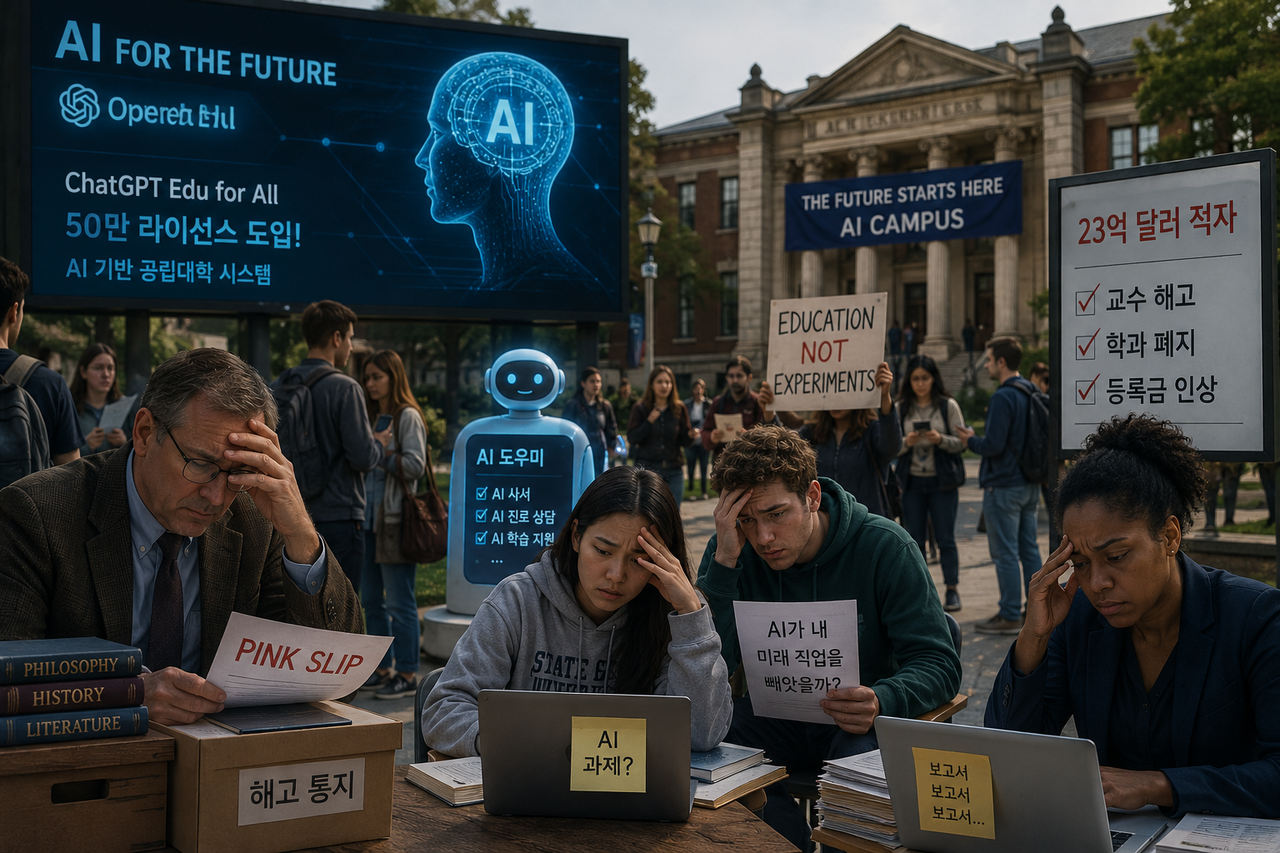 [Herald Economy = Reporter Jeong Mok-hee] California State University (CSU), the largest public university system in the U.S., partnered with OpenAI last year to prepare for the AI era and launched what it billed as the world’s largest university AI rollout. But within a year, the initiative has sparked sharp conflict among faculty, students and administrators.
The New York Times highlighted CSU’s AI experiment on June 2, reporting that although university leaders pitched AI as the solution for future education, many on campus are confused about what the university is trying to accomplish.
Last year CSU signed a 16.9 million USD contract with OpenAI (about 25 billion KRW) to provide 500,000 ChatGPT Edu licenses to students, faculty and staff. At the time, it was the largest single-institution deployment of ChatGPT in the world.
University officials said the deal would enable the creation of the nation’s first “AI-based public university system” across 22 campuses.
San Jose State University became one of the most aggressive implementers. Incoming freshmen receive a welcome message from an AI avatar of the university president. The campus has rolled out an AI librarian, an AI center, AI career counseling services and even used AI agents to support commencement operations.
The university president refers to himself as the institution’s CEO, arguing that “universities, like companies, must innovate in a rapidly changing environment.” He says the school is building a new model that integrates AI into teaching, research and career services.
California is home to major tech firms such as Nvidia, Google, Microsoft, Adobe and IBM, and Governor Gavin Newsom has actively backed efforts to expand AI education.
The state plans to expand AI training across high schools, community colleges and state universities to cultivate future AI talent.
But no one can predict exactly how AI will reshape the labor market.
The university markets the program as preparing students for future jobs, while many professors warn that AI could weaken students’ critical thinking and writing skills.
The controversy has intensified amid a financial crisis. Facing an estimated 2.3 billion USD deficit, CSU has laid off tenured faculty, eliminated some departments and raised tuition.
Faculty unions sharply criticized the university for investing what they describe as tens of billions of KRW in OpenAI. Professors organized a petition opposing an extension of the OpenAI contract; about 4,000 students and staff have signed so far.
Student reactions are mixed. Some view AI as an opportunity: among computer science majors, students are using AI to find internships and launch startups.
![[게티이미지뱅크]](https://cdn-union.tenbizt.com/contents/crawler-dev/image/2026/06/CP-2023-0083/image-b0821ec4-3877-42c2-b286-ace52aa66822.jpeg) Other students worry AI could threaten their future job prospects.
Other students worry AI could threaten their future job prospects.
A political science student criticized the administration: “The university says it lacks funds, yet it is paying large sums to AI companies. Students and faculty were excluded from the decision-making process.”
Despite the backlash, university officials recently extended the OpenAI contract by about 13 million USD and said graduates would continue to have ChatGPT access for one year after earning their degrees.
The New York Times concluded that the dispute has grown beyond the question of adopting AI and now raises deeper debates about the role of public education and the purpose of universities.










Most Commented