
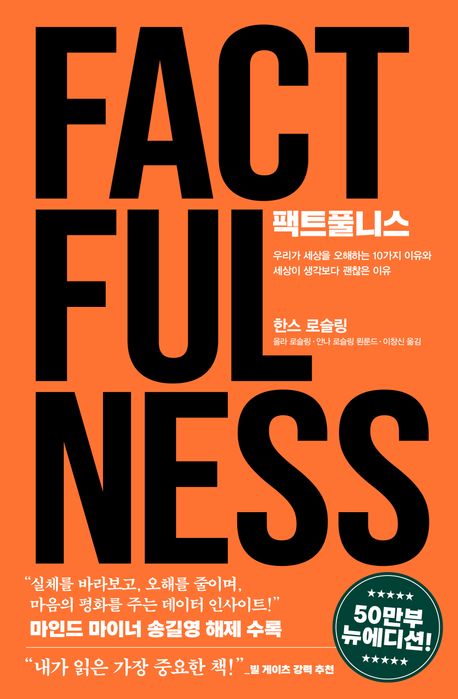
News coverage tends to amplify wars, natural disasters, disease outbreaks, and terrorist attacks. Quiet advances in public health, education, and living standards rarely make the front page. In Factfulness, Hans Rosling uses data to correct the distortions our instincts create.
In 2017 Rosling conducted a global survey of roughly 12,000 people across 14 countries, asking basic questions about the state of the world. Participants answered, on average, only two of the twelve questions correctly. No one scored perfectly, and 15 percent failed to answer a single question right. Even highly educated, well-informed groups performed only marginally better. Rosling argues the problem is not a lack of facts but instincts that let feelings override evidence.
The book identifies ten common instincts that skew our perception: the gap instinct, negativity instinct, straight-line instinct, fear instinct, size instinct, generalization instinct, destiny instinct, single-perspective instinct, blame instinct, and urgency instinct. These instincts make dramatic explanations more appealing. Simplistic divisions—such as rich versus poor or developed versus developing—erase the broad middle where most people actually live. To correct that misconception, Rosling introduces a four-level income framework that highlights the global middle class.
His critique of the media is equally pointed. Rare, dramatic events attract disproportionate coverage. Earthquakes, wars, refugee crises, disease outbreaks, and terrorism dominate headlines, while falling malaria rates or expanding access to electricity get far less attention. When the media repeatedly highlights sensational episodes, people begin to treat the unusual as ordinary. Fear spreads quickly; steady progress arrives quietly.
Rosling also stresses the importance of reading numbers correctly. Large raw totals can make problems look bigger than they are. Viewing statistics as proportions and comparing them to historical trends often reveals a different story: child mortality has fallen, vaccination rates have risen, electricity access has expanded, and girls’ education has improved over time. National carbon-emission totals can be misleading without accounting for population; per-capita figures are essential for meaningful comparisons.
Factfulness is not naive optimism. Rosling clearly identifies pandemics, financial crises, wars, climate change, and extreme poverty as serious threats. His point is not to downplay risks but to measure them accurately and to respond proportionately. Seeing the world clearly won’t eliminate anxiety, but it gives us a better basis for managing it.
After finishing the book, one question remains: is our picture of the world grounded in reality, or shaped by fear and bias? Factfulness doesn’t ask readers to memorize data; it asks them to habitually check their instincts against evidence.
Reported by News Culture M.J._mj94070777@nc.press















Most Commented