Quick access to main page (top) Direct access to main contents Quick access to main page (bottom)

Why Women Use AI 20% Less Than Men: The Hidden Bias Risk

Daniel Kim Views  

▲
▲ Scene from the Gender Equality Roundtable ‘Media in the AI Era: New Questions for Equality, Inclusion and Diversity,’ held the afternoon of the 22nd at the KBS Art Hall in Yeouido, Seoul. Photo: Yun Yookyung.

A study finding that women use generative AI about 20% less than men has raised concerns that a persistent gender gap could steer AI to learn disproportionately from male data and amplify bias. Panelists urged public broadcasters to produce countervailing datasets that preserve marginalized perspectives when training data skew in one direction.

At the KBS Art Hall in Yeouido on the afternoon of the 22nd, the KBS Gender Equality Center hosted the roundtable “Media in the AI Era: New Questions for Equality, Inclusion and Diversity.” So-yeon Lim, a professor at Dong-A University’s College of Convergence and a member of South Korea’s Ministry of Gender Equality and Family AI Strategy Forum, presented recent studies analyzing gender differences in AI use. She summarized a meta-analysis of 18 studies led by researchers at Harvard Business School that measured usage of conversational generative AI tools among roughly 140,000 people last year. Across countries and occupations, women used generative AI about 20% less than men; even when access to AI was equal, the gap persisted at roughly 13%.

Researchers attribute much of this difference to women’s greater concern that using AI to generate content could be perceived as cheating and result in penalties. Lim warned, “If women use AI less, AI will end up learning from and reproducing more male data. Bias can arise from the technology itself, but it also emerges from how people use AI. If men continue to use it more, generative AI will increasingly mirror men.”
▲
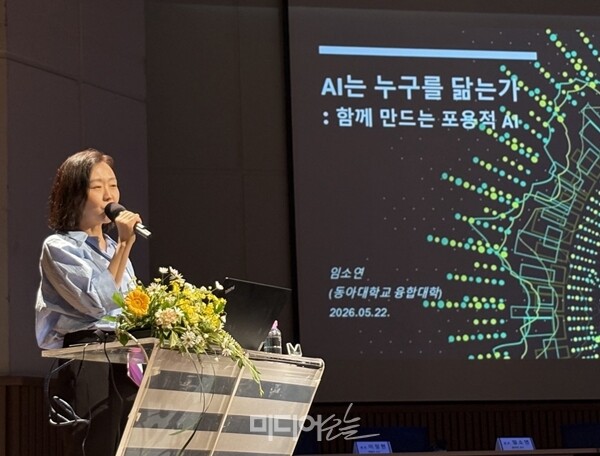
▲ So-yeon Lim, professor at Dong-A University’s College of Convergence and member of the Ministry of Gender Equality and Family’s AI Strategy Forum, speaking at the Gender Equality Roundtable. Photo: Yun Yookyung.

A recent Oxford Internet Institute study titled Women Worry, Men Use, which surveyed about 8,000 British adults, reached similar conclusions. The institute found that women’s lower use of AI stemmed not from a lack of technical understanding but from concerns about AI’s social harms. In some cases, the gender gap reached as high as 45%. Among 18- to 35-year-olds, risk perception was the second-most important factor influencing women’s decisions to use generative AI, whereas it ranked sixth among men of the same age. The study also found that as women’s trust in AI ethics increases and their perceived risk falls, they use AI more and the gender gap narrows.

Lim emphasized the need for inclusive AI and a proactive media role. She argued that beyond technical fixes to counter stereotypes and algorithmic bias, media organizations must help build public trust in AI. “If the gender gap in AI use persists, AI will come to resemble men,” she said. “Technical education matters, but so does the media’s role in cultivating trust in AI.”

The Role of Public Broadcaster KBS: Building Counter-Data for Generative AI

Panelists also underscored a public broadcaster’s responsibilities during the AI transition. In 2020, KBS issued production guidelines prohibiting content that promotes discriminatory stereotypes, assesses people by appearance, or sexualizes individuals, and calling for recognition of diverse family structures. Last year KBS adopted internal AI guidelines that call for attention to bias risks and the reflection of diverse social values.

Kwon Onam, president of the Korean Federation of Science and Technology Societies, called gender-aware algorithm testing the bridge between production-language guidelines and algorithm-language guidelines. He urged KBS to assume four roles: act as a reviewer at the data stage to check the diversity of training and recommendation data; serve as a verifier during training and evaluation by regularly measuring and disclosing accuracy gaps across groups; function as a discloser in deployment and operations by signaling AI transparency and publishing routine algorithm-impact assessment reports; and convene governance through a standing advisory council that includes citizens, women scientists, and members of the science and technology community.
▲
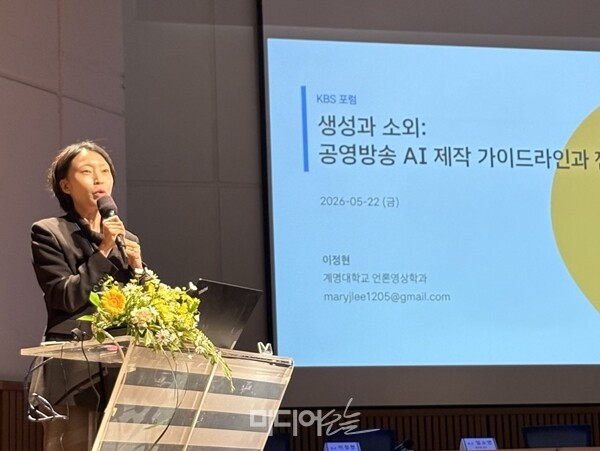
▲ Jeong-hyeon Lee, professor in the Department of Media and Visual Arts at Keimyung University, presenting at the Gender Equality Roundtable. Photo: Yun Yookyung.

Experts warned that in an era of synthesis—where generative AI produces averaged virtual representations—production guidelines focused solely on representation lose much of their force. They argued that public broadcasters should actively generate counter-data to challenge prevailing datasets and resurrect values that AI automation tends to exclude.

Jeong-hyeon Lee, a professor in Keimyung University’s Department of Media and Visual Arts, said, “When generative AI models select certain forms and assign weights as they create images, public broadcasters share a responsibility to intervene in those weighting processes — not merely by increasing data volume. Public broadcasters must continuously produce counter-data: images and videos that can carry weight.” He added, “At a time when everyone talks about automating content production, public broadcasters should intensify efforts to produce content that serves as counter-data.”

Daniel Kim
content@tenbizt.com

Comments0

300

Comments0

[Social] Latest Stories

  • Starbucks Korea CEO Fired Over Controversial ‘Tank Day’ Promotion
    Starbucks Korea CEO Fired Over Controversial 'Tank Day' Promotion
  • 25,000 Robots vs. Human Workers: The High-Stakes Battle at Hyundai
    25,000 Robots vs. Human Workers: The High-Stakes Battle at Hyundai
  • Hotel Hygiene Scandal: Cleaner Caught Using Guest Towels to Wipe Toilets
    Hotel Hygiene Scandal: Cleaner Caught Using Guest Towels to Wipe Toilets
  • South Korea’s Tech Giant Kakao Faces First Major Strike in 20 Years
    South Korea's Tech Giant Kakao Faces First Major Strike in 20 Years
  • South Korea’s Aging Crisis: How One Leader Is Redefining ‘Well-Dying’
    South Korea’s Aging Crisis: How One Leader Is Redefining 'Well-Dying'
  • Stop Calling Them ‘Hey You’: South Korea’s New Push for Worker Respect
    Stop Calling Them 'Hey You': South Korea's New Push for Worker Respect

Weekly Best Articles

  • Choi Dong-seok’s Family Bond: How a Simple Engraving Reveals Deep Love for His Children
  • Kwak Sun-hee’s Stunning Wedding Photos: A Celebration of Love and Courage
  • Is ‘I Am a Natural Person’ Just a Big Lie? Comedian Yoon-taek Reveals Shocking Secrets!
  • Health Scare: Why Fans Are Worried About Go Ji Yong’s Dramatic Weight Loss
  • Discover the Winter Gongju Chestnut Festival: A Taste of Korea at H-Mart in the USA!
  • 2026 Spring Wildfire Prevention: How Gyeryong City is Cutting Response Time to 30 Minutes!

You May Also Like

  • 1
    Ukraine’s EU Bid Surges as Hungary Drops Opposition Amid Russian Attacks

    Politics 

    Ukraine’s EU Bid Surges as Hungary Drops Opposition Amid Russian Attacks
  • 2
    Trump Backs Colombia's 'El Tigre' — What It Means for U.S. Relations

    Politics 

    Trump Backs Colombia’s ‘El Tigre’ — What It Means for U.S. Relations
  • 3
    Trump Backs Colombia's Far-Right Outsider—What's at Stake?

    Politics 

    Trump Backs Colombia’s Far-Right Outsider—What’s at Stake?
  • 4
    12.5% Tariff Hit: South Korea Faces New U.S. Trade Penalties

    Politics 

    12.5% Tariff Hit: South Korea Faces New U.S. Trade Penalties
  • 5
    12.5% Tariff Alert: Why the U.S. Is Targeting South Korean Imports

    Politics 

    12.5% Tariff Alert: Why the U.S. Is Targeting South Korean Imports

Popular Now

  • 1
    Marta Kostyuk Makes History at French Open Amid Ukraine Crisis

    Politics 

  • 2
    37 Years in Exile: The Tiananmen Leader Who Just Wants to Go Home

    Politics 

  • 3
    South Korea's Cheongju Airport Faces Crisis as Passenger Numbers Explode

    Politics 

  • 4
    Nuclear Submarine Race: South Korea's High-Stakes Bid for U.S. Fuel

    Politics 

  • 5
    France Finally Admits Complicity in the 1994 Rwandan Genocide

    Politics 

Weekly Best Articles

  • Choi Dong-seok’s Family Bond: How a Simple Engraving Reveals Deep Love for His Children
  • Kwak Sun-hee’s Stunning Wedding Photos: A Celebration of Love and Courage
  • Is ‘I Am a Natural Person’ Just a Big Lie? Comedian Yoon-taek Reveals Shocking Secrets!
  • Health Scare: Why Fans Are Worried About Go Ji Yong’s Dramatic Weight Loss
  • Discover the Winter Gongju Chestnut Festival: A Taste of Korea at H-Mart in the USA!
  • 2026 Spring Wildfire Prevention: How Gyeryong City is Cutting Response Time to 30 Minutes!

Must-Reads

  • 1
    Ukraine’s EU Bid Surges as Hungary Drops Opposition Amid Russian Attacks

    Politics 

    Ukraine’s EU Bid Surges as Hungary Drops Opposition Amid Russian Attacks
  • 2
    Trump Backs Colombia's 'El Tigre' — What It Means for U.S. Relations

    Politics 

    Trump Backs Colombia’s ‘El Tigre’ — What It Means for U.S. Relations
  • 3
    Trump Backs Colombia's Far-Right Outsider—What's at Stake?

    Politics 

    Trump Backs Colombia’s Far-Right Outsider—What’s at Stake?
  • 4
    12.5% Tariff Hit: South Korea Faces New U.S. Trade Penalties

    Politics 

    12.5% Tariff Hit: South Korea Faces New U.S. Trade Penalties
  • 5
    12.5% Tariff Alert: Why the U.S. Is Targeting South Korean Imports

    Politics 

    12.5% Tariff Alert: Why the U.S. Is Targeting South Korean Imports

Popular Now

  • 1
    Marta Kostyuk Makes History at French Open Amid Ukraine Crisis

    Politics 

  • 2
    37 Years in Exile: The Tiananmen Leader Who Just Wants to Go Home

    Politics 

  • 3
    South Korea's Cheongju Airport Faces Crisis as Passenger Numbers Explode

    Politics 

  • 4
    Nuclear Submarine Race: South Korea's High-Stakes Bid for U.S. Fuel

    Politics 

  • 5
    France Finally Admits Complicity in the 1994 Rwandan Genocide

    Politics 

Share it on...