Quick access to main page (top) Direct access to main contents Quick access to main page (bottom)

Samsung’s Internal Divide: Why a New Pay Deal is Splitting Its Workers

Daniel Kim Views  

[Green Economy News = Reporter Jeong Chang-hyun] Internal conflict within Samsung Electronics’ union has intensified since management and labor reached a tentative agreement. Opposition from DX employees (finished products such as home appliances and mobile devices) who oppose the deal, together with pushback from the loss-making System LSI and Foundry units, has spread concurrently, deepening divisions within the union.

Industry sources say that ahead of the membership vote on the tentative agreement, ranks in the third union, Samsung Electronics Labor Union Donghaeng (Donghaeng Union), swelled from roughly 2,000 members to about 11,000.

Union insiders attribute the surge to reports that Donghaeng members who completed CMS registration before 2 p.m. that day were also issued ballots, prompting rapid enrollment by employees dissatisfied with the deal.

Analysts say the move dovetails with rising discontent inside the DX division. Some DX employees contend that bonus distribution favors the memory division, leaving other units comparatively marginalized.

A DX union member said, “Those in memory may be satisfied, but divisions outside memory will understandably feel aggrieved. It appears the company ultimately engineered a memory-centric structure.”

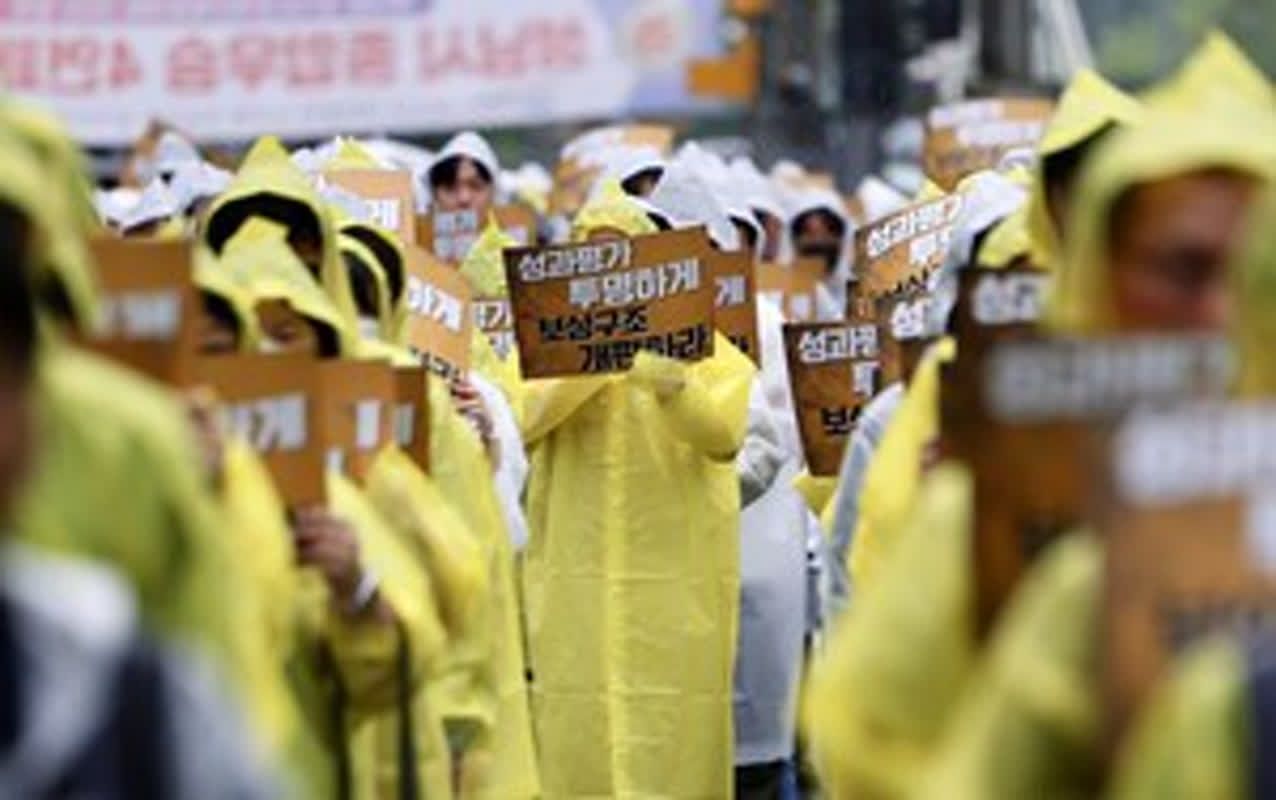
Scene from the May 23 rally in Pyeongtaek [Photo: Samsung Electronics Union]

Tensions have also widened between the memory division and the so-called loss-making System LSI and Foundry units.

Some System LSI and Foundry members argue the tentative deal effectively excludes loss-making units, saying those units’ shares were reduced compared with earlier negotiation drafts.

Several members claim the distribution retreated from the previously discussed “division-common 7 : business-unit 3” framework to roughly “4 : 6,” and that additional cuts in payout ratios for loss-making units effectively sidelined LSI and Foundry.

One member criticized, “The percentage floor dropped (15 → 10.5%), and the distribution ratios are distorted (7 → 4). In the end, memory was prioritized and LSI and Foundry were abandoned.” Another member added, “The tentative agreement now disadvantages the loss-making units more than the company’s May 17 proposal did. Isn’t the union simply using those units to preserve its majority?”

Some observers argue the union failed to secure the transparency of bonuses and the removal of caps it had advocated, resulting in an agreement that ultimately favors memory.

Others counter that, given government and public pressure and the prospect of emergency mediation, union leadership negotiated the most realistic agreement available. They note the company consistently resisted providing additional compensation for loss-making units.

Analysts say the outcome of the ratification vote could reshape internal union power dynamics as the divergent interests of DS units—Memory, System LSI and Foundry—and DX divisions become more pronounced.

Earlier, Samsung management and the union reached a tentative bonus agreement during talks chaired by the minister of employment and labor just before a planned general strike, and the strike was put on hold. The ratification vote begins on the 22nd, and the union will announce the result on the 27th.

Daniel Kim
content@tenbizt.com

Comments0

300

Comments0

[Social] Latest Stories

  • Starbucks Korea CEO Fired Over Controversial ‘Tank Day’ Promotion
    Starbucks Korea CEO Fired Over Controversial 'Tank Day' Promotion
  • 25,000 Robots vs. Human Workers: The High-Stakes Battle at Hyundai
    25,000 Robots vs. Human Workers: The High-Stakes Battle at Hyundai
  • Hotel Hygiene Scandal: Cleaner Caught Using Guest Towels to Wipe Toilets
    Hotel Hygiene Scandal: Cleaner Caught Using Guest Towels to Wipe Toilets
  • South Korea’s Tech Giant Kakao Faces First Major Strike in 20 Years
    South Korea's Tech Giant Kakao Faces First Major Strike in 20 Years
  • South Korea’s Aging Crisis: How One Leader Is Redefining ‘Well-Dying’
    South Korea’s Aging Crisis: How One Leader Is Redefining 'Well-Dying'
  • Stop Calling Them ‘Hey You’: South Korea’s New Push for Worker Respect
    Stop Calling Them 'Hey You': South Korea's New Push for Worker Respect

Weekly Best Articles

  • Choi Dong-seok’s Family Bond: How a Simple Engraving Reveals Deep Love for His Children
  • Kwak Sun-hee’s Stunning Wedding Photos: A Celebration of Love and Courage
  • Is ‘I Am a Natural Person’ Just a Big Lie? Comedian Yoon-taek Reveals Shocking Secrets!
  • Health Scare: Why Fans Are Worried About Go Ji Yong’s Dramatic Weight Loss
  • Discover the Winter Gongju Chestnut Festival: A Taste of Korea at H-Mart in the USA!
  • 2026 Spring Wildfire Prevention: How Gyeryong City is Cutting Response Time to 30 Minutes!

You May Also Like

  • 1
    Ukraine’s EU Bid Surges as Hungary Drops Opposition Amid Russian Attacks

    Politics 

    Ukraine’s EU Bid Surges as Hungary Drops Opposition Amid Russian Attacks
  • 2
    Trump Backs Colombia's 'El Tigre' — What It Means for U.S. Relations

    Politics 

    Trump Backs Colombia’s ‘El Tigre’ — What It Means for U.S. Relations
  • 3
    Trump Backs Colombia's Far-Right Outsider—What's at Stake?

    Politics 

    Trump Backs Colombia’s Far-Right Outsider—What’s at Stake?
  • 4
    12.5% Tariff Hit: South Korea Faces New U.S. Trade Penalties

    Politics 

    12.5% Tariff Hit: South Korea Faces New U.S. Trade Penalties
  • 5
    12.5% Tariff Alert: Why the U.S. Is Targeting South Korean Imports

    Politics 

    12.5% Tariff Alert: Why the U.S. Is Targeting South Korean Imports

Popular Now

  • 1
    Marta Kostyuk Makes History at French Open Amid Ukraine Crisis

    Politics&nbsp

  • 2
    37 Years in Exile: The Tiananmen Leader Who Just Wants to Go Home

    Politics&nbsp

  • 3
    South Korea's Cheongju Airport Faces Crisis as Passenger Numbers Explode

    Politics&nbsp

  • 4
    Nuclear Submarine Race: South Korea's High-Stakes Bid for U.S. Fuel

    Politics&nbsp

  • 5
    France Finally Admits Complicity in the 1994 Rwandan Genocide

    Politics&nbsp

Weekly Best Articles

  • Choi Dong-seok’s Family Bond: How a Simple Engraving Reveals Deep Love for His Children
  • Kwak Sun-hee’s Stunning Wedding Photos: A Celebration of Love and Courage
  • Is ‘I Am a Natural Person’ Just a Big Lie? Comedian Yoon-taek Reveals Shocking Secrets!
  • Health Scare: Why Fans Are Worried About Go Ji Yong’s Dramatic Weight Loss
  • Discover the Winter Gongju Chestnut Festival: A Taste of Korea at H-Mart in the USA!
  • 2026 Spring Wildfire Prevention: How Gyeryong City is Cutting Response Time to 30 Minutes!

Must-Reads

  • 1
    Ukraine’s EU Bid Surges as Hungary Drops Opposition Amid Russian Attacks

    Politics 

    Ukraine’s EU Bid Surges as Hungary Drops Opposition Amid Russian Attacks
  • 2
    Trump Backs Colombia's 'El Tigre' — What It Means for U.S. Relations

    Politics 

    Trump Backs Colombia’s ‘El Tigre’ — What It Means for U.S. Relations
  • 3
    Trump Backs Colombia's Far-Right Outsider—What's at Stake?

    Politics 

    Trump Backs Colombia’s Far-Right Outsider—What’s at Stake?
  • 4
    12.5% Tariff Hit: South Korea Faces New U.S. Trade Penalties

    Politics 

    12.5% Tariff Hit: South Korea Faces New U.S. Trade Penalties
  • 5
    12.5% Tariff Alert: Why the U.S. Is Targeting South Korean Imports

    Politics 

    12.5% Tariff Alert: Why the U.S. Is Targeting South Korean Imports

Popular Now

  • 1
    Marta Kostyuk Makes History at French Open Amid Ukraine Crisis

    Politics 

  • 2
    37 Years in Exile: The Tiananmen Leader Who Just Wants to Go Home

    Politics 

  • 3
    South Korea's Cheongju Airport Faces Crisis as Passenger Numbers Explode

    Politics 

  • 4
    Nuclear Submarine Race: South Korea's High-Stakes Bid for U.S. Fuel

    Politics 

  • 5
    France Finally Admits Complicity in the 1994 Rwandan Genocide

    Politics