Quick access to main page (top) Direct access to main contents Quick access to main page (bottom)

How AI is Reshaping Gender Roles: Insights from the 2026 Roundtable Discussion

Daniel Kim Views  

Translation result.

▲At
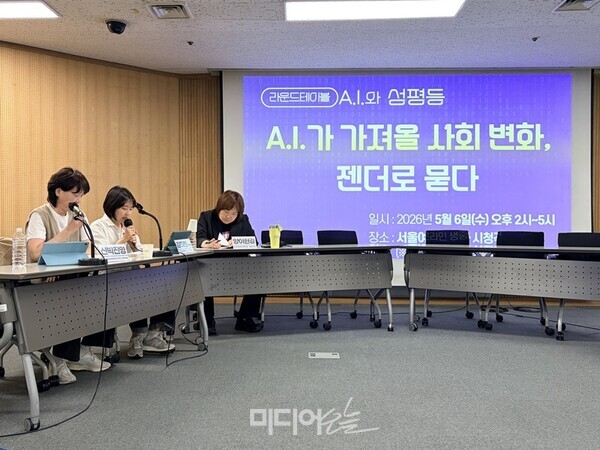
▲At the ‘Asking Gender About Social Changes Brought by AI’ roundtable hosted by the Korean Women’s Associations United on May 6, 2026, at Seoul Women’s Plaza in Dongjak District, Seoul. Photo by Jeong Min-kyung.

As policymakers accelerate AI deployment in the name of efficiency and productivity, advocates warn that the rollout must also address harms affecting women, minorities, and care workers — including new forms of gender-based violence.

At the roundtable \”Asking Gender About Social Changes Brought by AI,\” hosted by the Korean Women’s Associations United on May 6 at Seoul Women’s Plaza in Dongjak District, speakers argued that AI is reinforcing existing gendered inequalities. They highlighted problems such as the devaluation of women’s labor, surveillance and isolation in AI-driven care, and the use of deepfakes for sexual exploitation.

Kim Su-a, a professor in Seoul National University’s Department of Communication and Information, opened her presentation, \”AI Use and Social Change: A Gender Perspective,\” by noting that the National AI Strategy Committee’s Korea AI Action Plan emphasizes efficiency and speed. \”Officials often equate AI-driven efficiency with the public interest,\” she said. Kim warned that serious issues are emerging — from the collection of human data to train systems, to fraud and scams, AI in warfare, and deepfakes used for sexual exploitation — and that many of these raise acute gender concerns.

She said early research on AI and gender focused on algorithmic bias and imbalanced datasets. More recent studies show that bias during data collection and evaluation produces errors in assessments of minorities’ and women’s data, undermines worker autonomy, and enables new forms of control. \”Meta, for example, collected real-time data on workers’ keystrokes and hours, which created problems for the quality and ethics of AI training data,\” she said.

Kim added that gender-based harms such as cyberstalking are on the rise and that women’s labor is being devalued. While AI can temporarily increase women’s participation in the labor market, it often perpetuates and widens gaps in income, time allocation, and autonomy. Algorithmic evaluation and rapid AI substitution in care work — a sector with a high concentration of female workers — are intensifying polarization. \”Women’s organizations are calling for structural interventions to protect female-dominated occupations threatened by AI,\” she said.

Kim pointed to the growing use of AI robots in elder care, saying AI check-in call services can track and monitor elderly households and are replacing temporary welfare-center staff who make wellbeing calls. \”We must ask whether this kind of care, measured only by quantity, really counts as good care,\” she said. Kim also warned of a dilemma: while AI chatbots can provide comfort to socially isolated or vulnerable people, they may weaken social ties. Unlike humans, AI bots avoid conflict and offer only consolation — raising the question of whether they are genuinely good conversational partners for care recipients.
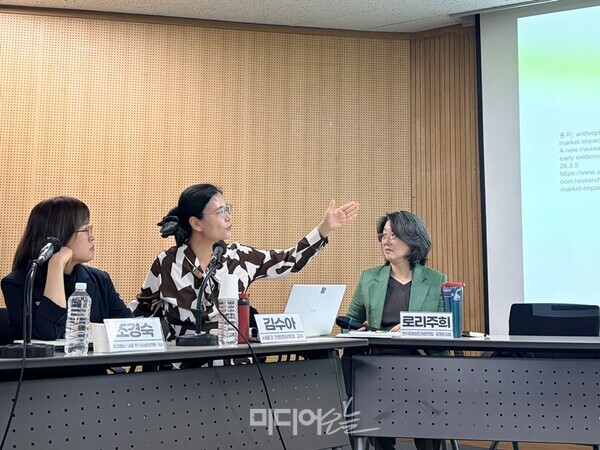
▲Kim
▲Kim Su-a (center), professor in the Department of Communication and Information at Seoul National University, presents at the ‘Asking Gender About Social Changes Brought by AI’ roundtable hosted by the Korean Women’s Associations United on May 6 in Dongjak District, Seoul. Photo by Jeong Min-kyung.

Reviewing global regulatory trends, Kim said that accountability for AI firms must prioritize the safety of women, children, and marginalized groups. She noted that Australia has begun assessing chatbots’ effects on children’s mental health and harm and will implement age-based controls for chatbots this year. Australia has also requested transparency and safety reports to determine whether grok bore responsibility for generating child sexual-exploitative images. \”Korea must now consider how to build a culture of responsibility into its AI policy,\” she said.

Lee Min-ju, an activist with the Korean Women’s Association Minwoo, raised concerns about X’s AI chatbot grok. She said that in December 2025 grok added a feature that, when tagged and asked to transform a photo in a particular way, would immediately synthesize an altered image. A French nonprofit analyzed 50,000 grok-tagged posts and 20,000 images over one week that month and found that more than half depicted people in underwear or bikinis, and most subjects were young women. Lee also cited a 2026 case in Seoul in which a district office worker stole a female colleague’s photo, manipulated it to appear intimate with himself, posted it on social media, and sexually harassed her. \”We need to recognize how AI can mediate gender-based violence in new ways,\” she said.
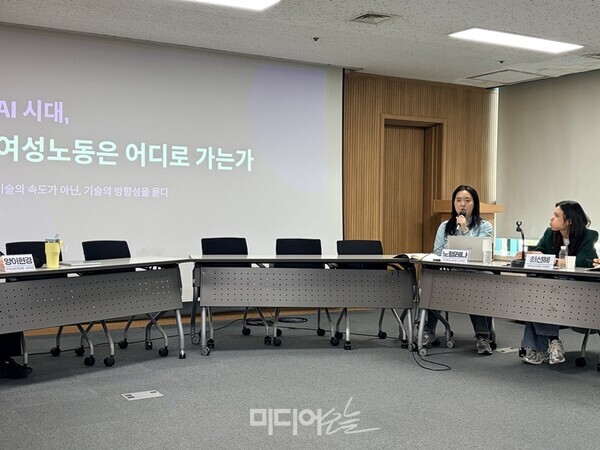
▲No
▲No Helena (left), secretary-general of the Korean Women’s Workers Association, speaks at the ‘Asking Gender About Social Changes Brought by AI’ roundtable hosted by the Korean Women’s Associations United on May 6 in Dongjak District, Seoul. Photo by Jeong Min-kyung.

Women’s work replaced by AI: emotional labor has intensified even as the work gets devalued

No Helena, secretary-general of the Korean Women’s Workers Association, said call-center work — a typical early target for AI substitution — illustrates the broader problem. \”AI now handles routine inquiries and repetitive responses, leaving humans to manage complex, emotionally charged consultations,\” she said. That shift does not reduce work; it makes it sharper, increasing emotional labor and skill requirements. Yet because the visible volume of tasks has fallen, employers often devalue the remaining work. Compensation has not kept pace with the increasing difficulty, turning this transitional phase into a more painful form of labor change.

No added that AI does more than replace jobs: during the transition it reshapes work in ways that can be more damaging and reinforces gender stereotypes. Kiosks and AI counselors typically use female voices. \”The technology may look new, but the gender roles embedded within it remain the same,\” she said. Longstanding beliefs that emotional labor and care are women’s responsibilities are being reproduced in technological form, strengthening existing stereotypes.

Daniel Kim
content@tenbizt.com

Comments0

300

Comments0

[Social] Latest Stories

  • Starbucks Korea CEO Fired Over Controversial ‘Tank Day’ Promotion
    Starbucks Korea CEO Fired Over Controversial 'Tank Day' Promotion
  • 25,000 Robots vs. Human Workers: The High-Stakes Battle at Hyundai
    25,000 Robots vs. Human Workers: The High-Stakes Battle at Hyundai
  • Hotel Hygiene Scandal: Cleaner Caught Using Guest Towels to Wipe Toilets
    Hotel Hygiene Scandal: Cleaner Caught Using Guest Towels to Wipe Toilets
  • South Korea’s Tech Giant Kakao Faces First Major Strike in 20 Years
    South Korea's Tech Giant Kakao Faces First Major Strike in 20 Years
  • South Korea’s Aging Crisis: How One Leader Is Redefining ‘Well-Dying’
    South Korea’s Aging Crisis: How One Leader Is Redefining 'Well-Dying'
  • Stop Calling Them ‘Hey You’: South Korea’s New Push for Worker Respect
    Stop Calling Them 'Hey You': South Korea's New Push for Worker Respect

Weekly Best Articles

  • Choi Dong-seok’s Family Bond: How a Simple Engraving Reveals Deep Love for His Children
  • Kwak Sun-hee’s Stunning Wedding Photos: A Celebration of Love and Courage
  • Is ‘I Am a Natural Person’ Just a Big Lie? Comedian Yoon-taek Reveals Shocking Secrets!
  • Health Scare: Why Fans Are Worried About Go Ji Yong’s Dramatic Weight Loss
  • Discover the Winter Gongju Chestnut Festival: A Taste of Korea at H-Mart in the USA!
  • 2026 Spring Wildfire Prevention: How Gyeryong City is Cutting Response Time to 30 Minutes!

You May Also Like

  • 1
    Ukraine’s EU Bid Surges as Hungary Drops Opposition Amid Russian Attacks

    Politics 

    Ukraine’s EU Bid Surges as Hungary Drops Opposition Amid Russian Attacks
  • 2
    Trump Backs Colombia's 'El Tigre' — What It Means for U.S. Relations

    Politics 

    Trump Backs Colombia’s ‘El Tigre’ — What It Means for U.S. Relations
  • 3
    Trump Backs Colombia's Far-Right Outsider—What's at Stake?

    Politics 

    Trump Backs Colombia’s Far-Right Outsider—What’s at Stake?
  • 4
    12.5% Tariff Hit: South Korea Faces New U.S. Trade Penalties

    Politics 

    12.5% Tariff Hit: South Korea Faces New U.S. Trade Penalties
  • 5
    12.5% Tariff Alert: Why the U.S. Is Targeting South Korean Imports

    Politics 

    12.5% Tariff Alert: Why the U.S. Is Targeting South Korean Imports

Popular Now

  • 1
    Marta Kostyuk Makes History at French Open Amid Ukraine Crisis

    Politics&nbsp

  • 2
    37 Years in Exile: The Tiananmen Leader Who Just Wants to Go Home

    Politics&nbsp

  • 3
    South Korea's Cheongju Airport Faces Crisis as Passenger Numbers Explode

    Politics&nbsp

  • 4
    Nuclear Submarine Race: South Korea's High-Stakes Bid for U.S. Fuel

    Politics&nbsp

  • 5
    France Finally Admits Complicity in the 1994 Rwandan Genocide

    Politics&nbsp

Weekly Best Articles

  • Choi Dong-seok’s Family Bond: How a Simple Engraving Reveals Deep Love for His Children
  • Kwak Sun-hee’s Stunning Wedding Photos: A Celebration of Love and Courage
  • Is ‘I Am a Natural Person’ Just a Big Lie? Comedian Yoon-taek Reveals Shocking Secrets!
  • Health Scare: Why Fans Are Worried About Go Ji Yong’s Dramatic Weight Loss
  • Discover the Winter Gongju Chestnut Festival: A Taste of Korea at H-Mart in the USA!
  • 2026 Spring Wildfire Prevention: How Gyeryong City is Cutting Response Time to 30 Minutes!

Must-Reads

  • 1
    Ukraine’s EU Bid Surges as Hungary Drops Opposition Amid Russian Attacks

    Politics 

    Ukraine’s EU Bid Surges as Hungary Drops Opposition Amid Russian Attacks
  • 2
    Trump Backs Colombia's 'El Tigre' — What It Means for U.S. Relations

    Politics 

    Trump Backs Colombia’s ‘El Tigre’ — What It Means for U.S. Relations
  • 3
    Trump Backs Colombia's Far-Right Outsider—What's at Stake?

    Politics 

    Trump Backs Colombia’s Far-Right Outsider—What’s at Stake?
  • 4
    12.5% Tariff Hit: South Korea Faces New U.S. Trade Penalties

    Politics 

    12.5% Tariff Hit: South Korea Faces New U.S. Trade Penalties
  • 5
    12.5% Tariff Alert: Why the U.S. Is Targeting South Korean Imports

    Politics 

    12.5% Tariff Alert: Why the U.S. Is Targeting South Korean Imports

Popular Now

  • 1
    Marta Kostyuk Makes History at French Open Amid Ukraine Crisis

    Politics 

  • 2
    37 Years in Exile: The Tiananmen Leader Who Just Wants to Go Home

    Politics 

  • 3
    South Korea's Cheongju Airport Faces Crisis as Passenger Numbers Explode

    Politics 

  • 4
    Nuclear Submarine Race: South Korea's High-Stakes Bid for U.S. Fuel

    Politics 

  • 5
    France Finally Admits Complicity in the 1994 Rwandan Genocide

    Politics