
Translation result.
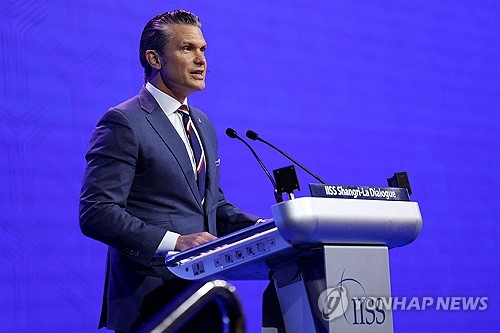 샹그릴라대화 연설 나선 헤그세스 미 국방장관[싱가포르 로이터=연합뉴스 제공][싱가포르 로이터=연합뉴스 제공]
U.S. Defense Secretary Pete Hegseth called the Lee Jae-myung administration’s intent to transfer wartime operational control “encouraging” during the Shangri-La Dialogue in Singapore on the 30th (local time). He also stressed the need to balance the transfer with U.S. operational plans and longstanding responsibilities to U.S. service members.In the Q&A after his speech, Hegseth said he had lengthy talks with U.S. Forces Korea commander Javier Brunson and discussed the issue with South Korean Defense Minister An Gyu-baek during An’s visit to the United States earlier this month. He welcomed Seoul’s push, saying it is “encouraging when an ally seeks to exercise more control sooner — an instinct we want to keep encouraging.” He added, however, that any transfer must strike a balance that respects U.S. operational plans and the responsibilities U.S. troops have carried for decades.His remarks appeared to both welcome the Lee administration’s move to expand allied burden-sharing — a policy emphasis under the Trump administration — and signal that the U.S. will realistically weigh the impacts on operational practices and troop morale.Brunson said the key to an OPCON transfer is ensuring “we have the right capabilities at the right time and place, and that we reflect alternative perspectives.” Under an agreement to base the handover on meeting specified conditions, Seoul aims to complete the transfer as early as next year. Washington, however, has pointed to the first quarter of 2029 — a period that would span outgoing and incoming U.S. administrations — highlighting a timing gap between the two countries.Hegseth also cited South Korea as a model for Asian allies increasing defense spending. “South Korea cannot treat war as an academic exercise, so it has steadily invested in defense,” he said. “Positioned on the front line, Korea has built real combat capability.” He praised President Lee’s decision to raise defense spending to the new international benchmark of 3.5% of GDP and to assume greater responsibility for conventional defense, saying it reflects a clear recognition of the threat environment. “It won’t be easy, but it’s essential for Korea’s security and prosperity,” he added, calling the decision a firm, reality-based response.“We applaud Korea’s pragmatism and leadership,” Hegseth said, warning that if other allies and partners follow Korea’s path, the region “will become far more stable and secure.” He made clear the United States will treat allies differently based on how actively they share the burden. “Countries that shoulder responsibilities as true partners will receive clear benefits,” he said, adding that the U.S. will fast-track weapons sales, deepen industrial cooperation, and expand intelligence sharing for those partners. He warned, “Countries that expect to keep freeloading on American taxpayers should heed our words — that era is over,” and said allies who do not do their part for collective defense “will face clear changes in how we cooperate with them.”Hegseth emphasized, “President Trump made helping countries become self-reliant a principle, and the Department of Defense holds the same view. That is the essence of burden sharing.”Separately, Brunson addressed controversy over comments he made on a U.S. Army War College podcast on the 22nd, when he described South Korea as “a dagger positioned at the center of Asia” from China’s perspective. He referenced a Prussian military strategist who likened Korea to “a dagger aimed at Japan,” saying the point was to shift perspective and consider how other countries in the region view the United States and South Korea. Brunson framed the “dagger” remark as an effort to encourage policymakers to put themselves in Beijing’s shoes when responding to security threats from China.#Hegseth #AsiaSecurityConference #ShangriLaDialogue #OPCON #BurdenSharing #ROKUSAlliance Yonhap NewsTV inquiries and tips: KakaoTalk/LINE jebo23 Jang Hyo-in (hijang@yna.co.kr)











Most Commented