
Translation result
“Pursue the parallel strengthening of the alliance and of self-reliant defense to counter North Korea’s nuclear and missile threats”
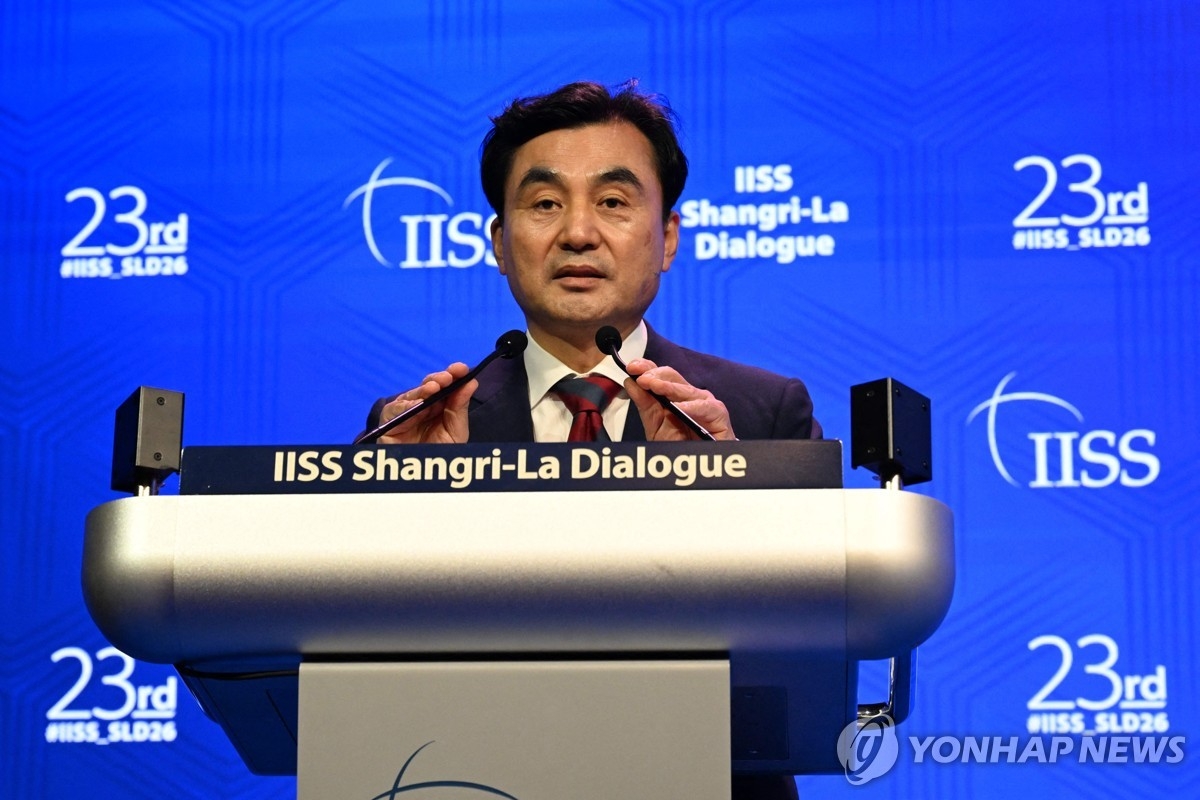 Attending the 23rd Asia Security Conference (Shangri-La Dialogue) in Singapore, Defense Minister An Gyu‑baek told reporters on the 30th that when asked about the recent controversy over U.S. Forces Korea commander Javier Brunson’s remark that \”South Korea is a dagger aimed at China,\” he replied, \”I regularly communicate with (Pete) Hegsees of the U.S. Department of Defense whenever issues arise, so I do not regard that matter as particularly significant.\”
In his speech that day, Hegsees gave a positive assessment of South Korea’s nuclear-powered submarines and its push to assume wartime operational control (OPCON), calling those moves highly significant and saying the allies’ evaluations and mutual trust run very deep.
An said those remarks appeared to have signaled to the international community that South Korea has consistently prepared for the OPCON transfer in a systematic, stable, and proactive manner.
Meanwhile, An said he will pursue parallel progress in strengthening the alliance and enhancing self-reliant defense to respond to a more uncertain global security environment and to threats such as North Korea’s nuclear and missile programs.
In his plenary address at the Asia Security Conference on \”Regional Security Challenges and the Republic of Korea’s Strategic Response,\” he outlined that approach.
He cited North Korea’s hostile \”two-state\” rhetoric toward the South, the advancement of its nuclear and missile capabilities, and military cooperation between North Korea and Russia, warning that as the situation on the Korean Peninsula becomes more tightly linked with international security, developments on the peninsula are now a major variable in global security.
In response, An stressed that South Korea will pursue both alliance strengthening and the reinforcement of autonomous defense.
He said, \”While maintaining a robust ROK-U.S. combined defense posture, our military will actively strengthen independent capabilities so that the Republic of Korea can take the lead in defending the peninsula. We will further develop the Korea-specific three-axis system to counter North Korea’s nuclear and missile threats and deepen and advance extended deterrence cooperation with the United States.\”
He highlighted efforts to develop AI-based detection-and-strike systems, manned-unmanned integrated combat systems, and enhanced cyber and space capabilities, adding, \”Through high-tech, self-reliant efforts, the Republic of Korea will play a more leading role in defending the peninsula.\”
An also said Seoul will pursue multidimensional security cooperation with the international community and mentioned the Korean government’s role in restoring normal navigation in the Strait of Hormuz.
\”Our government attaches great importance to guaranteeing freedom of navigation in major sea lanes based on international law,\” he said. \”Accordingly, we are participating in various international efforts to secure the Strait of Hormuz and are actively reviewing realistic contribution measures that take domestic law into account.\”
Those remarks followed the government’s release of an investigation that effectively identified Iran as the attacker in the Namu ship shooting incident in the Strait of Hormuz. He did not provide details on concrete contribution measures such as dispatching warships.
An went on to declare, \”Maintaining stability on the Korean Peninsula is directly linked to world peace,\” and pledged to pursue a consistent policy of peaceful coexistence on the peninsula. \”The Republic of Korea will uphold the firm principle that the most certain form of security is a peace in which fighting is unnecessary,\” he said. \”We will maintain strong deterrence against North Korea’s threats and pursue a policy of peaceful coexistence that builds a sustainable system through inter-Korean dialogue.\”











Most Commented