
Translation result.
“Shipping and ports…as national strategic industries”
Opening Arctic routes and developing a southern maritime capital
Target: launch regular Korea–Europe routes by 2030
Establish Southeast Investment Corporation and maritime court in Busan
Link ports, airports and railways in ‘tri-port’ development
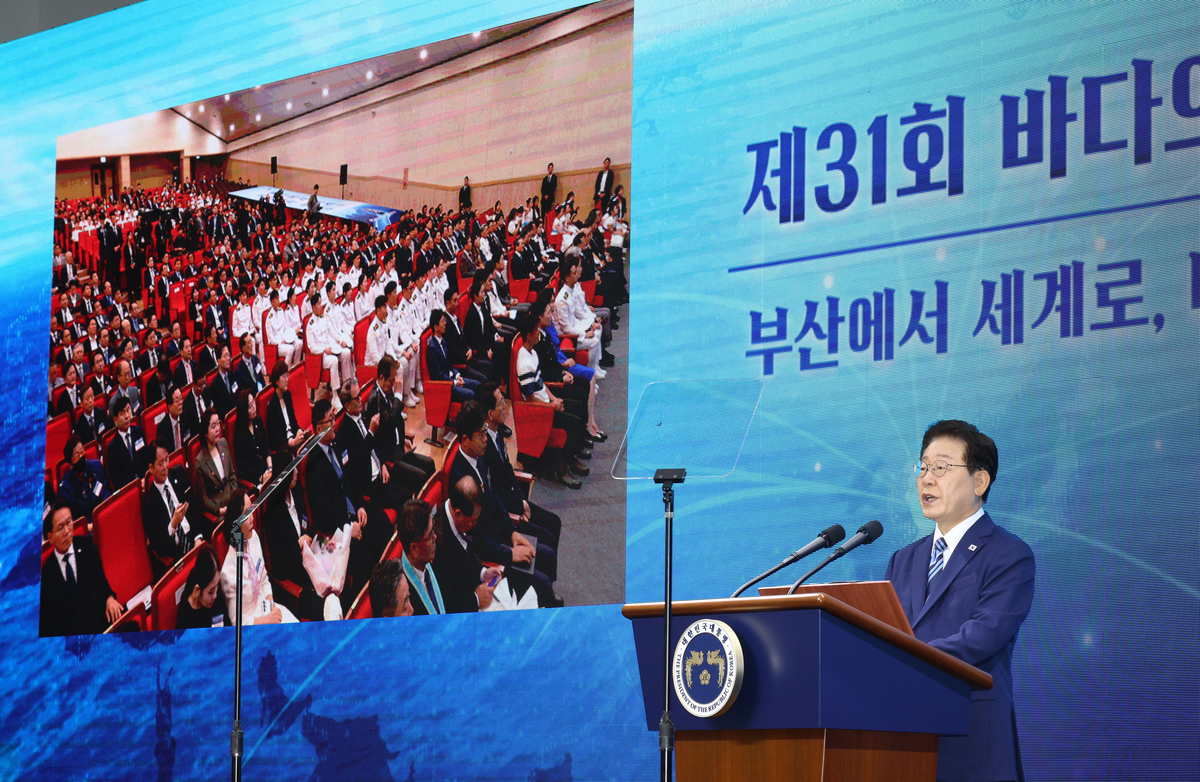 President Lee Jae‑myung visited Busan on May 27 and pledged to accelerate the realization of the maritime powerhouse envisioned by former President Kim Young‑sam, saying his administration will designate shipping and port operations as national strategic industries. The government identified Arctic-route development and creation of a southern maritime capital as core priorities and published a roadmap that calls for pilot round‑trip sailings between Busan and Rotterdam in the second half of this year, with the goal of establishing regular Korea–Europe services by 2030.
At the 31st Sea Day ceremony at Korea Maritime and Ocean University in Yeongdo, Busan, Lee said the 1996 establishment of the Ministry of Oceans and Fisheries under Kim Young‑sam demonstrated a strong national will to become a maritime power, and he vowed his government would lead a new maritime order.
The administration stressed it will treat the shipping industry not as mere logistics but as a strategic sector underpinning the national economy and security — a response to heightened strategic concerns around recent Middle East conflict, risks in the Strait of Hormuz, and the reconfiguration of global supply chains.
Lee said the government will accelerate recovery of global shipping supply chains so South Korea can exercise greater control over them. He pledged to build a cooperative shipping-and-shipbuilding ecosystem and to expand marine insurance, ship finance and a broader maritime services industry. He also framed the southern maritime capital as more than a regional development project: it is, he said, a national survival strategy that links the maritime-power vision to jobs and balanced regional growth.
Referring to his campaign pledge to relocate the Ministry of Oceans and Fisheries to Busan, Lee promised to promptly establish the maritime court whose enabling legislation has been passed, and to quickly complete an integrated maritime cluster — including the Southeast Investment Corporation — once parliamentary procedures conclude.
Minister of Oceans and Fisheries Hwang Jong‑woo publicly outlined plans for relocating companies and public agencies. Hwang said the government will recruit additional shipping and logistics firms following HMM, begin relocating maritime public agencies next year, establish the Southeast Investment Corporation in 2027, and open an international maritime commercial court in 2028.
As a first step in opening Arctic routes, the government will begin pilot round trips between Busan and Rotterdam in the second half of this year. Hwang said the plan includes expanding the national icebreaker fleet, training polar specialists, developing the new Jinhae port, and building infrastructure for clean fuels, with the aim of launching regular Korea–Europe services by 2030. The government also plans to position Busan as an Asian logistics hub by attracting multimodal freight and developing integrated connections among ports, airports and railways through a ‘tri-port’ strategy.
Hwang compared the southern maritime capital strategy to Singapore’s model, noting that Singapore — situated on two major international trunk routes — grew its population by 74% and its GDP by 6.5 times over 30 years through deregulation, corporate attraction and development of high‑value related industries. He argued that the Southeast region, with access to three major international trunk routes including the Arctic corridor, can achieve even greater growth.
The government laid out more concrete industrial strategies: leveraging K‑shipping and shipbuilding cooperation to secure a decisive lead in autonomous and eco‑friendly vessels, promoting knowledge industries such as marine finance and maritime law, expanding ship maintenance, repair and overhaul (MRO) capacity, and growing the green bunkering sector.
Regional specialization plans were detailed for Busan, Ulsan and South Gyeongsang. Hwang said Busan will be developed as an international maritime finance and business center concentrating administrative, judicial, economic and financial functions; Ulsan will be positioned as a green‑energy hub to support future fuel transitions; and South Gyeongsang will be cultivated as a core advanced marine ecosystem combining ports, logistics, manufacturing and AI.
The southern maritime capital initiative also includes talent development and residential planning. The government will build a regional transit network to create a “one‑hour living zone” across the Southeast, and will expand housing, education and cultural infrastructure to improve living conditions. The Korea Shipping Association, the public foundation Badaui Pum, and HMM signed an MOU with Korea Maritime University and Mokpo National Maritime University to develop future talent. HMM and 27 other shipping firms will provide 5 billion KRW to each of the two national maritime universities — 10 billion KRW in total (approximately $3,750,000 and $7,500,000 USD, respectively) — and will help establish industry‑linked, hire‑track academic programs to attract and retain young talent.












Most Commented