
Translation result
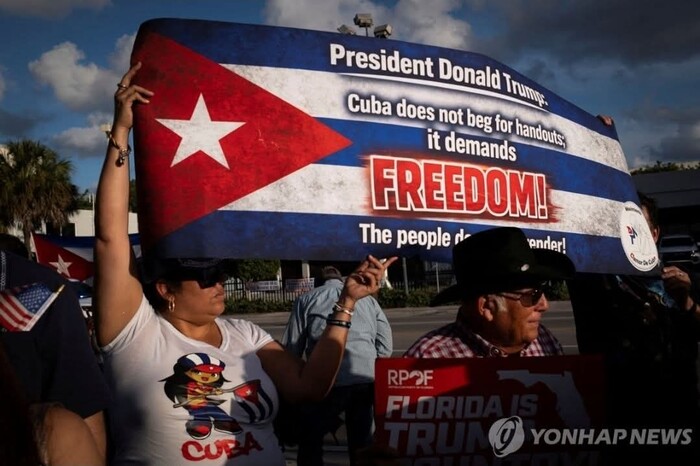
As President Donald Trump has failed to produce decisive results on major foreign-policy fronts—Iran, Ukraine and the Gaza Strip—analysts say he has shifted to a hard-line campaign targeting Cuba as a new diplomatic gamble.
Observers note that the indictment of former head of Cuba’s Council of State Raúl Castro and measures to cut off the island’s oil supply go beyond routine sanctions and appear aimed at destabilizing the Cuban leadership.
On the 21st (local time), U.S. media described the Trump administration’s recent Cuba strategy as reflecting “diplomatic impatience.” Since returning to the White House, Trump has vowed to end the war in Ukraine, secure a Gaza cease-fire and resolve the Iran nuclear issue, but he has yet to produce tangible results. Instead, tensions in the Middle East and Eastern Europe have become more complex.
Against that backdrop, Cuba has emerged as a new pressure point. Earlier this year the administration moved to choke off Cuba’s oil supply chain. It then abruptly indicted 94-year-old Raúl Castro over a plane shootdown from three decades ago. While officials framed the indictment as an effort to clarify a past incident, many analysts view it primarily as a political and diplomatic move aimed at Cuba’s ruling circle.
Trump’s recent remarks—that the United States “could take over Cuba” and is “liberating Cuba”—have further elevated tensions. Increased U.S. intelligence activity near Cuban waters and airspace is being read as a signal of heightened military pressure. Some analysts see parallels with past U.S. pressure campaigns against Iran and Venezuela.
Within political and academic circles, some argue Trump may be pursuing the historical symbolism of becoming “the U.S. president who toppled the Castro regime.” Since the Cold War, no U.S. president has succeeded in dismantling Cuba’s communist system, so a confrontation over Cuba could offer a way to reclaim foreign-policy leadership while energizing hard-line conservatives.
Yet most experts judge a U.S. military intervention unlikely in practical terms, pointing to widespread American fatigue with new overseas military engagements.
Recent polls show a majority of Americans oppose escalating military tensions related to Iran and Cuba.
Democrats have hit back immediately. Democratic lawmakers criticized the administration’s hard-line approach, saying, “Americans want relief from rising living costs, not bombings in Cuba,” and accusing the White House of trying to exploit a foreign-policy crisis for political gain ahead of the election.
International specialists warn that if a military option were to materialize, the consequences could be severe. They note that decades of sanctions have led Cuba to develop nationwide resistance mechanisms; U.S. military action could result not only in U.S. casualties but also civilian deaths and an intensified wave of anti-American sentiment across Latin America.
In sum, analysts say Trump’s pressure campaign against Cuba is more than a standard foreign-policy maneuver: it is a political and strategic gamble intended to break through a deadlocked international landscape. Whether this hard-line approach can produce regime change remains uncertain, and many caution it risks provoking a broader international crisis.














Most Commented