
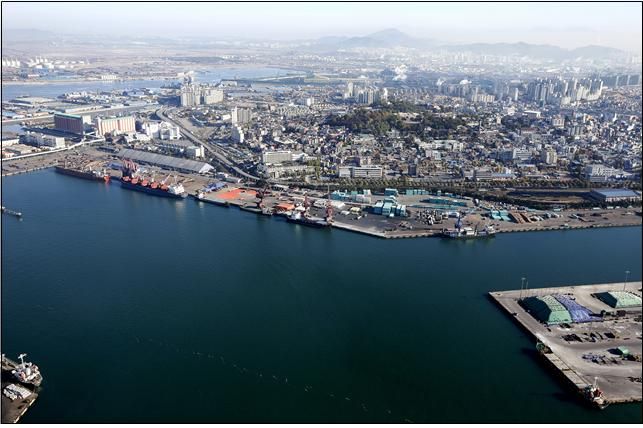
Debate over restructuring Incheon’s two strategic assets — its airport and its port — has moved forward simultaneously, raising tensions across the local community.
On the 21st, political circles in Incheon reported that proposals to consolidate airport operations have resurfaced both within government and among lawmakers. At the same time, Park Chan-dae, the mayoral candidate from the Democratic Party of Korea, pledged to relocate the Incheon Port Authority (IPA) to Jemulpo Pier, prompting concerns that the city’s core infrastructure could be destabilized.
Currently, South Korea’s airport system is split between Incheon International Airport Corporation and Korea Airports Corporation.
Discussion broadened after the idea of including the Gadeokdo New Airport Construction Authority in a unified management structure was raised, intensifying the debate.
Advocates say integration would improve efficiency and eliminate duplicated functions.
But many in Incheon fear that revenue from Incheon Airport would be tapped to offset persistent deficits at regional airports and to subsidize the construction of new airports.
Indeed, while many regional airports across the country run chronic deficits, Incheon Airport posts operating profits in the hundreds of billions of KRW each year — equivalent to several hundred million U.S. dollars — and functions as the nation’s only global hub.
Critics warn that if integration proceeds, investment funds earmarked for Incheon Airport could be dispersed, weakening its long-term competitiveness.
Competition to serve as the Northeast Asian hub is intensifying.
Hong Kong International Airport is pursuing a major expansion, and Shanghai Pudong and Taiwan’s Taoyuan airports are accelerating runway and terminal enlargements.
Analysts say that if Incheon Airport’s capacity to invest is diminished under these conditions, it could fall behind in the regional hub competition.
The port sector is following a similar trend.
After the Ministry of Oceans and Fisheries relocated to Busan, maritime public agencies and large shipping companies increasingly concentrated there. Park’s pledge to relocate the IPA has heightened local apprehension.
Park’s campaign frames the proposal as a policy to balance development in the old downtown and to revitalize Jemulpo, but some observers see it as more than a simple administrative move.
Because the Port Authority Act allows integrated operations between adjacent ports, combining this relocation plan with future discussions about reorganizing port functions could alter Incheon Port’s status.
A local business leader said, “Airports and ports are not just Incheon’s assets; they are national critical infrastructure that underpin South Korea’s logistics competitiveness. These recent developments may appear to be discrete issues, but together they could weaken Incheon’s strategic role, which worries residents.”
He added, “What we need now is not merely an organizational reshuffle. We need a long-term vision for how to preserve and strengthen Incheon’s airport and port systems as part of a national growth strategy.”
© Dailyan Co., Ltd. Unauthorized reproduction and redistribution prohibited
- Memory: 600 million KRW (approximately $450,000)? Loss-making division: 160 million KRW (approximately $120,000)? We dug into how Samsung calculates bonuses
- Jeong Jeom-sik: Samsung Electronics bonus issue is ‘just beginning’… Lee administration, re-amend the Yellow Envelope Act
- Samsung avoided a full strike, but 5 million shareholders remain sidelined amid labor-management conflict
- In Ulsan’s multi-candidate race, Kim Sang-wook 37.3%, Kim Du-gyeom 35.9%…a neck-and-neck result within the margin of error [Realmeter]
- [6·3 pick] Han Dong-hoon to Park Min-sik’s ‘traitor’ attack: Are you talking about yourself? You should have stayed quiet













Most Commented