
Kwon Young-guk’s Bold Promises for Seoul: Will His ‘Labor-Friendly City’ Plans Reshape the Future?
Daniel Kim Views
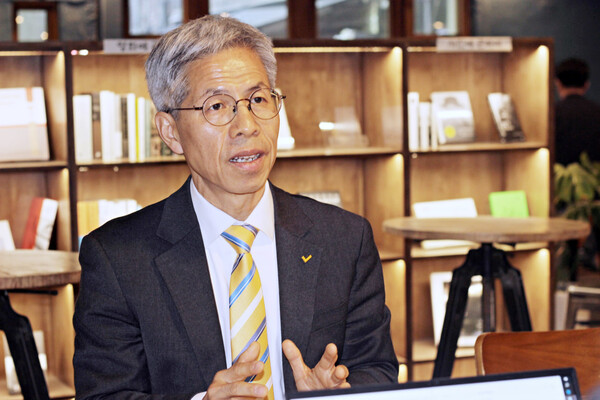
Kwon Young-guk, the Justice Party leader running for Seoul mayor in the June 3 local elections, announced his candidacy in front of Yongsan Station on April 8. He chose a spot near the former Namildang site—the scene of the 2009 Yongsan tragedy—and adjacent to the Yongsan train maintenance depot that Mayor Oh Se-hoon plans to redevelop as an international business district. Kwon said he picked Yongsan to directly challenge a city administration that, he argues, has pursued displacement-driven development for 17 years.
His campaign’s core slogans, Appropriate Seoul and Let’s live together, let’s go together, promise to reshape the city into one that coexists with surrounding areas—one that protects human dignity rather than building ever larger, flashier spaces where longtime residents can no longer afford to live. Aiming to make Seoul a city where people can live on labor income, he has proposed three essential public-service pledges focused on housing, transit and healthcare. They include capping annual out-of-pocket hospital bills at 1,000,000 KRW (approximately $750) starting with children; making public transit free; and supplying 50,000 public rental homes a year while imposing limits on rent increases.
The goal of creating a Seoul where workers can survive also shapes his proposed response to the TBS crisis. Kwon stands out as the only candidate framing the threat to TBS as a question of workers’ right to livelihood. In the April 30 interview, he called TBS a prominent example of Mayor Oh’s media suppression and said the Democratic Party’s actions during the recent supplementary budget process left people feeling betrayed. He added that, if elected, he would review contingency funds and push for urgent financial support.
On recent election coverage, he criticized the press for largely ignoring smaller parties: The media doesn’t just show insufficient interest—they give us no attention at all. Calls to report proportionally on minor-party candidates have become meaningless. That’s the biggest problem, he said. Below is a Q&A.
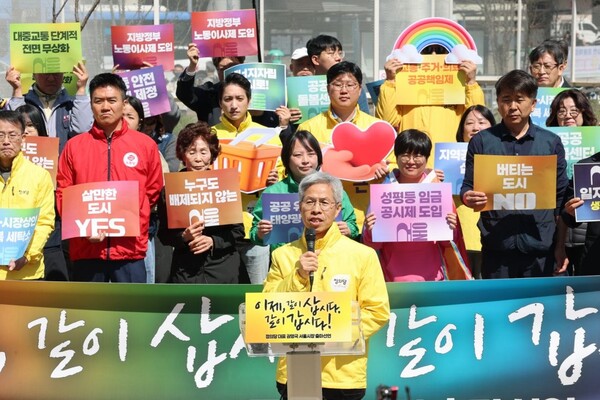
“A city where workers can make a living without investing — the spirit of our time”
– Why did you announce your candidacy at Yongsan?
“Yongsan is a symbolic site in Seoul’s development history. In 2009, an attempt to evict tenants at the old Namildang building led to a prolonged standoff and a subsequent forced crackdown. The pattern has been to displace people who have long built their lives and opportunities in a neighborhood, then replace them with high-rise developments catering to wealthier newcomers. I once served as counsel for displaced residents. Even then, Mayor Oh Se-hoon was in office. His approach hasn’t changed in 17 years. From adjusting bus routes along the Han River to redevelopment around Jongmyo, the city keeps creating skyscrapers and landmarks that make neighborhoods unaffordable for tenants and wage earners. They’ve proposed turning Eunpyeong Innovation Park into commercial space and selling the Yongsan maintenance depot to private developers. I chose Yongsan to directly challenge this model of ‘development that pushes people out.’”
– Your core concept is ‘Appropriate Seoul.’ You’ve pledged to guarantee housing, healthcare and transit as public services. Can you explain?
“Past policies that funneled resources toward central Seoul created a single dominant core and led to overcrowding. That growth drove housing costs sky-high, produced transit chaos, and raised the overall cost of living. Seoul has become a place where working people cannot live securely. We need to deflate that overinflated balloon. ‘Appropriate Seoul’ means shifting away from ever-larger, flashier projects toward spaces that coexist with other regions and protect human dignity rather than forcing people to merely survive. Just as we enacted free school lunches, public transit can be discussed as a public good. Everyone who’s sick should be able to receive care. Food costs are especially high—household food spending averages about 910,000 KRW per month (approximately $682.50). We’re even exploring city-run public breakfast programs.”
– ‘Appropriate Seoul’ resembles New York Mayor Eric Adams’ ‘affordability’ theme. Do you see a parallel?
“I regard guaranteeing a city where people can live on labor income as the defining imperative of our time. Today’s Seoul makes it nearly impossible to cover housing and living costs no matter how hard you work. If nothing changes, only those who inherit assets or receive external help will be able to live here. Is it normal for working people to be pushed to the periphery? Officials say ‘make up the gap with investment,’ but that shifts responsibility and risk to individuals. If investments fail, people fall into an unrecoverable abyss. When I say ‘a city where people can live on labor income,’ I mean ‘without needing to rely on speculative investment.’”
On TBS: “Stop the shutdown first…provide emergency aid to restore normal operations”
– You described TBS as ‘a prime example of Mayor Oh’s press suppression’ and said the Democratic Party betrayed it during the recent budget process. Can you elaborate?
“Last year lawmakers attempted to pass emergency support funds that failed. This time the funds were included in a supplementary budget and were later removed by party leadership. Labeling it a ‘war supplementary budget’ may have raised controversy, but the urgent issue is that TBS faces an imminent shutdown. If decision-makers had seriously weighed the need to prevent a shutdown, the outcome might have been different. It’s deeply regrettable. While the relevant committees considered many factors, a single remark from a party leader undone what had been decided.”
– You met with TBS management and labor on April 28. What did you learn?
“The meeting clarified the situation on the ground. I recall visiting around the 2024 general election when the ordinance was being repealed. Since then, funding was cut and staff have been keeping the station running like unpaid volunteers for about 19 months. Hearing that was heartbreaking. The fate of these broadcast workers can hinge on a single judgment by Seoul’s administrative leader. After enduring persistent threats to their livelihoods while keeping the station on air, the continued neglect feels irresponsible.”
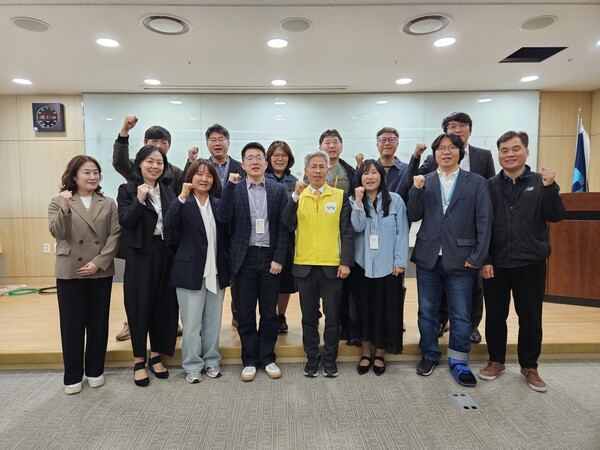
– With Seoul’s funding cuts, TBS faces the risk of losing its broadcast signal. You pledged to issue emergency orders—how would you resolve the TBS crisis if elected mayor?
“Our immediate priority must be to prevent a shutdown and a halt to broadcasting. TBS has missed payments for transmission fees for two months and will stop broadcasting if it misses another payment. We must provide immediate fiscal and administrative support for the station’s most urgent needs. If elected, I will scrutinize contingency funds and push for emergency financial aid—first to cover transmission fees and then to secure payroll for essential professional staff. The current leadership is largely in acting positions and cannot exercise full authority; we must appoint a CEO to normalize decision-making and execution. We should also begin restoring the repealed ordinance and consult with the Ministry of the Interior and Safety and the Korea Communications Commission to restore TBS’s legal and operational status.”
– You emphasize ‘workers’ right to survive’ with regard to TBS. How should the city address nearly two years of unpaid wages?
“This will be a significant issue during TBS’s recovery. After 19 months without pay, many workers’ households are close to bankruptcy, and individuals are surviving on temporary or part-time jobs. Given that Seoul’s actions have effectively pushed the station toward closure and compromised employees’ livelihoods, this is a serious labor-rights matter. We must investigate carefully and address it through phased, deliberate measures.”
– How would you restructure TBS’s funding and operations?
“Deciding whether TBS should remain a Seoul-funded entity or transition to another public-broadcasting model requires careful consultation with the station’s staff, the Seoul government, and the Korea Communications Commission. The first step is to restore the ordinance, followed by a thorough, long-term discussion about TBS’s role. Climate change has raised the importance of disaster and traffic-focused broadcasting, but TBS has historically provided civic, educational and multicultural programming as well. We should strengthen TBS’s specialist capacities and, through internal deliberation, aim to program a balanced mix of public affairs and cultural content consistent with the station’s founding purpose.”
The media gives not just insufficient interest to small parties—it gives none. They must show basic fairness.
– Some argue that municipal control over public-broadcast budgets can threaten media independence. What’s your view?
“Tension between political power and the media is not unique to TBS. The Yoon administration pushed for separate collection of KBS license fees in a way that created a financial strain for KBS. Public broadcasters must function as checks on power. We should minimize Seoul’s dependence and diversify revenue sources for TBS. The Korea Communications Commission has conditionally reauthorized TBS with limits on commercial advertising; exploring multiple funding avenues is necessary.”
– The press has given minor-party candidates, including the Justice Party, inadequate coverage in local elections. How do you respond?
“They don’t just show insufficient interest—they give us no attention at all. Media coverage treats the race as if only the Democratic Party and the People Power Party exist. The fundamental problem is that coverage ignores candidates outside the two major parties, rendering calls for proportionate reporting meaningless. Even when multiple mayoral candidates voice distinct positions, coverage often presents only two viewpoints and polls frequently exclude other contenders. During the presidential cycle, it took protests and complaints to media outlets and pollsters before minor-party candidates were included. The media should at minimum observe basic fairness toward all candidates.”













Most Commented