
Reform Party’s Lee Jun-seok Challenges Political Norms: Is It Time for a New Choice in South Korea’s Elections?
Daniel Kim Views
Translation result
Reform New Party leader Lee Jun-seok likened the entrenched two-party political establishment to \”beans and red beans\” on April 19, saying, \”This election should demonstrate that voters do not have to choose between the two.\”
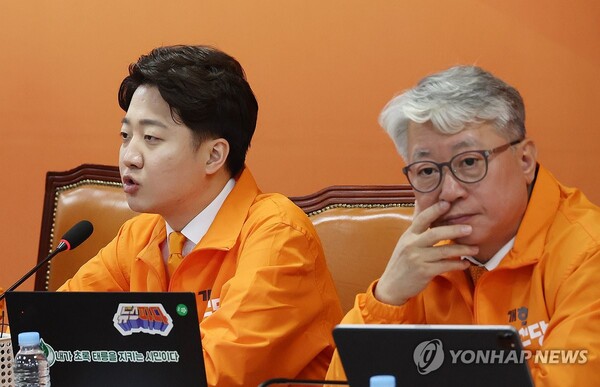
He attended the Seoul party’s local election vision briefing and send-off ceremony at the National Assembly Members’ Office Building and warned, \”If you plant beans or red beans and dislike the outcome, choosing between those same two options again will produce the same result.\”
Lee urged voters not to repeat the same \”grain farming\” choice this time. Instead, he said, they should make his party a clear alternative by \”planting orange trees\” — a reference to the Reform New Party’s signature color. Observers interpreted the remark as an appeal for voters to back his party in the local elections rather than one of the two major parties.
Lee noted that when he previously led the People Power Party he helped carry candidates to victory. \”This time, I want to write a new chapter under the Reform New Party’s name,\” he said, adding that he hopes to work with supporters to bring about another significant change in South Korean politics.
Meanwhile, the Reform New Party is reportedly courting former lawmaker Cho Eung-chun as its candidate for governor of Gyeonggi Province in the June 3 local elections. Cho served as secretary for public service ethics during the Park Geun-hye administration, later joined the Democratic Party for the 20th general election, and won re-election in Namyangju Gap, Gyeonggi Province.
After clashing with the pro-Moon faction, he left the Democratic Party ahead of the 22nd general election, joined the Reform New Party, ran in Namyangju Gap as its candidate, and was defeated.











Most Commented