
Why Constitutional Reform is Essential to Prevent Future Martial Law in South Korea
Daniel Kim Views
Translation result.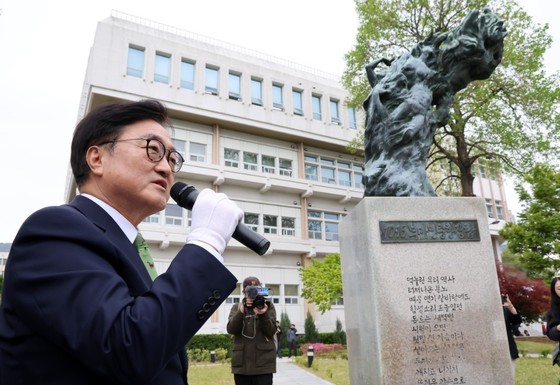
National Assembly Speaker Woo Won-sik visited Busan on April 14 and said a constitutional amendment is necessary to ensure no one ever again contemplates imposing illegal martial law.
That day he visited Busan National University, the birthplace of the Bu-Ma Democratic Uprising, laid a wreath at the Bu-Ma People’s Uprising monument and said the uprising’s meaning must be firmly inscribed in the country’s history so the same events are not repeated.
Woo said he will work to carry forward the civic passion and courage displayed during the Bu-Ma Uprising so that South Korea can continue to develop as a modern democracy with strong economic growth. He emphasized that the National Assembly must lead the effort to break with past wrongs and craft a constitution oriented toward the future.
Jeon Jae-soo, the Democratic Party’s candidate for Busan mayor who joined the event, supported the proposal. He said the constitution’s preamble should record the May 18 Gwangju Democratic Movement and the Bu-Ma Uprising, and that constitutional change is needed to prevent tragic episodes like martial law from recurring in South Korea.
He criticized the People Power Party, saying he could not understand why they oppose constitutional revision when there is basic agreement across parties that martial-law–style violations of constitutional order must never happen again.
On April 3, six political parties excluding the People Power Party jointly proposed a constitutional amendment that would enshrine the spirit of the Bu-Ma Uprising and the May 18 movement in the constitution’s preamble, require parliamentary approval for presidential declarations of martial law, and elevate the National Assembly’s right to request the lifting of martial law to the authority to order its lifting.
Woo said he supports holding a national referendum on constitutional revision alongside the June 3 local elections.
Earlier, he paid respects at Busan Democracy Park and wrote in the guestbook: “I will enshrine the noble meaning of the Bu-Ma Democratic Uprising in the constitution and further strengthen the roots of democracy in South Korea.”
At a subsequent meeting with the citizen-led committee advocating the inclusion of the Bu-Ma Uprising in the constitution’s preamble, he described the uprising as more than regional pride—a proud chapter of South Korea’s history—and stressed that recording it in the preamble would fully reflect the historical trajectory and lineage of the nation’s democratic constitutional order.
He added that the experience of the Dec. 3 emergency martial law has made it imperative to reaffirm constitutional democratic values. He said he hopes the day’s events will both reaffirm the public’s commitment to that democratic history and open the door to constitutional reform as the country moves forward.









Most Commented