
Political Loyalty or Artistic Expertise? The Controversial Appointment of 서승만 as 정동극장 CEO
Daniel Kim Views
Translation result
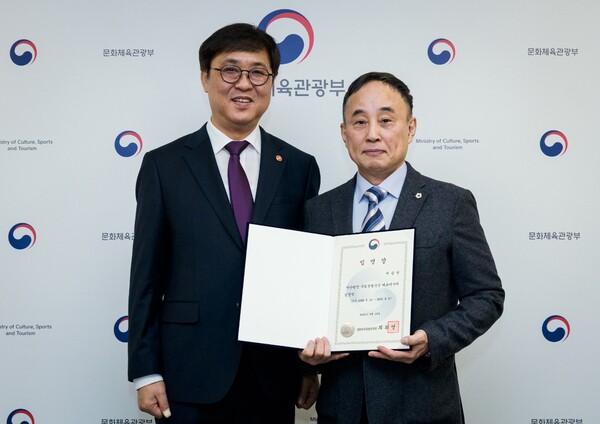
The Lee Jae-myung administration is facing criticism for appointing a comedian known for vocally defending the president and attacking citizens who raised questions about the Daejang-dong scandal. Critics have labeled the appointment a political reward, a parachute hire, and an act of political quid pro quo.
On April 10, Culture, Sports and Tourism Minister Choi Hwi-young appointed comedian Seo Seung-man as chief executive of the National Jeongdong Theater foundation for a three-year term. The ministry described Seo as a performing-arts and content planner with experience in broadcasting, directing and theater management, noting that he holds a Ph.D. in public administration from Kookmin University and has served as artistic director of Theater SangSangNanum, director of the small SangSangNanum Theater, president of the Korea Safety Culture Association, publicity chair of the Korean Association for Public Administration, and publicity ambassador for the Ministry of the Interior and Safety.
Minister Choi said he expects Seo to apply his field experience and promotional skills to strengthen the National Jeongdong Theater’s role as a tourist asset on Jeongdong-gil and to play a central role in bringing outstanding performances to global audiences.
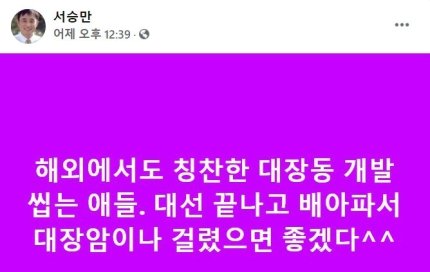
Seo has been a long-standing supporter of President Lee Jae-myung and has used harsh language to defend him against allegations. On Sept. 22, 2021, he posted on Facebook, “Those who trash-talk the Daejang-dong development that even earned praise abroad — I hope they get stomach pain and end up with colon cancer after the election^^.” After heavy criticism, Seo issued a public apology two days later, on Sept. 24, saying, “I sincerely apologize for using words that should never have been used,” and that he deeply regretted thoughtlessly turning a pun about ‘Daejang-dong’ into ‘colon cancer.’ He added that he had been arrogant about his humor. Seo later deleted those posts from Facebook.
On Jan. 3, 2022, Seo published a column titled “You Call Me a Swearer?” on the Democratic Party’s communication app, Lee Jae-myung Plus, where he suggested, in reference to the brother-in-law’s abusive remarks, that “I would have done worse,” drawing further criticism for coarse language.
On Feb. 20 last year, ahead of the 22nd general election, Seo announced at a National Assembly press briefing that he would run as a proportional-representation candidate for the Democratic Party. He said, “Some may ask, ‘What does a comedian have to do with politics?’ But as an ordinary citizen, I feel fear and urgency about a reality that’s more unreal than drama and funnier than comedy. I’m somewhat embarrassed to be raising my voice only now.” Seo did not win a proportional seat.
On April 12, People Power Party chief spokesperson Choi Bo-yun condemned the appointment as “an affront to public common sense and the pride of the performing-arts community,” calling it a textbook case of political patronage and a “code appointment” that hands public posts to regime loyalists.
Choi argued that appointments to public institutions have degraded from being based on expertise to being determined solely by political loyalty. He questioned whether someone who has used vitriol and crude language is fit to lead a symbolic institution of Korea’s modern performing arts, the National Theater. “The core problem is a lack of expertise,” he said, calling the move an insult that reduces the dignity of art to a political favor. He demanded the appointment be rescinded, that the entire process—from candidate nomination through screening and vetting—be made transparent to the public, and that those responsible be held accountable.
Party spokesperson Ham In-kyung likewise criticized the appointment, saying, “These crude remarks are not accidental slips but reflect a habitual mindset. Patronage exposes the administration’s true face.” He added, “Anyone who treats the public with contempt should not be a candidate for public office or head a taxpayer-funded institution.”
In a written statement, Democratic Party floor spokesperson Baek Seung-ah defended the appointment, saying, “Appointments to public institutions should be evaluated on objective qualifications and the ability to perform the role, not through a political lens.” She described Seo as an arts professional who, over a 40-year career as an actor, director and civic leader, earned a doctorate and brings both practical experience and theoretical training. “Appointments should be judged by results,” she wrote, arguing that what’s needed now is sober, responsible scrutiny of future operations and performance, not stigmatization.
On April 11, Seo wrote on Facebook that he had seen “about 100 articles in just two days after taking office,” and framed criticism over his past language as attempts to define him by fragments of his history. He said some are using brief, heat-of-the-moment posts as a tool to dismiss his years of experience and accumulated expertise.
Seo added, “I will not be shaken by that wind,” and said, “While sharp pens linger on the past, I will work on the ground for Jeongdong’s future. While biased views chase controversy, I will focus on high-quality content for the public to enjoy. Criticism is short; art endures.” With those remarks, he signaled he would not accept the criticism, and his references to the “past” and “bias” suggest discomfort with the backlash.











Most Commented