
Why the Support Rate for South Korea’s People Power Party Plummeted to 18%: Key Insights
Daniel Kim Views
Translation result.
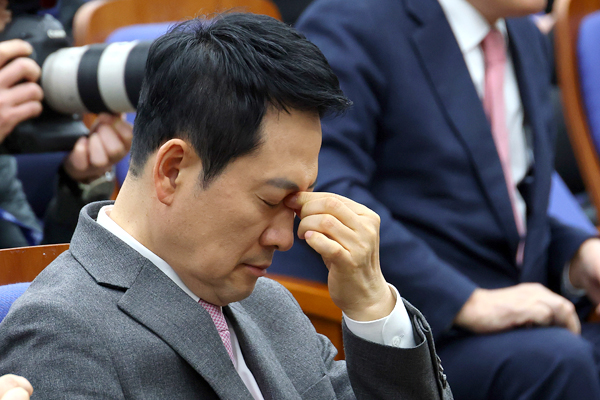
Media criticism of the People Power Party’s falling approval ratings has been relentless. The party also received coverage over the expulsion of Kim Kwan-young, governor of North Jeolla Province (Jeonbuk), prosecutor Park Sang-yong’s refusal to take the witness oath at a parliamentary probe, and the Korea–France summit. Below is a roundup of editorials from major newspapers on April 4.
People Power support collapse draws harsh words even from conservative outlets
A Korea Gallup poll put the People Power Party’s support at a record low of 18%, with backing in Seoul falling to 13%. That prompted even conservative outlets to deliver sharp criticism of party leaders.
The Chosun Ilbo, in “People Power’s Seoul support at 13% — now they can’t even recruit candidates,” reported, “The party is finding it difficult to recruit candidates in the Seoul metropolitan area. The Seoul party chair said, ‘Candidates hesitate to run because they fear they won’t even recover campaign costs.’ Under current law, campaigns receive full reimbursement only if they secure at least 15% of the vote, and potential candidates worry they won’t meet that threshold.” The paper noted that while the party has weathered hard times before, it has never faced a situation in Seoul where campaign-cost reimbursement was a central concern. It criticized the party for failing to offer a sincere apology or reflection after the martial-law and impeachment episodes and for filling key posts with loyalists of the “Yoon again” faction.
The Dong-A Ilbo, in “People Power trails the ruling party by 30 percentage points… Are they just going to sit and wither?”, faulted the party’s senior ranks. “No one in the People Power leadership has taken responsibility. The party counts 34 veteran lawmakers with three or more terms who could steady the party. Yet none have expressed urgent concern or publicly urged changes to Jang Dong-hyeok’s leadership,” the paper wrote, condemning senior members for their lack of accountability.
Recalling 2004, the Dong-A noted that when the Grand National Party faced an existential crisis over the cash-for-votes scandal, it set up a tent office in Yeouido and 28 senior lawmakers pledged not to run in the next election. The paper argued that today’s leadership refuses to break ties with unconstitutional martial-law elements, appears influenced by a few extreme far-right YouTubers, and that senior lawmakers seem to watch as if it were someone else’s problem.
The Korea Gallup party-support survey, conducted March 31–April 2 with 1,001 voters aged 18 and over nationwide (sampling error ±3.1 percentage points at the 95% confidence level; mobile-phone virtual-number interviews), found People Power support at 18%. For further details, consult the National Election Survey Deliberation Commission website.
Progressive outlets urge People Power to join constitutional amendment effort
After six parties, excluding the People Power Party, jointly submitted a constitutional amendment, progressive media strongly urged the party to cooperate.
The Hankyoreh, in “A constitutional amendment to strengthen martial-law controls has been proposed; the People Power Party should cooperate,” wrote, “It’s hard to accept the People Power Party’s lone dismissal of the amendment as a ‘local-election stunt.’ The proposal contains measures the party has previously supported, and the party has issued official apologies regarding the Dec. 3 martial-law episode. If those apologies and reflections were sincere rather than performative, there is no reason to oppose the amendment.” The paper warned that if opposition stemmed from a belief that higher turnout on the amendment would benefit the ruling party in local elections, then subordinating an urgent national issue to narrow electoral calculation would be a petty and destructive choice.
The Kyunghyang Shinmun, in “One year after Yoon Suk Yeol’s removal — institutional reform should be sealed by holding the constitutional vote alongside local elections,” argued that the so-called “Revolution of Light” should culminate in constitutional change that institutionalizes safeguards against insurrection. It called the party’s stance self-contradictory and said joining the amendment process would offer a symbolic opportunity to demonstrate a commitment to break with pro-insurrection forces. If the party truly does not want to remain aligned with those elements, there is no practical reason to reject the amendment.
Parliamentary probe into prosecution’s investigation — how did the media assess it?
When Prosecutor Park Sang-yong refused the witness oath and left the parliamentary probe, the inquiry made little progress in clarifying allegations surrounding the Ssangbangwool North Korea remittance case. The Hankyoreh and the Hankook Ilbo covered the same events but placed criticism on different targets.
The Hankyoreh, in “‘He calls the allegation patchwork’ — yet refused the parliamentary oath: strong criticism of Prosecutor Park Sang-yong,” sharply criticized Park. “After allegations surfaced that former Gyeonggi Vice Governor Lee Hwa-young tried to induce testimony, Park repeatedly appeared on broadcasts and YouTube to vigorously deny the claims. He accused the Democratic Party of stitching together parts of recordings to distort the facts. If that’s true, he could have testified at the parliamentary probe to set the record straight; it’s hard to understand why he refused the oath,” the paper wrote, asking whether his refusal reflected concern about penalties for perjury before the National Assembly.
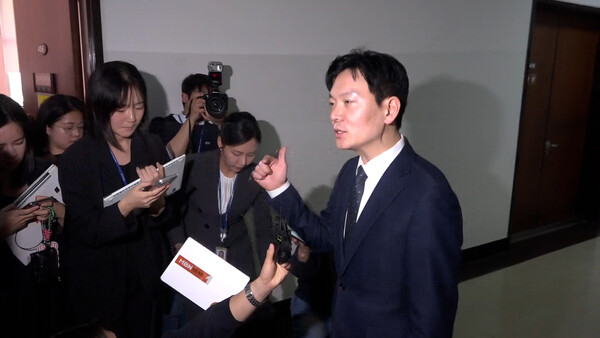
The Hankook Ilbo, in “Parliamentary probe into ‘fabricated indictments’ raises doubts about the will to find the truth,” criticized both the ruling Democratic Party and Park. “Although Park appeared in person at the National Assembly, the ruling party did not release the full recordings and failed to resolve allegations that prosecutors attempted to induce testimony,” it argued. “If there is evidence that could reveal the truth or that would warrant reconsidering charges against President Lee, the ruling party should disclose it—common sense demands it.” The paper said the public witnessed only a wasteful back-and-forth and questioned the probe’s effectiveness.
Other issues that drew media attention
The Dong-A Ilbo, in “Trump: ‘Turn Iran into the Stone Age’… Does this foreshadow chaos after a self-declared end to hostilities?”, noted that former President Trump avoided committing to ground troop deployments and signaled he would not prolong the conflict. Still, the paper argued, his speech echoed long-standing justifications for war and assertions of unilateral victory, reading like a preview of a potential Trump-style, self-declared end to hostilities.
The Kukmin Ilbo, in “Meaningful Korea–France cooperation on the Strait of Hormuz,” praised the summit between President Lee Jae-myung and French President Emmanuel Macron. “President Donald Trump has dismissed calls to block the Strait of Hormuz, saying that countries that take the oil should protect it themselves. But instability in Hormuz threatens global energy security, and when the parties to a conflict shirk responsibility, allies bear the greatest cost. The two leaders’ cooperation to secure the strait was therefore both inevitable and timely,” the paper concluded.
The Chosun Ilbo, in “No ambulance ping-pong in Honam for a month — expand the program,” highlighted a pilot program for tailored emergency transport in Gwangju and North and South Jeolla provinces. “Instead of EMTs phoning around until an ER accepts a patient, ER physicians now coordinate first via real-time chat; if needed, a regional control center intervenes. The system also ensures that, once immediate treatment is complete, patients are transferred to higher-level hospitals that can provide more advanced care, with 119 (emergency services) handing patients off to the final treating hospital,” the paper wrote, crediting modest institutional changes and proactive medical staff for the results.
MediaToday brings you the “AI News Briefing.” Knowledge-content startup Underscore used generative AI to compare major domestic news articles by issue and then reorganize them. This article underwent review and editing by the MediaToday newsroom and received support from the Korea Press Foundation. (Editor’s note)









Most Commented