
Translation result.
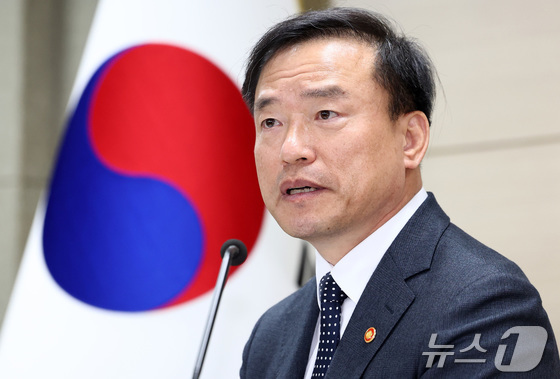
With key issues at the Broadcasting, Media and Communications Committee stalled by delays in appointing members, Kim Jong-cheol marked his 100th day in office and urged a swift formation of the full committee.
He said he regretted the delay and expects it will take more time before the committee reaches full strength. He identified administrative work to enable committee activity as the top priority once the panel returns to normal.
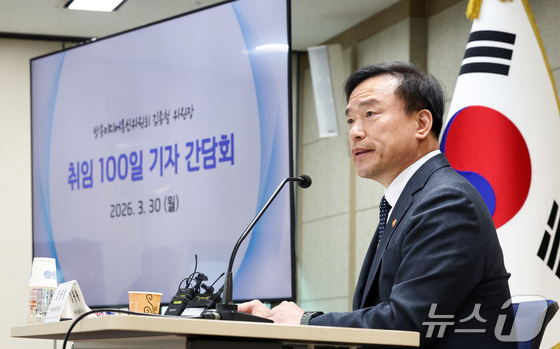
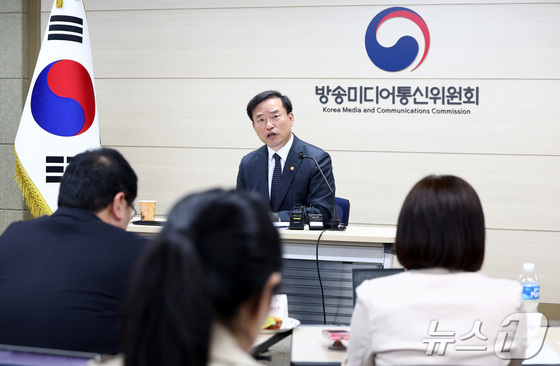
The Broadcasting, Media and Communications Committee held a 100-day briefing for Chairman Kim Jong-cheol on the 30th in the main auditorium of the Gwacheon government complex in Gyeonggi Province.
Kim opened the briefing by expressing frustration over the stalled appointments and vowed to move quickly on policy as soon as the committee is restored to full function.
He said the committee is unlikely to be at full strength until the National Assembly completes its nomination process. He expressed hope that the parliamentary nominations would be finalized soon, saying he hoped the nominees currently under vetting would be confirmed within the week and that he was \”praying hard\” for that outcome.
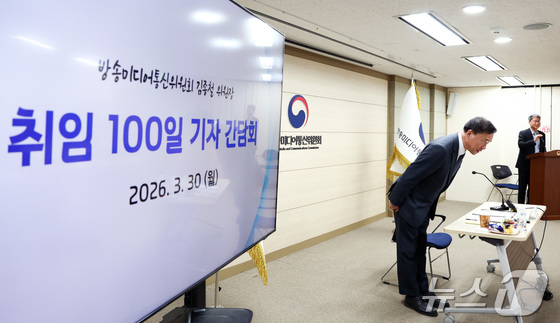
He said the most urgent task after normalization is to establish the legal framework that will allow the stalled committee to operate effectively.
Kim explained that the No. 1 item should be an urgent, uncontestable matter. Establishing the legal basis for the committee’s activities is the top priority, so issues related to committee operations should be addressed first.
The committee outlined its policy direction around three keywords: order (establishing a fair order), trust (restoring media credibility), and leap (advancing into the AI era). It also proposed supporting the creation of the Korea Broadcasting, Media and Communications Promotion Agency and establishing a transparency center.
Kim said the role of the state is to guarantee freedom while forming a fair order. He pledged to provide support commensurate with broadcasters’ public responsibilities so a healthy broadcasting ecosystem can be sustained, and said that, as the government’s media ministry, he will take the lead on a cross-cutting \”media sovereignty AX\” strategy across policy, administration and industry.
No immediate breakthrough on universal viewing rights — I will see this through
On the high-profile issue of guaranteeing universal viewing rights ahead of the World Cup, he said negotiations have not proceeded smoothly but pledged that the committee will continue to mediate and keep discussions alive.
Before the briefing, Kim convened a meeting in Seoul with executives from JTBC, KBS, MBC and SBS to mediate broadcast-rights talks. The negotiations ultimately collapsed.
He said, \”We don’t have immediate results to show, but I believe we’ve laid the groundwork. Guaranteeing universal viewing rights is a public responsibility that should not be left solely to the market. The chances are slim, but we will not give up hope.\”
He added that, although there was no visible gain today, the parties established a foundation for long-term talks — including exploring joint broadcast rights through 2032 — and that shifting the debate from short-term bargaining to a future-oriented cooperative framework is significant even amid pessimism.
Monitoring proposed bans on youth social media closely — but regulation alone won’t suffice
On the growing global debate over restricting youth access to social media, his stance appears to have evolved since his confirmation hearings.
Kim said he had told the confirmation panel he would consider banning youth access to social media. At the briefing, he said he prefers not to rely on blanket bans and will pair regulatory measures with efforts to normalize the broader media environment.
\”Protecting young people is a core duty of media policy,\” he said. \”Legislative moves to regulate youth use of social media are happening worldwide, and we are watching closely, aware this is not someone else’s problem. But after listening to young people, we recognized social media’s positive aspects, and we learned the hard truth that regulation alone cannot solve the problem.\”
He noted that past policies, such as the shutdown law, showed regulation cannot lead technological development. He said he still supports rational countermeasures but favors a differentiated approach: efforts to normalize the overall media environment and capacity-building education should proceed in tandem.













Most Commented