
2026 Policy Shift: How South Korea’s New Approach to North Korea Aims for Peaceful Coexistence
Daniel Kim Views
Translation result.
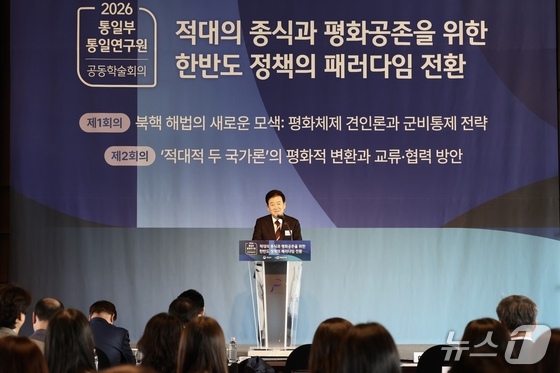
Unification Minister Jeong Dong-yeong on the 25th again referred to North Korea by its official name, the Democratic People’s Republic of Korea, and said South Korea must redesign its peninsula policy to place peaceful coexistence—not reunification—at its center.
Jeong made the remarks at a joint academic conference hosted by the Unification Ministry and the Korea Institute for National Unification at The Plaza Hotel in Jung-gu, Seoul. The conference was titled \”A Paradigm Shift in Peninsula Policy to End Hostility and Achieve Peaceful Coexistence.\”
Earlier this year, at the Unification Ministry’s New Year ceremony in January, Jeong was the first senior domestic official to address North Korea by its official state name, a move widely read as signaling respect for the North’s political system.
Jeong also referenced comments last month by Kim Jong Un general secretary of the Workers’ Party of Korea, who at the party’s 9th congress dismissed the current South Korean government’s North policy as a \”charade\” and a \”botched work.\” Jeong responded that Seoul’s policy of peaceful coexistence will not waver. He said the government will demonstrate consistently that its approach is not the clumsy charade or botched work denounced by the North.
\”At this moment, both the South and the North, both the Republic of Korea and the Democratic People’s Republic of Korea, need responsible decisions oriented toward the future rather than the past,\” Jeong said. Whether in inter-Korean relations, Korea–Joseon relations, or Han–Jo relations, he added, Seoul hopes the two sides will generate shared benefits and advance national development through new frameworks of cooperation.
Observers interpret Jeong’s invocation of \”Han–Jo relations\” as reflecting Pyongyang’s practice, since its declaration of a hostile two-state theory, of referring to the two sides as \”Jo-Han\” (Joseon and Korea).
Jeong argued that the entire international context surrounding the peninsula is changing. \”When structure changes, order must change as well,\” he said, calling for a new paradigm that converts the structural shift embodied by the North’s hostile two-state thesis into an opportunity.
\”Frankly, until now we tended to prioritize rhetoric and principles aimed at changing the other side rather than respecting it,\” he said. \”Peace has often been treated merely as a means to achieve reunification. Those old assumptions and our one-sided, self-centered thinking are no longer adequate. Peace should not be a means to an end; peaceful coexistence must be the end itself.\”
Jeong said it is time to place peaceful coexistence, rather than reunification as an ultimate objective, at the center of policy and to redesign peninsula strategy accordingly. He emphasized this is not a renunciation of reunification but an effort to institutionalize peace. Jeong said that when talks with relevant parties begin on a basic South–North accord and the establishment of a peninsula peace regime, the long-standing peninsula impasse could finally find a way out.
Given that North Korea now defines South Korea as hostile, rejects the concepts of reunification and shared nationality, and refuses dialogue with Seoul, Jeong’s remarks signal that Seoul intends to prioritize reducing mutual hostility over immediate pursuit of reunification.
He also urged Pyongyang to change its stance. Pointing to recent meetings between President Trump and Prime Minister Kim Min-seok, Jeong said those talks reaffirmed President Trump’s strong interest and commitment to U.S.–North Korea dialogue. \”Our government hopes to serve as a pacemaker and, as a party to the peninsula issue, to help open the curtain on ending U.S.–North Korean hostility,\” he said, adding that Seoul hopes the North will not miss this opportunity.
Experts urge mutual recognition of sovereignty between the two Koreas
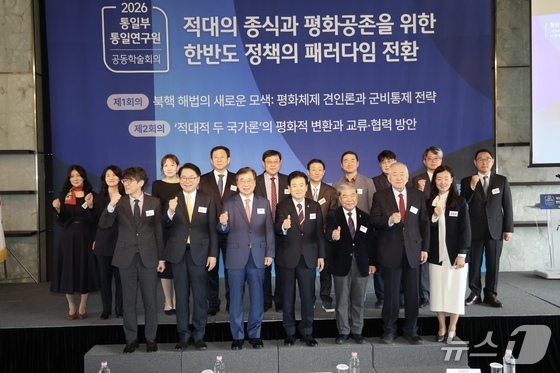
At the conference, experts debated Seoul’s new approach to Pyongyang’s hostile two-state proposition.
Ku Gap-woo, a professor at the University of North Korean Studies, argued that Jeong’s idea of a de facto peaceful two-state arrangement amounts to a passive response. Ku said Seoul’s continued use of the term \”Bukhan\” (North Korea) instead of \”Joseon\” shows a reluctance to extend the core recognition of the North as a sovereign state. He recommended adopting a cognitive recognition that refers to the North as Joseon.
Ku added that mutual recognition of two sovereign states with different ideologies and systems would require constitutional revisions to Articles 3 and 4—changes analogous to past legal reforms such as those involving the National Security Act or Ireland’s constitutional amendments.
Choi Eun-ju, a research fellow at the Sejong Institute, said Seoul should reassess its approach to inter-Korean exchanges in light of shifts in Pyongyang’s policy toward the South. The conventional linear model—expand exchanges → build trust → establish peace → create a foundation for reunification—no longer guarantees results, she argued.
Choi warned that the North may perceive inter-Korean engagement as a threat to its regime or a factor that undermines internal control. At this stage, she recommended that Seoul focus less on restoring bilateral cooperation and more on increasing the North’s participation in multilateral initiatives—working with China, Southeast Asian, and Central Asian partners on health, disease control, environment, and transportation—to encourage Pyongyang’s engagement in broader cooperation.










Most Commented