
Middle Crime Investigation Agency vs. Prosecution: What You Need to Know About the Upcoming Legislation
Daniel Kim Views
March 20: Ruling bloc advances bill to plenary
Lee: Corruption Investigation Office would monopolize investigation and prosecution…
Claims that only the prosecution will be stripped of power are ‘self‑contradictory’
Vote on Major Crimes Investigation Office bill expected the afternoon of the 21st
The ruling and its allied parties advanced the Major Crimes Investigation Office (MCIO) bill to the National Assembly plenary session. The opposition People Power Party warned that placing the MCIO under the Ministry of the Interior and Safety, as with the police, could concentrate investigative power excessively and launched a filibuster to block the bill.
On March 20, the National Assembly convened in plenary and put the Act on the Organization and Operation of the Major Crimes Investigation Office on the agenda.
Under the bill, the MCIO would be established as an agency under the Minister of the Interior and Safety. Its primary investigative targets would be six categories of offenses: corruption, economic crimes, defense-industry offenses, narcotics, insurrection and foreign-exchange crimes, and cybercrime.
The MCIO’s remit would also include crimes such as perverting the course of justice and offenses committed by staff of the prosecution service, the police, the Corruption Investigation Office for High-ranking Officials (CIO), and court officials while in office. Any offenses that separate statutes specify should be referred to or investigated by the MCIO or its chief would also fall within its jurisdiction.
MCIO investigators would be appointed as designated public officials in a single rank system from grade 1 to 9. While open recruitment is the default, the bill allows for experienced hires for candidates with relevant academic credentials, professional experience, technical skills, or research achievements.
A clause in the government’s original draft that would have required the MCIO to notify the prosecution service when it opened an investigation was deleted during discussions among the party, government and Blue House.
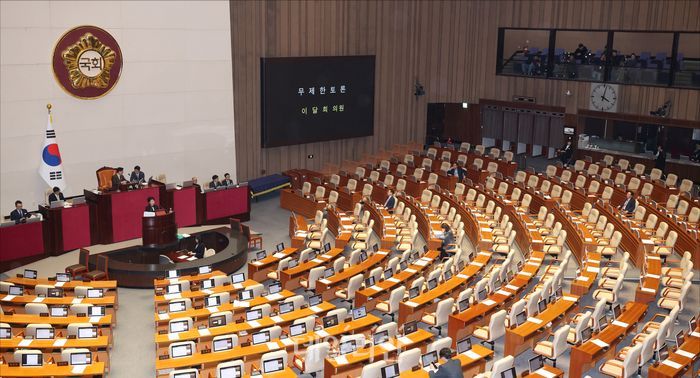
Still, the People Power Party pressed concerns about the Interior Ministry’s expanding authority and urged the president to exercise the veto (request reconsideration).
In a statement, chief spokesperson Park Seong-hoon warned, \”If the minister of the Interior, who supervises the police, also controls the MCIO, it would create a system in which the president could steer investigations through that minister. Investigations would start to follow the will of power rather than the law, and the neutrality of investigations would effectively be declared dead.\”
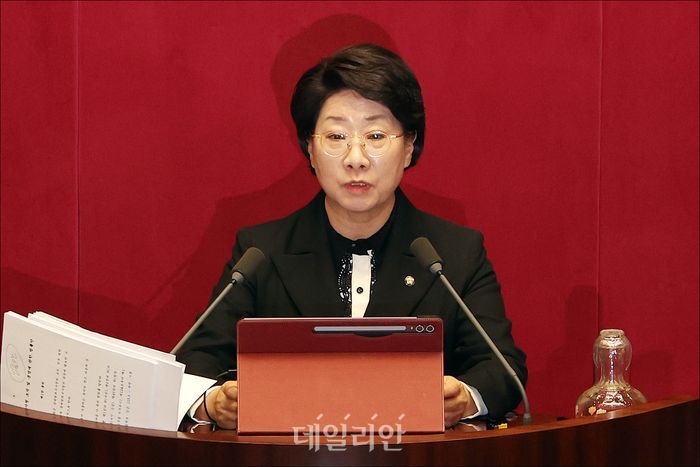
The People Power Party then launched a filibuster to prevent passage of the MCIO bill. The first speaker was Rep. Lee Dal-hee.
Rep. Lee said, \”The state exists to provide a framework of law and justice so ordinary citizens do not suffer injustice. I stand on this podium, driven to the edge, determined to prevent that framework from collapsing.\”
He added, \”I will expose to the public the awful truth hidden beneath the glossy packaging of separating investigation and prosecution in the MCIO bill. If separating investigation and prosecution is such a sacrosanct, absolute principle, why does the CIO hold both investigative and prosecutorial powers?\”
He also criticized the ruling party’s favored special prosecutor mechanism, asking, \”Does the special prosecutor the ruling party wields like a cure‑all also monopolize both investigative and prosecutorial powers? Allowing politically created investigative bodies to hold both investigation and prosecution while stripping only the prosecution of its investigative authority is an obvious self‑contradiction.\”
Meanwhile, the ruling bloc submitted a motion to end the People Power Party’s filibuster. Lawmakers expect the MCIO bill to come to a vote on the afternoon of the 21st.
© Dailian Co. Unauthorized reproduction and redistribution prohibited













Most Commented