
Job Security vs. Flexibility: How President Lee’s Proposal Affects South Korean Workers in 2023
Daniel Kim Views
This discussion emerged while addressing the employment situation of foreign workers in the shipbuilding sector. The President acknowledged the complex dynamics: companies increasing subcontracting and hiring foreign workers to weather economic downturns, and workers fearing job loss without guarantees of return or immediate livelihood alternatives. He urged all parties to find solutions to break this cycle.
It’s worth noting that the Blue House recently established a Cross-Ministerial Labor Structure Reform Task Force. This group, comprising representatives from various ministries and the Blue House, is exploring reforms such as easing the two-year limit on fixed-term contracts, providing severance pay for short-term employees, extending labor standards to smaller businesses, and legislating equal pay for equal work.
“Clinging to job preservation actually leads to job losses. The real issue is creating a safety net alongside employment flexibility,” the President remarked.
President Lee stressed that economic growth and reducing inequality must go hand in hand. Using the shipbuilding industry as an example, he warned against replacing domestic jobs with minimum-wage foreign labor, stating it would harm local economies. “We cannot allow a situation where economic gains are monopolized by a few while the majority struggle,” he asserted.
“While we’re not advocating socialism, we must ensure fair opportunities within reasonable bounds,” Lee continued. “When businesses and industries thrive, all workers – including those in small and medium-sized enterprises – should benefit. This creates a vibrant economic ecosystem.”
The President acknowledged that improving overall job quality requires addressing employment flexibility. He pointed out the paradox that efforts to protect jobs often result in job losses.
Given the shipbuilding industry’s boom-bust cycles, companies increasingly rely on non-regular workers and outsourcing. Lee suggested that even modest increases in employment flexibility could improve the job market.
He called on businesses to play a more significant role in bolstering social safety nets.
“For workers in permanent positions, job loss feels catastrophic,” Lee explained. “The weak social safety net, limited re-employment prospects, and the vast gap between regular and non-regular workers leave them feeling precarious. That’s why they desperately cling to their jobs.”
“The core issue is the safety net,” he continued. “That’s why I believe non-regular workers should be compensated more than regular employees, as seen in other countries. To give workers confidence in the face of potential job loss, we need robust safety nets. This requires funding, which companies must contribute to.”
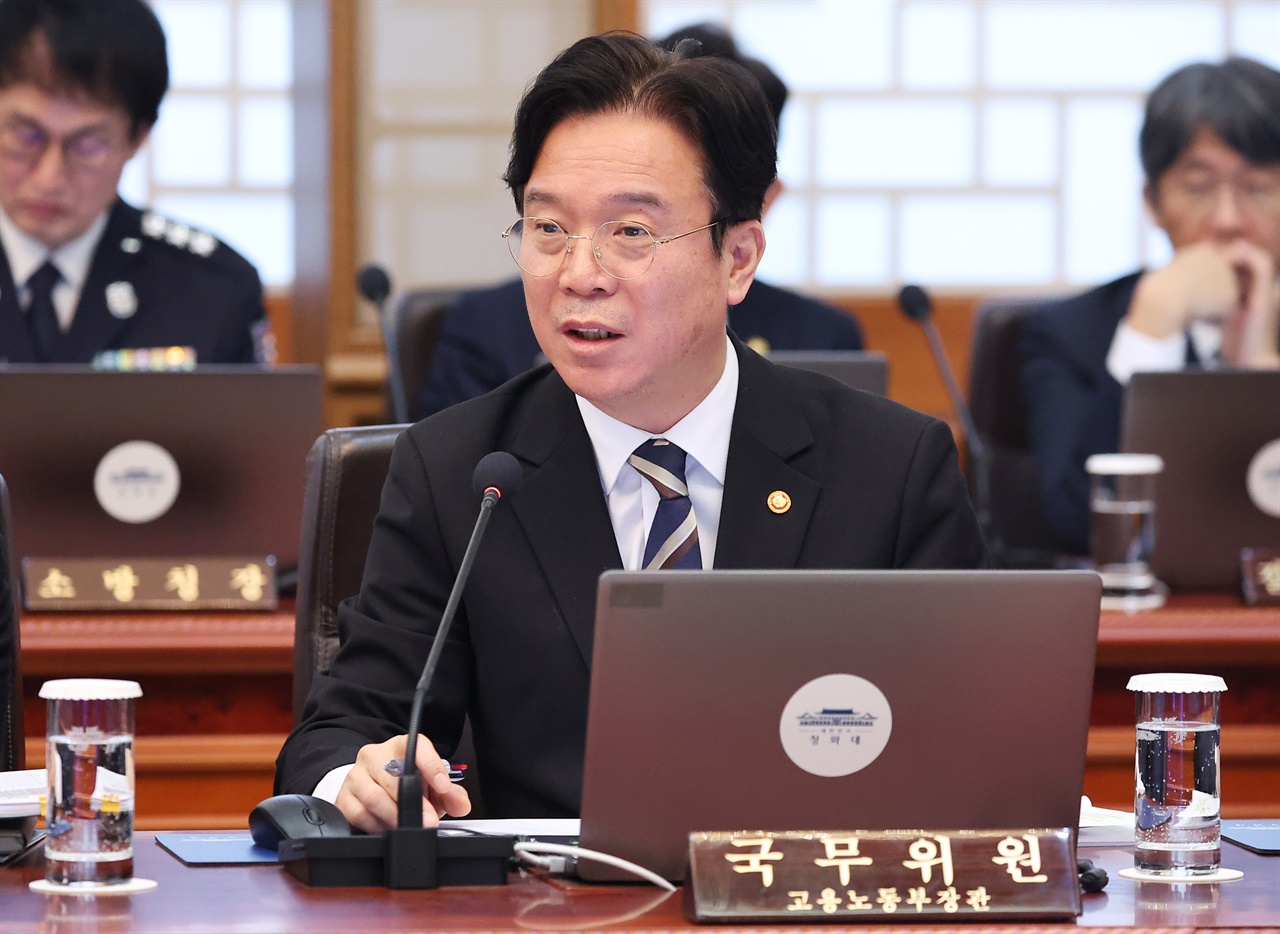
“We must reach a compromise through constructive dialogue,” the President urged.
Lee emphasized that rebuilding trust between labor and management is essential for progress. He noted that the current lack of trust impedes effective dialogue.
“We need a broader perspective,” he stated. “Workers should show flexibility in employment, while companies that benefit from increased efficiency should share the gains. This requires compromise through social dialogue, but the lack of mutual trust is a significant obstacle. We must eventually overcome this.” He urged the Ministers of Labor and Industry to initiate discussions.
When the Minister of SMEs and Startups suggested including small businesses in the dialogue, Lee agreed, noting the influence of union structures. He advocated for industry-wide unions and broader wage negotiations to normalize labor relations.
Responding to the Labor Minister’s commitment to rebuilding trust, Lee remarked, “Our society’s development depends on our democratic capacity. This underscores the importance of internal discussions across ministries and dialogue through the Economic and Social Labor Commission.”













Most Commented