
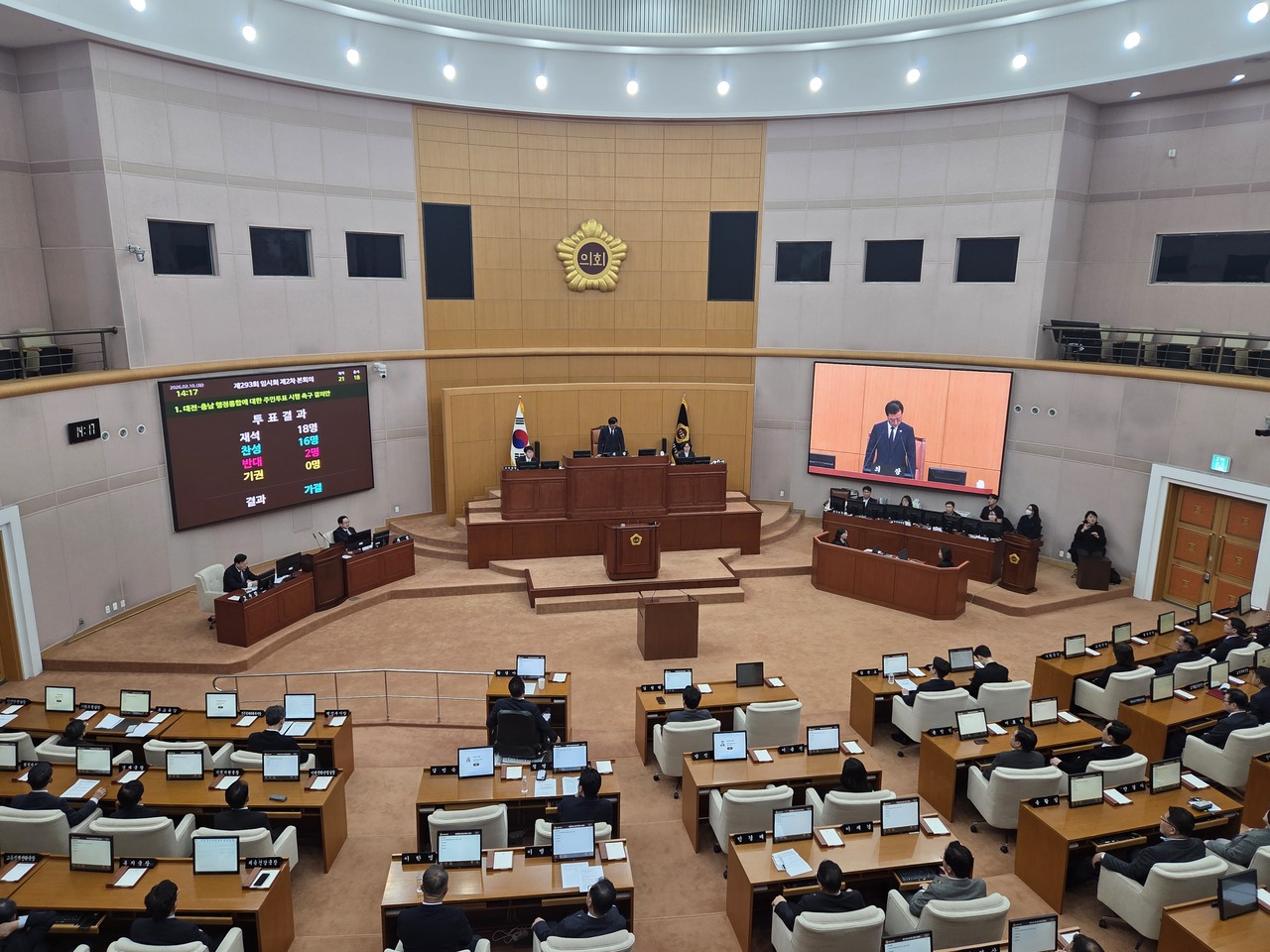
The Daejeon City Council has officially approved a resolution calling for a public referendum on the Daejeon-Chungnam administrative merger.
While this move formalizes the council’s intent to seek citizen input on the final decision regarding integration, it’s unclear whether an actual referendum will materialize. Given the tight timeline for subsequent legal procedures, some analysts doubt the feasibility of implementing such a vote.
During the session, the council passed the referendum resolution, proposed by Kim Jin-oh of the conservative People Power Party, with 16 votes in favor and 2 against out of 18 members present. This outcome reflects the majority’s view that the legitimacy of the integration process should be validated through public consultation.
The critical question now is whether the referendum will actually occur. While the resolution expresses the council’s stance, holding a public vote requires navigating several legal steps. Any delays in this process—from issuing demands and announcements to coordinating with relevant agencies and setting a voting date—could derail the entire timeline.
Legal interpretation remains a variable. There’s ongoing debate about whether administrative integration qualifies as a subject for a public referendum, given that it straddles the line between national and local affairs.
Experts suggest that political and policy considerations outweigh legal arguments in this case. The federal government’s stance will ultimately determine whether a referendum is held. Given the current push by the administration and ruling party to expedite the integration process, it seems unlikely that this demand for a public vote will be accepted. The prevailing attitude in Congress and the administration favors a “integrate first, adjust later” approach, making it difficult for the referendum initiative to gain traction.
Professor Choi Ho-taek from Paichai University’s Department of Public Administration commented, “The Interior Minister will likely have the final say on whether to allow a referendum. If the current administration is committed to actualizing the principle of popular sovereignty, they might consider it. However, if administrative efficiency takes precedence, approving a referendum could be challenging.”
Meanwhile, tensions flared as both parties held competing press conferences just before the resolution was processed.
Democratic Party members Kim Min-sook and Bang Jin-young criticized their conservative counterparts, stating, “It’s hypocritical for those who initially backed the integration to now demand a public vote. The city council is contradicting its own decision.”
The People Power Party, on the other hand, emphasized the shortcomings in the financial planning and procedural legitimacy of the current integration proposal.
Conservative leaders, including Lee Eun-kwon and Kang Seung-kyu, publicly rebuked the Democratic Party, noting, “Even Shin Jeong-hoon, the Democratic chair of the National Assembly’s Administrative Safety Committee, has criticized the lack of effort from the federal government in decentralization and meeting public expectations. We cannot endorse a superficial integration law.” They argued, “Forcing integration without public consent isn’t reform—it’s imposition. And rushing without legitimacy isn’t integration—it’s recklessness.”












Most Commented