
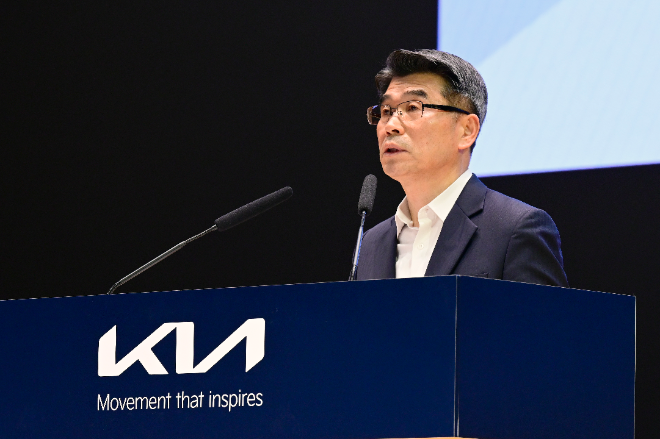
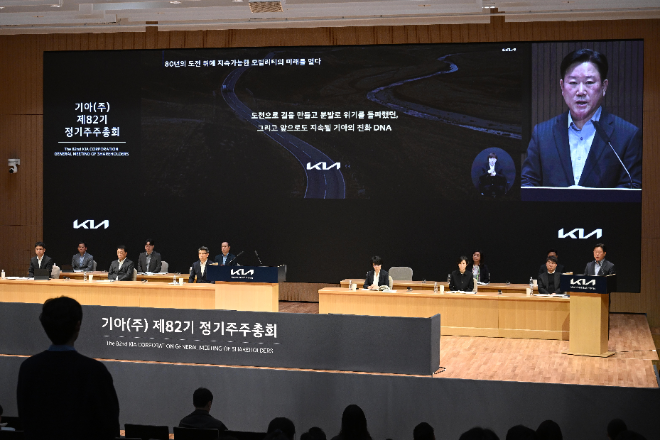
Kia President Song Ho-sung presents the company’s business vision at the regular shareholders’ meeting on the 20th. / Photo=Kia
Kia CEO Song Ho-sung: “13 EVs by 2030, strengthen intelligent leadership”
Enlarge image
[Korea Financial News Reporter Kim Jae-hoon] Song Ho-sungClose
Song Ho-sungView all articles Kia’s CEO said the company will accelerate its push for market leadership through an EV mass-market strategy while strengthening future leadership in PBVs (purpose-built vehicles) and intelligent mobility solutions.
On the 20th, Kia held its 82nd annual shareholders’ meeting at its headquarters in Seocho-gu, Seoul, where it laid out its future business vision.
Song said, “Despite domestic and international uncertainties, Kia responded to rising global demand for eco-friendly vehicles—driven by strength in the U.S. market and EV-led demand in Europe—and achieved record sales and more than 100 trillion KRW (approximately 75 billion USD) in revenue for two consecutive years.” He added, “We will strengthen our core competitiveness by expanding our product portfolio through enhanced product offerings, strengthened EV leadership and the launch of mass-market EVs.”
Song outlined core strategies that include “EV mass-market adoption,” “strengthening PBV momentum,” and “evolving into intelligent mobility solutions.”
First, Kia plans to launch 13 new EV models by 2030. The company says a broader lineup and improved product appeal will enhance the customer experience and help close the EV adoption chasm.
Song said, “We will strengthen EV competitiveness by improving product appeal and offering an EV lineup that meets diverse customer needs. From product innovation to supply-chain reinforcement, Kia will lead EV mass-market adoption with a comprehensive EV strategy.”
To support that plan, Kia will expand infrastructure such as ultra-fast charging stations and diversify production locations to match market characteristics in the U.S., Europe and other regions, optimizing the EV supply chain.
Kia will use PBVs to reflect varied customer needs more effectively and enhance convenience, while integrating robotics and AI to deliver people-centered value. The company envisions PBVs as a customizable platform that configures space and software for passenger, logistics, retail and leisure uses.
Song said, “After launching the first PBV model PV5 last year, we plan to expand the lineup with PV7 in 2027 and PV9 in 2029. To that end, Kia has completed the Hwaseong EVO Plant East to produce PV5, and plans to complete EVO Plant West in 2027 to make PV7.”
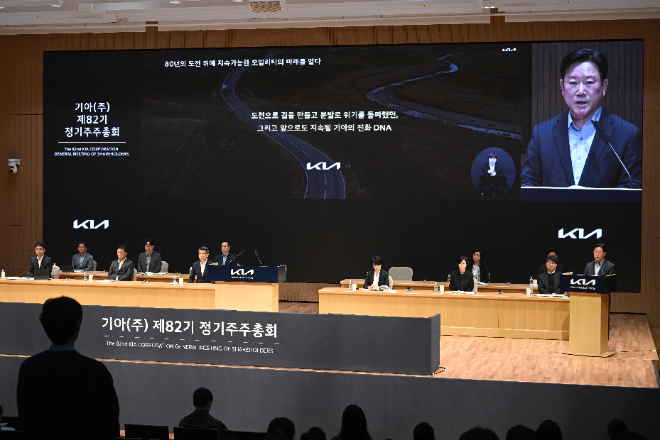
Kia regular shareholders’ meeting. / Photo=Kia
Kia CEO Song Ho-sung: “13 EVs by 2030, strengthen intelligent leadership”
Enlarge image
He emphasized, “Through a PBV conversion center, we will collaborate with partners to create specialized conversion models—open-bed, box trucks and camping vehicles—and build a PBV ecosystem that strengthens industry competitiveness and supports shared growth.”
Finally, to evolve intelligent mobility solutions, Kia will make digitalizing the customer experience its top product strategy priority and execute a roadmap to shift toward software-centric vehicles.
Song said, “Kia plans to introduce a next-generation software-defined vehicle (SDV) by 2027 that integrates hardware and software by combining AI-based UX and connectivity, and to apply it to mass-production models thereafter. For SDV’s core function—autonomous driving—we are progressively building core capabilities through partnerships with Motional and 42dot to internalize the technology.”
He added, “We will leverage Hyundai Motor Group’s industry-leading physical AI technology to assist with tasks that are difficult or dangerous for humans across manufacturing, sales and logistics. We also plan to expand broad partnerships with global AI leaders to lead the growth of a human-centered physical AI ecosystem.”
Song said, “As the global auto industry undergoes a structural shift, Kia will treat this as an opportunity to redefine its business model and corporate value and to lead the paradigm change in future mobility. Kia will continue to prioritize customer-focused innovation, profitability-driven growth, responsible management and trust with shareholders as our core values, and we will keep meeting shareholders’ expectations.”
Kim Jae-hoon, Korea Financial News rlqm93@fntimes.com











Most Commented