
North Korea said it successfully test-fired a short-range, ground-to-ground ballistic missile fitted with a cluster warhead.
On the 20th, the Korean Central News Agency reported that the Missile General Bureau conducted a test launch on the 19th to evaluate the warhead of the upgraded Hwasongpo-11Ra tactical ballistic missile.
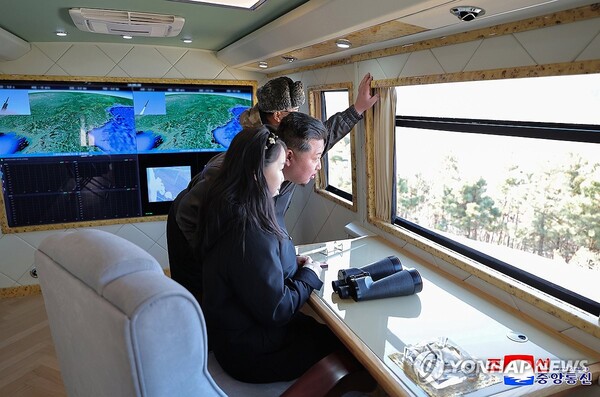
Kim Jong Un observed the test in person, accompanied by his daughter, Ju-ae.
KCNA said the test was intended to verify the characteristics and destructive power of dispersion (cluster) warheads and a fragmentation-mine warhead for use on tactical ballistic missiles.
The Hwasongpo-11 refers to the KN-23, North Korea’s take on the Russian Iskander. The missile fired in this test appears to have been armed with both a cluster (dispersion) warhead and a fragmentation-mine warhead; both are designed to maximize lethality by dispersing submunitions or metal fragments.
Earlier, between the 6th and the 8th, North Korea conducted a dispersion-warhead test of the Hwasongpo-11Ga variant. KCNA said five tactical ballistic missiles fired at a target area centered on an island line 136㎞ (about 84.5 miles) away struck 12.5–13㏊ (about 30.9–32.1 acres) with very high density.
Kim said that with the development and introduction of dispersion warheads for different roles, the military can meet operational needs more fully and efficiently. He added that increasing high-density suppression strike capability against specific target areas, alongside high-precision strike capability, holds great significance for military operations.
He also said the techniques and records obtained and renewed during the test clearly demonstrate that organizing a specialized missile-warhead research group and devoting five years to the effort were not in vain.
KCNA reported that Kim expressed great satisfaction with the results.












Most Commented